A New Diagnosis in the Diagnostic and Statistical Manual of Mental
... health professionals in the United States. This manual lists mental diseases, conditions and disorders and also lists the criteria established by the APA to diagnose them. For a particular mental disorder to be diagnosed in an individual, the individual must exhibit the symptoms listed in the criter ...
... health professionals in the United States. This manual lists mental diseases, conditions and disorders and also lists the criteria established by the APA to diagnose them. For a particular mental disorder to be diagnosed in an individual, the individual must exhibit the symptoms listed in the criter ...
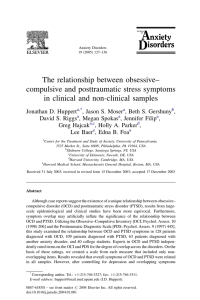
The relationship between obsessive– compulsive and posttraumatic
... empirical data on comorbidity between these two disorders are inconsistent across studies (see Table 1 for a summary) and epidemiological and clinical studies have failed to elucidate the relationship between OCD and PTSD. Most of the existing studies focus solely on the presence or absence of syndr ...
... empirical data on comorbidity between these two disorders are inconsistent across studies (see Table 1 for a summary) and epidemiological and clinical studies have failed to elucidate the relationship between OCD and PTSD. Most of the existing studies focus solely on the presence or absence of syndr ...
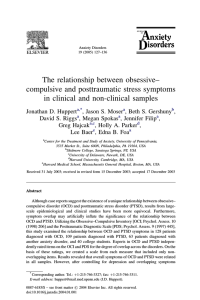
The relationship between obsessive– compulsive and posttraumatic stress symptoms
... empirical data on comorbidity between these two disorders are inconsistent across studies (see Table 1 for a summary) and epidemiological and clinical studies have failed to elucidate the relationship between OCD and PTSD. Most of the existing studies focus solely on the presence or absence of syndr ...
... empirical data on comorbidity between these two disorders are inconsistent across studies (see Table 1 for a summary) and epidemiological and clinical studies have failed to elucidate the relationship between OCD and PTSD. Most of the existing studies focus solely on the presence or absence of syndr ...

File
... The American Psychiatric Association rendered a Diagnostic and Statistical Manual of Mental Disorders (DSM) to describe psychological disorders. The most recent edition, DSM-IV-TR (Text Revision, 2000), describes 400 psychological disorders compared to 60 in the 1950s. ...
... The American Psychiatric Association rendered a Diagnostic and Statistical Manual of Mental Disorders (DSM) to describe psychological disorders. The most recent edition, DSM-IV-TR (Text Revision, 2000), describes 400 psychological disorders compared to 60 in the 1950s. ...

... Obsessive-compulsive disorder (OCD) is characterized by the presence of intrusive unwanted thoughts, images, or impulses (obsessions) along with repetitive behaviors or mental acts (compulsions) designed to reduce the distress caused by the obsessions (American Psychiatric Association [APA], 2013). ...

Somatization Disorder
... to the direct physiological effects of a substance (e.g., drug abuse, medication) or a general medical condition (e.g., temporal lobe epilepsy) The symptoms cause significant distress or impairment in social, occupational, or other important areas of functioning ...
... to the direct physiological effects of a substance (e.g., drug abuse, medication) or a general medical condition (e.g., temporal lobe epilepsy) The symptoms cause significant distress or impairment in social, occupational, or other important areas of functioning ...
CHAPTER 14 Psychological Disorders
... 5. Posttraumatic Stress Disorder (PTSD): anxiety disorder following extraordinary stress (discussed in Chapter 3) ...
... 5. Posttraumatic Stress Disorder (PTSD): anxiety disorder following extraordinary stress (discussed in Chapter 3) ...

Memory
... inflexible and enduring behavior patterns that impair social functioning. They are usually without anxiety, depression, or delusions. ...
... inflexible and enduring behavior patterns that impair social functioning. They are usually without anxiety, depression, or delusions. ...

Ch 17 Mental Disorders
... • A. The most serious mental disturbance that involves loss of contact with reality, thought disorder, hallucinations, and delusions. It effects about 1% of the population. Obvious symptoms are disorganized thoughts garbled speech, as well as hallucinations and delusions. – 1. Probably not a single ...
... • A. The most serious mental disturbance that involves loss of contact with reality, thought disorder, hallucinations, and delusions. It effects about 1% of the population. Obvious symptoms are disorganized thoughts garbled speech, as well as hallucinations and delusions. – 1. Probably not a single ...

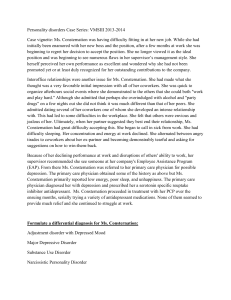
Personality disorders Case Series: VMSIII 2013
... beginning to regret her decision to accept the position. She no longer viewed it as the ideal position and was beginning to see numerous flaws in her supervisor’s management style. She herself perceived her own performance as excellent and wondered why she had not been promoted yet or at least duly ...
... beginning to regret her decision to accept the position. She no longer viewed it as the ideal position and was beginning to see numerous flaws in her supervisor’s management style. She herself perceived her own performance as excellent and wondered why she had not been promoted yet or at least duly ...

Psychological Disorders
... Presence of at least 2 distinct personalities within the same individual Leads to sudden changes in identity and consciousness Each personality has its unique style and may unaware of the existence of the other personalities Often related to severe abuse in early childhood ...
... Presence of at least 2 distinct personalities within the same individual Leads to sudden changes in identity and consciousness Each personality has its unique style and may unaware of the existence of the other personalities Often related to severe abuse in early childhood ...

Psychological Disorders
... relationships, behavior, mood, and self-image. Abrupt and extreme mood changes, stormy interpersonal relationships, an unstable and fluctuating self-image, unpredictable and selfdestructive actions characterize the person with borderline personality disorder. These individuals generally have great d ...
... relationships, behavior, mood, and self-image. Abrupt and extreme mood changes, stormy interpersonal relationships, an unstable and fluctuating self-image, unpredictable and selfdestructive actions characterize the person with borderline personality disorder. These individuals generally have great d ...

Psychological Disorders
... • Compulsion – feeling that you they must repeat certain actions again and again. – Obsession: A young woman is continuously terrified by the thought that cars might careen onto the sidewalk and run her over – Compulsion: She always walks as far from the street pavement as possible and wears red clo ...
... • Compulsion – feeling that you they must repeat certain actions again and again. – Obsession: A young woman is continuously terrified by the thought that cars might careen onto the sidewalk and run her over – Compulsion: She always walks as far from the street pavement as possible and wears red clo ...

Glossary
... A type of dissociative disorder characterized by the coexistence in one person of two or more largely complete, and usually very different, personalities. Also called multiple-personality disorder. ...
... A type of dissociative disorder characterized by the coexistence in one person of two or more largely complete, and usually very different, personalities. Also called multiple-personality disorder. ...
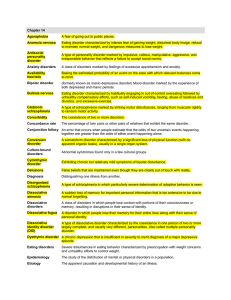
Chapter 14 - Mater Academy Lakes High School
... A type of dissociative disorder characterized by the coexistence in one person of two or more largely complete, and usually very different, personalities. Also called multiple-personality disorder. ...
... A type of dissociative disorder characterized by the coexistence in one person of two or more largely complete, and usually very different, personalities. Also called multiple-personality disorder. ...
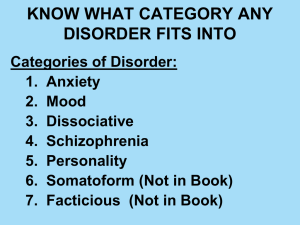
Psychological Disorders are - AKHSewing
... • Operant conditioning is responsible because the patient gets rewarded for his/her complaints (medicine, attention) ...
... • Operant conditioning is responsible because the patient gets rewarded for his/her complaints (medicine, attention) ...

Psychological Disorders
... • Diathesis-stress (integration) – Biological predisposition combined with stressful situation • Systems approach (integration) – Biological, psychological, and social combination (biopsychosocial model) ...
... • Diathesis-stress (integration) – Biological predisposition combined with stressful situation • Systems approach (integration) – Biological, psychological, and social combination (biopsychosocial model) ...
Introduction to Psychological Disorders
... behavior; include the current version of the Diagnostic and Statistical Manual, the MMPI, and projective tests. c. Compare anxiety disorders, mood disorders, personality disorders, and schizophrenia and describe appropriate treatments for these disorders. d. Analyze the challenges associated with la ...
... behavior; include the current version of the Diagnostic and Statistical Manual, the MMPI, and projective tests. c. Compare anxiety disorders, mood disorders, personality disorders, and schizophrenia and describe appropriate treatments for these disorders. d. Analyze the challenges associated with la ...

Anger Management
... People with personality disorders are often impulsive. Watch for suicidal/homicidal ideation. Remember the duty to warn A referral for therapy is needed. Bring client in for emergency assessment if a danger to self or others ...
... People with personality disorders are often impulsive. Watch for suicidal/homicidal ideation. Remember the duty to warn A referral for therapy is needed. Bring client in for emergency assessment if a danger to self or others ...

Memory
... The American Psychiatric Association rendered a Diagnostic and Statistical Manual of Mental Disorders (DSM) to describe psychological disorders. The most recent edition, DSM-IV-TR (Text ...
... The American Psychiatric Association rendered a Diagnostic and Statistical Manual of Mental Disorders (DSM) to describe psychological disorders. The most recent edition, DSM-IV-TR (Text ...
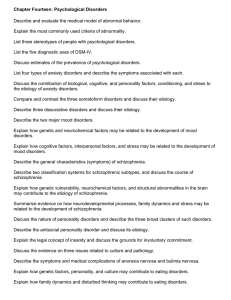
Chapter Fourteen: Psychological Disorders Describe and evaluate
... Describe and evaluate the medical model of abnormal behavior. Explain the most commonly used criteria of abnormality. List three stereotypes of people with psychological disorders. List the five diagnostic axes of DSM-IV. Discuss estimates of the prevalence of psychological disorders. List four type ...
... Describe and evaluate the medical model of abnormal behavior. Explain the most commonly used criteria of abnormality. List three stereotypes of people with psychological disorders. List the five diagnostic axes of DSM-IV. Discuss estimates of the prevalence of psychological disorders. List four type ...

Mental Disorders
... thoughts, feelings, and behaviors of a person, preventing him or her from leading a happy, healthful, and productive life. ...
... thoughts, feelings, and behaviors of a person, preventing him or her from leading a happy, healthful, and productive life. ...

Classification in Psychiatry
... normality: Sex Paraphilia as an example: recurrent, intensely sexually arousing fantasies, sexual urges or sexual behaviors that involve nonhuman objects, the suffering of self or partner, children or non consenting partner. ...
... normality: Sex Paraphilia as an example: recurrent, intensely sexually arousing fantasies, sexual urges or sexual behaviors that involve nonhuman objects, the suffering of self or partner, children or non consenting partner. ...