
Document
... • Explain how the test results change the treatment (if they do at all) • Avoid “well if we don’t find anything then I’ll refer” Barsky 1999 ...
... • Explain how the test results change the treatment (if they do at all) • Avoid “well if we don’t find anything then I’ll refer” Barsky 1999 ...

職場心理衛生
... Onset around late adolescence, early adulthood More women than men High rates of service utilization, poor quality of life ...
... Onset around late adolescence, early adulthood More women than men High rates of service utilization, poor quality of life ...
Dissociative Diso
... People with Hypochondriasis often see many doctors, looking for someone to confirm the illness. ...
... People with Hypochondriasis often see many doctors, looking for someone to confirm the illness. ...
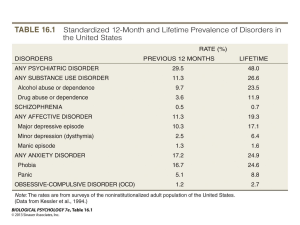
Epidemiology of Anxiety
... Comorbidity between Anxiety and Other Mental Disorders • “Comorbidity among anxiety disorders is quite common, with up to half of the people with a lifetime anxiety disorder in some surveys meeting criteria for two or more such disorders. “ (Kessler 2010) • “Three-quarters (75%) of people with a li ...
... Comorbidity between Anxiety and Other Mental Disorders • “Comorbidity among anxiety disorders is quite common, with up to half of the people with a lifetime anxiety disorder in some surveys meeting criteria for two or more such disorders. “ (Kessler 2010) • “Three-quarters (75%) of people with a li ...

Ch 12
... 45. What is the Freudian linkage to conversion disorder? 46. Why do the authors say conversion disorder was more common a century ago in Europe and the U. S. than it is today? 47. Discuss hypochondriasis. Where do hypochondriacs often end up going for treatment? 48. What is the common denominator fo ...
... 45. What is the Freudian linkage to conversion disorder? 46. Why do the authors say conversion disorder was more common a century ago in Europe and the U. S. than it is today? 47. Discuss hypochondriasis. Where do hypochondriacs often end up going for treatment? 48. What is the common denominator fo ...
DSM-5 - American Psychiatric Association
... mild or early phase and dependence as the more severe manifestation. In practice, the abuse criteria were sometimes quite severe. The revised substance use disorder, a single diagnosis, will better match the symptoms that patients experience. Additionally, the diagnosis of dependence caused much con ...
... mild or early phase and dependence as the more severe manifestation. In practice, the abuse criteria were sometimes quite severe. The revised substance use disorder, a single diagnosis, will better match the symptoms that patients experience. Additionally, the diagnosis of dependence caused much con ...

Somatoform Disorders and Dissociative Disorders
... • A person experiences very specific genuine physical symptoms for which no physiological basis can be found – Anxiety is presumably converted into a physical symptom ...
... • A person experiences very specific genuine physical symptoms for which no physiological basis can be found – Anxiety is presumably converted into a physical symptom ...
Abnormal Psychology
... • Diagnosis can provide etiology (study of causation) clues • Diagnosis provides prognosis (likely outcome) • Diagnosis can give direction for treatment plans Disadvantages of Diagnosis and the DSM-IV ...
... • Diagnosis can provide etiology (study of causation) clues • Diagnosis provides prognosis (likely outcome) • Diagnosis can give direction for treatment plans Disadvantages of Diagnosis and the DSM-IV ...

Introduction to Psychological Disorders, Summary Notes
... Putting a name to a particular set of symptoms and behaviors naturally allows health professionals to treat the condition. However, research has shown that labels affect how we perceive one another and thus how we treat one another. Behaviors that we may observe to be "normal" in an otherwise normal ...
... Putting a name to a particular set of symptoms and behaviors naturally allows health professionals to treat the condition. However, research has shown that labels affect how we perceive one another and thus how we treat one another. Behaviors that we may observe to be "normal" in an otherwise normal ...

Psychosocial Risk Factors Interventions_2010
... externalizing problems, although many display both. ...
... externalizing problems, although many display both. ...
Chapter 14- Psychological disorders
... Dissociative Identity Disorder (DID): the coexistence of more than one personality in an individual Depersonalization: Feelings of unreality concerning the self and environment. Anxiety producing. Many young ...
... Dissociative Identity Disorder (DID): the coexistence of more than one personality in an individual Depersonalization: Feelings of unreality concerning the self and environment. Anxiety producing. Many young ...
“He`s a born worrier” CBT for GAD
... research has shown that 80% of hoarders: 1) Do not meet diagnostic criteria for OCD 2) Do not endorse other clinically significant OCD symptoms (Mataix-Cols, Frost, Pertusa et al, Depress Anxiety,2010) Clinically significant hoarding is prevalent and severe; standardized assessment specifies hoardin ...
... research has shown that 80% of hoarders: 1) Do not meet diagnostic criteria for OCD 2) Do not endorse other clinically significant OCD symptoms (Mataix-Cols, Frost, Pertusa et al, Depress Anxiety,2010) Clinically significant hoarding is prevalent and severe; standardized assessment specifies hoardin ...

DSM-5 ICD-10 Disorder Name Description A
... development, 2. diminished communication skills, and 3. restrictive/repetitive behavior. The disorder is highly variable and is now described in terms of a spectrum rather than a set of discrete categories. For example, Asperger's, once classified separately, is now considered by many experts to be ...
... development, 2. diminished communication skills, and 3. restrictive/repetitive behavior. The disorder is highly variable and is now described in terms of a spectrum rather than a set of discrete categories. For example, Asperger's, once classified separately, is now considered by many experts to be ...

Dr Jim Lucey is a Consultant Psychiatrist and Director of the Anxiety
... hyperventilation. The emotional follow-on from such symptoms might include anxiety, panic and fear. The person might then begin to catastrophise and to have thoughts of impending doom. Their resulting behaviour might include hypervigilance, agitation or excessive safety behaviour. Many individuals w ...
... hyperventilation. The emotional follow-on from such symptoms might include anxiety, panic and fear. The person might then begin to catastrophise and to have thoughts of impending doom. Their resulting behaviour might include hypervigilance, agitation or excessive safety behaviour. Many individuals w ...

Mood Disorders
... into smaller, more achievable ones. Point out facts that contradict or offer alternative explanations for things that children worry about. Encourage children to accept less than perfect performances in school and at home. Teach children to repeat positive, self-encouraging statements to themselves ...
... into smaller, more achievable ones. Point out facts that contradict or offer alternative explanations for things that children worry about. Encourage children to accept less than perfect performances in school and at home. Teach children to repeat positive, self-encouraging statements to themselves ...

Chapter 14: Psychological Disorders
... Define psychopathology and discuss some of the issues related to labeling behavior as “abnormal.” ...
... Define psychopathology and discuss some of the issues related to labeling behavior as “abnormal.” ...
PSY100-disorders11
... possible evaluation by others • individual fears that he/she may do something humiliating or embarrassing. ...
... possible evaluation by others • individual fears that he/she may do something humiliating or embarrassing. ...
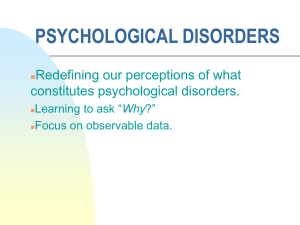
PSYCHOLOGICAL DISORDERS
... guilt, anxiety, or remorse for actions Ongoing disregard for the rights of others ...
... guilt, anxiety, or remorse for actions Ongoing disregard for the rights of others ...
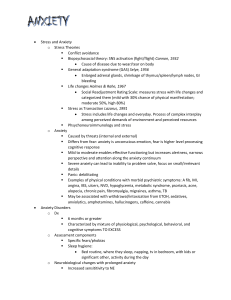
File - Pharmacology (HOME)
... OCD, Hoarding, Tichotillomania o Obsessive Compulsive Disorder (OCD) Recurrent obsessions ( recurrent thoughts/impulses experienced as intrusive) or compulsions (repetitive ritualistic behaviors) that is time consuming or marked distress/significant impairment Person recognize they are irrationa ...
... OCD, Hoarding, Tichotillomania o Obsessive Compulsive Disorder (OCD) Recurrent obsessions ( recurrent thoughts/impulses experienced as intrusive) or compulsions (repetitive ritualistic behaviors) that is time consuming or marked distress/significant impairment Person recognize they are irrationa ...
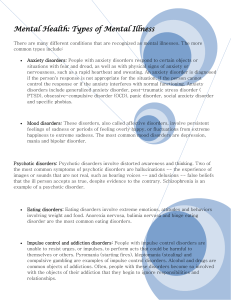
Mental Health: Types of Mental Illness
... Personality disorders: People with personality disorders have extreme and inflexible personality traits that are distressing to the person and/or cause problems in work, school or social relationships. In addition, the person's patterns of thinking and behavior significantly differ from the expectat ...
... Personality disorders: People with personality disorders have extreme and inflexible personality traits that are distressing to the person and/or cause problems in work, school or social relationships. In addition, the person's patterns of thinking and behavior significantly differ from the expectat ...

Chapter 14- Abnormal Behavior
... Dissociative Amnesia: sudden loss of memory for personal information that is not due to normal forgetfulness • Fugue: forming a new identity ...
... Dissociative Amnesia: sudden loss of memory for personal information that is not due to normal forgetfulness • Fugue: forming a new identity ...

Writing 101 assignment 9/19/09 Jason Grossman Anxiety disorders
... among young adults, all phobias and OCD can begin in childhood. Treatment techniques for anxiety disorders vary from patient to patient. The length of treatment and the process to establish a successful treatment plan differs among patients. Patients may respond to treatment after a few months, whil ...
... among young adults, all phobias and OCD can begin in childhood. Treatment techniques for anxiety disorders vary from patient to patient. The length of treatment and the process to establish a successful treatment plan differs among patients. Patients may respond to treatment after a few months, whil ...

Chapter 13 PowerPoint
... •Psychological disorder--a pattern of behavioral and psychological symptoms that causes significant personal distress, impairs the ability to function in one or more important areas of daily life, or both ...
... •Psychological disorder--a pattern of behavioral and psychological symptoms that causes significant personal distress, impairs the ability to function in one or more important areas of daily life, or both ...
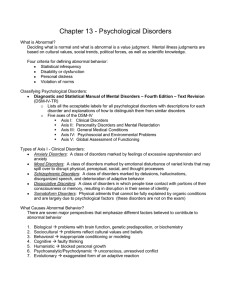
Chapter 13 - Psychological Disorders
... Agoraphobia: Anxiety characterized by marked fear and avoidance of being alone in a place from which escape might be difficult or embarrassing (such as airplanes, tunnels, being in crowds) Social phobia: Fear of, and desire to avoid, situations in which one might be exposed to scrutiny by others ...
... Agoraphobia: Anxiety characterized by marked fear and avoidance of being alone in a place from which escape might be difficult or embarrassing (such as airplanes, tunnels, being in crowds) Social phobia: Fear of, and desire to avoid, situations in which one might be exposed to scrutiny by others ...