
Anxiety, Somatoform, Dissociative Disorders and Stress
... Disorder is a disorder in which one may experience racing pulse or difficulty breathing. Heart rate can accelerate up to 180 beats per minute and can last from a few minutes to an hour. Victims may believe they are going crazy or having a heart attack. –This collection of symptoms is called a ...
... Disorder is a disorder in which one may experience racing pulse or difficulty breathing. Heart rate can accelerate up to 180 beats per minute and can last from a few minutes to an hour. Victims may believe they are going crazy or having a heart attack. –This collection of symptoms is called a ...

File
... recall all details from a person’s past. – Continuous: Unable to recall details from a specific event forward to the present. ...
... recall all details from a person’s past. – Continuous: Unable to recall details from a specific event forward to the present. ...
Anxiety Disorders - Austin Community College
... stumbling while dancing, choking while eating Specific phobia: fear of a specific object or situation; animals, heigth, flying ...
... stumbling while dancing, choking while eating Specific phobia: fear of a specific object or situation; animals, heigth, flying ...
Anxiety Disorders - Austin Community College
... stumbling while dancing, choking while eating Specific phobia: fear of a specific object or situation; animals, heigth, flying ...
... stumbling while dancing, choking while eating Specific phobia: fear of a specific object or situation; animals, heigth, flying ...

An Overview of Somatoform Disorders
... Extended history of physical complaints before age 30 Substantial impairment in social or occupational functioning Concerned over the symptoms themselves, not what they might mean Symptoms become the person’s identity Facts and Statistics Rare condition Onset usually in adolescence M ...
... Extended history of physical complaints before age 30 Substantial impairment in social or occupational functioning Concerned over the symptoms themselves, not what they might mean Symptoms become the person’s identity Facts and Statistics Rare condition Onset usually in adolescence M ...
Personality Disorders
... 2. A lack of a sense of autonomy 3. A view that others are powerful while they are weak ...
... 2. A lack of a sense of autonomy 3. A view that others are powerful while they are weak ...

Psychiatry—Personality Disorders
... 9) Lacks empathy, is unwilling to recognize or identify with the feelings and needs of others 10) Is often envious of others or believes that others are envious of him or her 11) Shows arrogant, haughty behaviors or attitudes 12) Crave excitement to ward off boredom and emptiness Avoidant Personali ...
... 9) Lacks empathy, is unwilling to recognize or identify with the feelings and needs of others 10) Is often envious of others or believes that others are envious of him or her 11) Shows arrogant, haughty behaviors or attitudes 12) Crave excitement to ward off boredom and emptiness Avoidant Personali ...
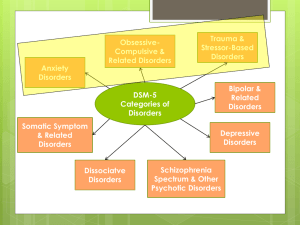


File
... _________ of Anxiety Disorders? •We ______ our painful and intolerable ideas, feelings, and thoughts, resulting in anxiety. •Fear ___________ & _____________ Anxiety •________ & Natural Selection causes anxiety for certain objects/ situations •Generalized anxiety, panic attacks, and even OCD are li ...
... _________ of Anxiety Disorders? •We ______ our painful and intolerable ideas, feelings, and thoughts, resulting in anxiety. •Fear ___________ & _____________ Anxiety •________ & Natural Selection causes anxiety for certain objects/ situations •Generalized anxiety, panic attacks, and even OCD are li ...

MOOD DISORDERS
... Depressive Disorders Bipolar Disorders Mood Disorders due to a general medical ...
... Depressive Disorders Bipolar Disorders Mood Disorders due to a general medical ...

Chapter 5
... Anorexia nervosa – self-starvation motivated by obsession with thinness and overwhelming fear of fat; often times have a grossly distorted body image Bulimia nervosa – repeated bouts of binge eating followed by some form of purging ** * Both are forms of eating disorders that are serious psychologic ...
... Anorexia nervosa – self-starvation motivated by obsession with thinness and overwhelming fear of fat; often times have a grossly distorted body image Bulimia nervosa – repeated bouts of binge eating followed by some form of purging ** * Both are forms of eating disorders that are serious psychologic ...
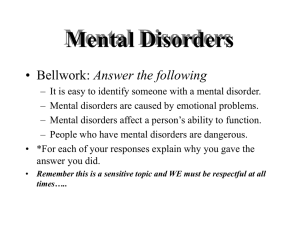
Mental Disorders - health and physical education
... organizer on assigned Anxiety Disorder. • If time: View clips of Aviator ...
... organizer on assigned Anxiety Disorder. • If time: View clips of Aviator ...
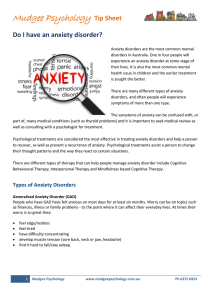
Info Sheet. Do I have an anxiety disorder?
... disorders in Australia. One in four people will experience an anxiety disorder at some stage of their lives. It is also the most common mental health issue in children and the earlier treatment is sought the better. There are many different types of anxiety disorders, and often people will experienc ...
... disorders in Australia. One in four people will experience an anxiety disorder at some stage of their lives. It is also the most common mental health issue in children and the earlier treatment is sought the better. There are many different types of anxiety disorders, and often people will experienc ...


building the essay draft - Business Information Management
... Biological factors (more than one) Psychological factors (also more than one) Social/cultural factors (again, more than one) … more complex, more inclusive, more difficult to investigate ...
... Biological factors (more than one) Psychological factors (also more than one) Social/cultural factors (again, more than one) … more complex, more inclusive, more difficult to investigate ...

Chapter 4 Review
... do. Unable to be assertive and express their anger openly, they vent it indirectly. People with antisocial personality disorders perform cruel and violent acts without feeling any guilt. Because of this, they usually have criminal records. 22. Why is schizophrenia one of the most severe of the menta ...
... do. Unable to be assertive and express their anger openly, they vent it indirectly. People with antisocial personality disorders perform cruel and violent acts without feeling any guilt. Because of this, they usually have criminal records. 22. Why is schizophrenia one of the most severe of the menta ...

Eating Disorders - Institute of Welfare
... automatically assume the person has a problem with food. Eating disorders are not a sign that a person has a problem with food; rather eating disorders are actually only the symptoms of underlying problems in that person's life. With proper treatment, people can fully recover. This section will prov ...
... automatically assume the person has a problem with food. Eating disorders are not a sign that a person has a problem with food; rather eating disorders are actually only the symptoms of underlying problems in that person's life. With proper treatment, people can fully recover. This section will prov ...
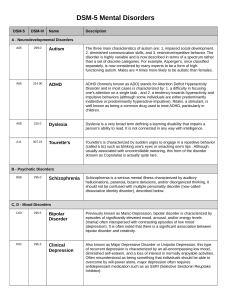
DSM V Mental Disorders
... hypochondriac. Such as person constantly worries about their health even when they have no reason to do so and often any minor symptom is perceived as being a sign of a serious illness. ...
... hypochondriac. Such as person constantly worries about their health even when they have no reason to do so and often any minor symptom is perceived as being a sign of a serious illness. ...

Ch. 16 Psychological Disorders
... › Cultural relativity (all definitions of abnormality are relative) › It is generally agreed that behavior must interfere with normal activities and cause distress to be abnormal; behavior must be “maladaptive,” not meeting demands of day to day life (e.g., danger to self and/or others) ...
... › Cultural relativity (all definitions of abnormality are relative) › It is generally agreed that behavior must interfere with normal activities and cause distress to be abnormal; behavior must be “maladaptive,” not meeting demands of day to day life (e.g., danger to self and/or others) ...
ABNORMAL PSYCH
... Most common type of mental disorders Life consumed by inappropriate fears Difficulty forming stable & satisfying ...
... Most common type of mental disorders Life consumed by inappropriate fears Difficulty forming stable & satisfying ...
Perspectives: What causes abnormal behavior?
... http://www.healthyplace.com/psychological-tests/borderlinepersonality-disorder-test/ ...
... http://www.healthyplace.com/psychological-tests/borderlinepersonality-disorder-test/ ...
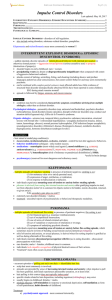
Impulse Control Disorders - Viktor`s Notes for the Neurosurgery
... (2) impaired personal, social, educational, and occupational functioning as consequence of gambling; (3) overly determined, out-of-control quality that drives, perpetuates, and escalates gambling despite derivative functional impairment and adverse consequences. patients often attempt unsuccessful ...
... (2) impaired personal, social, educational, and occupational functioning as consequence of gambling; (3) overly determined, out-of-control quality that drives, perpetuates, and escalates gambling despite derivative functional impairment and adverse consequences. patients often attempt unsuccessful ...