
Rocky Mountains
... sedimentary rocks. These include limestone,dolomite,sandstone and shale. • There are also a few isolated pockets of igneous (formerly molten) rocks. • Sedimentary rocks have a unique method of deposition – one layer on top of another. Digging through the layers, geologists can analyze their composit ...
... sedimentary rocks. These include limestone,dolomite,sandstone and shale. • There are also a few isolated pockets of igneous (formerly molten) rocks. • Sedimentary rocks have a unique method of deposition – one layer on top of another. Digging through the layers, geologists can analyze their composit ...
Our Changing Earth - Bal Bharati Public School
... Weathering is the breaking up of the rocks on the earth’s surface. Erosion is the wearing away of the landscape by different agents like water, wind, and ice. Q2. What are endogenic and enogenic forces? The forces which act in the interior of the earth, are called endogenic forces. The forces which ...
... Weathering is the breaking up of the rocks on the earth’s surface. Erosion is the wearing away of the landscape by different agents like water, wind, and ice. Q2. What are endogenic and enogenic forces? The forces which act in the interior of the earth, are called endogenic forces. The forces which ...
8 - Balbharatipp.org
... Weathering is the breaking up of the rocks on the earth’s surface. Erosion is the wearing away of the landscape by different agents like water, wind, and ice. Q2. What are endogenic and enogenic forces? The forces which act in the interior of the earth, are called endogenic forces. The forces which ...
... Weathering is the breaking up of the rocks on the earth’s surface. Erosion is the wearing away of the landscape by different agents like water, wind, and ice. Q2. What are endogenic and enogenic forces? The forces which act in the interior of the earth, are called endogenic forces. The forces which ...
WG3200 Unit 1 Term Sheet File
... ____________ - formed when two normal faults occur parallel to each, with the plate in-between dropping down as plates move away from each other. ____________ - land between two parallel faults rise to form this. ____________ - fault where movement is up, rather than down, the face over which moveme ...
... ____________ - formed when two normal faults occur parallel to each, with the plate in-between dropping down as plates move away from each other. ____________ - land between two parallel faults rise to form this. ____________ - fault where movement is up, rather than down, the face over which moveme ...
An Introduction to the Geology and Fossils of Essex
... 'bedrock' geology. Much of the solid geology is concealed beneath unconsolidated sediments laid down during the Ice Age. These Ice Age sediments (sand, gravel etc.) are called 'superficial' or 'drift' deposits. The Oldest Rocks The geological story of Essex starts with rocks that are between 440 and ...
... 'bedrock' geology. Much of the solid geology is concealed beneath unconsolidated sediments laid down during the Ice Age. These Ice Age sediments (sand, gravel etc.) are called 'superficial' or 'drift' deposits. The Oldest Rocks The geological story of Essex starts with rocks that are between 440 and ...
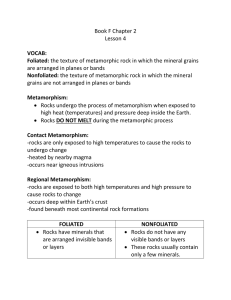
Book F Ch. 2 L4 NOTES
... Rocks undergo the process of metamorphism when exposed to high heat (temperatures) and pressure deep inside the Earth. Rocks DO NOT MELT during the metamorphic process Contact Metamorphism: -rocks are only exposed to high temperatures to cause the rocks to undergo change -heated by nearby magma ...
... Rocks undergo the process of metamorphism when exposed to high heat (temperatures) and pressure deep inside the Earth. Rocks DO NOT MELT during the metamorphic process Contact Metamorphism: -rocks are only exposed to high temperatures to cause the rocks to undergo change -heated by nearby magma ...

What Kind of Rock am I Looking At?
... being buried very deep in the earth's crust, or from the huge plates of the earth's crust pushing against each other. The deeper below the surface of the earth, the higher the temperature, so deep burial also means high temperatures. Another way that high temperatures occur is when magma rises throu ...
... being buried very deep in the earth's crust, or from the huge plates of the earth's crust pushing against each other. The deeper below the surface of the earth, the higher the temperature, so deep burial also means high temperatures. Another way that high temperatures occur is when magma rises throu ...

Topic 3 Notes - Gouverneur Central School District
... Displaced fossils – fossils that are found in locations where they do not belong Uplift- the strata is raised up, ex. marine fossils found in the mountains Subsidence- the strata sinks, ex. Land derived or shallow ocean fossils found in deeper ocean Passive margin basin- shallow basin where sediment ...
... Displaced fossils – fossils that are found in locations where they do not belong Uplift- the strata is raised up, ex. marine fossils found in the mountains Subsidence- the strata sinks, ex. Land derived or shallow ocean fossils found in deeper ocean Passive margin basin- shallow basin where sediment ...

Topic 10: GEOLOGY of SYDNEY REGION
... ridgetops. When deeply buried, crystallisation and recrystallization of the constituent quartz has produced sandstone with a range of hardness. Part is now solid hard quartzite. In some bands with residual porosity the quartz sand grains developed overgrowths extending into cavities between the grai ...
... ridgetops. When deeply buried, crystallisation and recrystallization of the constituent quartz has produced sandstone with a range of hardness. Part is now solid hard quartzite. In some bands with residual porosity the quartz sand grains developed overgrowths extending into cavities between the grai ...
fundamentals of earth history
... a. Sauk & Tippecanoe - Early Paleozoic b. Kaskaskia - Late Paleozoic c. Absaroka - extends into Mesozoic B. Cambrian to Devonian Time - Beginnings of Pangea 1. Shallow Epicontinental Seas 2. Continental Positions 3. Mobile (Mountain) Belts - Protoatlantic closes a. Taconic Orogeny - Ordovician (Quee ...
... a. Sauk & Tippecanoe - Early Paleozoic b. Kaskaskia - Late Paleozoic c. Absaroka - extends into Mesozoic B. Cambrian to Devonian Time - Beginnings of Pangea 1. Shallow Epicontinental Seas 2. Continental Positions 3. Mobile (Mountain) Belts - Protoatlantic closes a. Taconic Orogeny - Ordovician (Quee ...

Unit 2. EARTH`S RELIEF 1. THE EARTH
... 2. Vegetation. Most of the times, plants help fix soil but their roots can also split rocks. ...
... 2. Vegetation. Most of the times, plants help fix soil but their roots can also split rocks. ...

12.1 Notes - power point
... Sediments along the ridge became thicker farther away from the ridge. Paleomagnetism shows that iron-based rocks along the ridges are striped with reversing magnetic fields. Volcanoes are frequently found on boundaries between tectonic plates. ...
... Sediments along the ridge became thicker farther away from the ridge. Paleomagnetism shows that iron-based rocks along the ridges are striped with reversing magnetic fields. Volcanoes are frequently found on boundaries between tectonic plates. ...

12.1 Evidence for Continental Drift
... Sediments along the ridge became thicker farther away from the ridge. Paleomagnetism shows that iron-based rocks along the ridges are striped with reversing magnetic fields. Volcanoes are frequently found on boundaries between tectonic plates. ...
... Sediments along the ridge became thicker farther away from the ridge. Paleomagnetism shows that iron-based rocks along the ridges are striped with reversing magnetic fields. Volcanoes are frequently found on boundaries between tectonic plates. ...

12.1 Evidence for Continental Drift How Can Continents Move? Sea
... Sediments along the ridge became thicker farther away from the ridge. Paleomagnetism shows that iron-based rocks along the ridges are striped with reversing magnetic fields. Volcanoes are frequently found on boundaries between tectonic plates. ...
... Sediments along the ridge became thicker farther away from the ridge. Paleomagnetism shows that iron-based rocks along the ridges are striped with reversing magnetic fields. Volcanoes are frequently found on boundaries between tectonic plates. ...

The top layer of the earth is the Crust made of mostly
... Igneous rocks are made from melted rocks called magma. Sometimes magma squeezes up between the layers of rock, hardens, and forms underground. When magma comes to the surface it is called lava. Pumice and Obsidian are examples of igneous rocks. Native Americans used Obsidian to make arrowheads and ...
... Igneous rocks are made from melted rocks called magma. Sometimes magma squeezes up between the layers of rock, hardens, and forms underground. When magma comes to the surface it is called lava. Pumice and Obsidian are examples of igneous rocks. Native Americans used Obsidian to make arrowheads and ...

NorthShoreGeol - Salem State University
... The last pulse of Appalachian orogenesis occurred when Gondwana collided with southeastern North America during the Permian Period and then moved slightly northward along strike-slip faults. This third event, known as the Alleghenian orogeny, produced the fold belts and mountains of the southern App ...
... The last pulse of Appalachian orogenesis occurred when Gondwana collided with southeastern North America during the Permian Period and then moved slightly northward along strike-slip faults. This third event, known as the Alleghenian orogeny, produced the fold belts and mountains of the southern App ...

FIREPLACE GEOLOGY
... The fireplace is primarily comprised of horizontally layered sandstone. Pieces of conglomerate and breccia are interspersed throughout the fireplace. (Breccia is a form of conglomerate containing angular rock fragments that have not been transported far enough to round off.) The fireplace also cont ...
... The fireplace is primarily comprised of horizontally layered sandstone. Pieces of conglomerate and breccia are interspersed throughout the fireplace. (Breccia is a form of conglomerate containing angular rock fragments that have not been transported far enough to round off.) The fireplace also cont ...

Sedimentary Rocks
... loose sediment into stone. 1. Compaction – as sediments accumulate through time, the weight of the overlying material compresses the deeper sediments until they harden. 2. Cementation – cementing material through time precipitate on to the sediment, filling the spaces and joining the particles, Calc ...
... loose sediment into stone. 1. Compaction – as sediments accumulate through time, the weight of the overlying material compresses the deeper sediments until they harden. 2. Cementation – cementing material through time precipitate on to the sediment, filling the spaces and joining the particles, Calc ...

Plate Tectonics – The Lecture Notes
... Mid-Atlantic ridge. What they found changed geology and oceanography. a) Continental Rocks date the Earth at about 5 billion years old. Since the ocean floor is lower in the lithosphere, scientists expected to find older rocks at those depths. Continental geology’s law of Superposition states that o ...
... Mid-Atlantic ridge. What they found changed geology and oceanography. a) Continental Rocks date the Earth at about 5 billion years old. Since the ocean floor is lower in the lithosphere, scientists expected to find older rocks at those depths. Continental geology’s law of Superposition states that o ...

Our Changing World
... • About 925 million years ago, periods of severe cold began known as ice ages ...
... • About 925 million years ago, periods of severe cold began known as ice ages ...
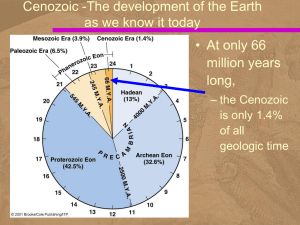
No Slide Title
... Coastal Plain Similarities • Both areas have horizontal or gently seaward-dipping strata deposited mostly on land or in shallow water them • Seaward of the coastal plains lie the continental shelf, slope and rise, which are areas of notable Mesozoic and Cenozoic deposition ...
... Coastal Plain Similarities • Both areas have horizontal or gently seaward-dipping strata deposited mostly on land or in shallow water them • Seaward of the coastal plains lie the continental shelf, slope and rise, which are areas of notable Mesozoic and Cenozoic deposition ...
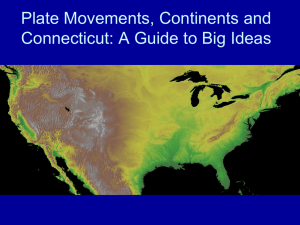
Baltica (proto
... • The collision crumpled the crust, creating a tall mountain range that stretched from Canada to Mexico: the Grenville Mountains. • These mountains are the earliest evidence of mountain building in our region, and ...
... • The collision crumpled the crust, creating a tall mountain range that stretched from Canada to Mexico: the Grenville Mountains. • These mountains are the earliest evidence of mountain building in our region, and ...


Sedimentary Rocks Answers Explained
... compressed turn into the sedimentary rock conglomerate. 4. (3) Sediments that are 0.05 cm in size are sand sized which when compacted and compressed turn into the sedimentary rock sandstone. 5. (1) Some of the major characteristics of sedimentary rocks include layering of sediments, fossils, mud-cra ...
... compressed turn into the sedimentary rock conglomerate. 4. (3) Sediments that are 0.05 cm in size are sand sized which when compacted and compressed turn into the sedimentary rock sandstone. 5. (1) Some of the major characteristics of sedimentary rocks include layering of sediments, fossils, mud-cra ...

Syseca normal blank template - Manchester Geological Association
... Biostratigraphical work, including the study of abundant fossil graptolite remains, has allowed the basin’s sedimentary fill to be dated in detail and revealing complex lateral changes in thickness and sedimentary facies. Periods of rapid subsidence during the late Llandovery and early Wenlock were ...
... Biostratigraphical work, including the study of abundant fossil graptolite remains, has allowed the basin’s sedimentary fill to be dated in detail and revealing complex lateral changes in thickness and sedimentary facies. Periods of rapid subsidence during the late Llandovery and early Wenlock were ...
Geology of Great Britain

The geology of Great Britain is renowned for its diversity. As a result of its eventful geological history, Great Britain shows a rich variety of landscapes across the constituent countries of England, Wales and Scotland. Rocks of almost all geological ages are represented at outcrop, from the Archaean onwards.