
Glacial deposits
... for the Cromerian Stage. The Chalk and Crag deposits which can be seen along the beaches of North Norfolk are also of world importance. Above these sediments however, are the glacial deposits which were laid down starting approximately 500,000 years ago, during the Ice Age. These form most of the cl ...
... for the Cromerian Stage. The Chalk and Crag deposits which can be seen along the beaches of North Norfolk are also of world importance. Above these sediments however, are the glacial deposits which were laid down starting approximately 500,000 years ago, during the Ice Age. These form most of the cl ...


MS Word
... Exam will cover material for the first part of the course. Exam format will be short answer style. You can answer the questions with an outline /short answer/sketch-concise answers and well-labeled sketches are best. Take a look at the outlines on the webpage as well as your notes and the readings f ...
... Exam will cover material for the first part of the course. Exam format will be short answer style. You can answer the questions with an outline /short answer/sketch-concise answers and well-labeled sketches are best. Take a look at the outlines on the webpage as well as your notes and the readings f ...

Even More Landform Changes
... B. Weathering is the breaking down of rock into smaller particles. C. Plate tectonics is a theory that explains the movements of the Earth’s plates. D. Deposition is the process of depositing sediment in a new ...
... B. Weathering is the breaking down of rock into smaller particles. C. Plate tectonics is a theory that explains the movements of the Earth’s plates. D. Deposition is the process of depositing sediment in a new ...

Chapter 12 Thermal Energy Transfer Drives Plate Tectonics 12.1
... There was evidence of different climates, (eg. Such as ___________________) on warm continents. Act. 12-1C – Piecing Together Pangaea 2. How Can Continents Move? • Wegener’s evidence for continental drift did ___________________ New scientific equipment _________________. It was noted that ___ ...
... There was evidence of different climates, (eg. Such as ___________________) on warm continents. Act. 12-1C – Piecing Together Pangaea 2. How Can Continents Move? • Wegener’s evidence for continental drift did ___________________ New scientific equipment _________________. It was noted that ___ ...

Geologic Time
... In your notes, answer the following question. Of the three types of rocks we have discussed (Igneous, Sedimentary and Metamorphic), which one do you think would be able to hold clues to Earth’s past? Why? ...
... In your notes, answer the following question. Of the three types of rocks we have discussed (Igneous, Sedimentary and Metamorphic), which one do you think would be able to hold clues to Earth’s past? Why? ...

Project 2003-02A : Gold in high-grade metamorphic rocks There are
... these rocks cover a large part of Quebec. This study aims to evaluate the potential of these terrains for gold mineralization. To this end, the different types of gold mineralization which may be found in these rocks must be described from known examples around the world. Hypozonal orogenic gold dep ...
... these rocks cover a large part of Quebec. This study aims to evaluate the potential of these terrains for gold mineralization. To this end, the different types of gold mineralization which may be found in these rocks must be described from known examples around the world. Hypozonal orogenic gold dep ...


Worksheet 046 - Nature Conservation Lewisham
... Rocks and Soils Worksheet 046 – The Rock Cycle (Answers) ...
... Rocks and Soils Worksheet 046 – The Rock Cycle (Answers) ...

Chapter1305.ppt
... within it can still be recognized; these relics define the position of the orogen that once was. ...
... within it can still be recognized; these relics define the position of the orogen that once was. ...

Handout
... within it can still be recognized; these relics define the position of the orogen that once was. ...
... within it can still be recognized; these relics define the position of the orogen that once was. ...
Unit 1 Major land forms and water forms DEFINITIONS
... plateau. An extensive, relatively flat upland area. plate tectonics. The theory that Earth's crust consists of eight large and several small plates. The movement of some plates causes earthquakes and volcanoes. This occurs when one plate plunges below another. At oceanic ridges, plates divide and ma ...
... plateau. An extensive, relatively flat upland area. plate tectonics. The theory that Earth's crust consists of eight large and several small plates. The movement of some plates causes earthquakes and volcanoes. This occurs when one plate plunges below another. At oceanic ridges, plates divide and ma ...

Rocks and minerals
... Metamorphic rocks have been changed over time by extreme pressure and heat. Metamorphic rocks can be formed by pressure deep under the Earth's surface, from the extreme heat caused by magma or by the intense collisions and friction of tectonic plates. Uplift and erosion help bring metamorphic rock ...
... Metamorphic rocks have been changed over time by extreme pressure and heat. Metamorphic rocks can be formed by pressure deep under the Earth's surface, from the extreme heat caused by magma or by the intense collisions and friction of tectonic plates. Uplift and erosion help bring metamorphic rock ...

Kaikoura tectonic
... • The Seaward Kaikoura Mountains rise to over 2600 metres just 12km from the sea. • The Hope fault, which marks the boundary between the Pacific and Australian Plates, runs along the foot of the Kaikoura Mountains. ...
... • The Seaward Kaikoura Mountains rise to over 2600 metres just 12km from the sea. • The Hope fault, which marks the boundary between the Pacific and Australian Plates, runs along the foot of the Kaikoura Mountains. ...

3A8 Week 03 Lecture 08-The Geology of Ireland Part One
... Newfoundland, SE Ireland, S England and Brittany • The majority of the Avalonian basement is comprised of c. 630 to 590 Ma calcalkaline arc complexes • The only fragment of Avalonian basement in SE Ireland is the Rosslare Complex ...
... Newfoundland, SE Ireland, S England and Brittany • The majority of the Avalonian basement is comprised of c. 630 to 590 Ma calcalkaline arc complexes • The only fragment of Avalonian basement in SE Ireland is the Rosslare Complex ...

EARTH SCIENCE SOL REVIEW
... Ocean crust is younger than continental crust. Youngest area of ocean floor is at midocean ridges Ocean crust is thinner than continental crust ...
... Ocean crust is younger than continental crust. Youngest area of ocean floor is at midocean ridges Ocean crust is thinner than continental crust ...

22 questions - ReviewEarthScience.com
... apart, showed that the area had been uplifted 5 centimeters during the interval. If the rate of uplift remains constant, how many years will it take for this area to be uplifted a total of 70 centimeters? A) 500 years B) 250 years ...
... apart, showed that the area had been uplifted 5 centimeters during the interval. If the rate of uplift remains constant, how many years will it take for this area to be uplifted a total of 70 centimeters? A) 500 years B) 250 years ...
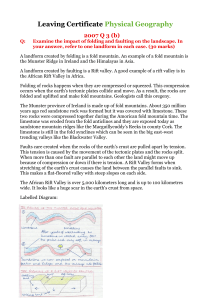
2007 Q3 B folding faulting on landscape
... A landform created by folding is a fold mountain. An example of a fold mountain is the Munster Ridge in Ireland and the Himalayas in Asia. A landform created by faulting is a Rift valley. A good example of a rift valley is in the African Rift Valley in Africa. Folding of rocks happens when they are ...
... A landform created by folding is a fold mountain. An example of a fold mountain is the Munster Ridge in Ireland and the Himalayas in Asia. A landform created by faulting is a Rift valley. A good example of a rift valley is in the African Rift Valley in Africa. Folding of rocks happens when they are ...

GEOLOGY 335 LAB -- SEDIMENTARY PROCESSES
... may be deposited near the margin of the fan in the valley, commonly in shallow lakes. These lakes may periodically dry, and evaporite deposits may result. Eolian. Wind is an effective sorting agent and will selectively transport sand. Gravel is left behind and dust-sized particles are lifted high in ...
... may be deposited near the margin of the fan in the valley, commonly in shallow lakes. These lakes may periodically dry, and evaporite deposits may result. Eolian. Wind is an effective sorting agent and will selectively transport sand. Gravel is left behind and dust-sized particles are lifted high in ...


Plate Tectonics
... been near the equator. • Evidence of glaciers existed in South Africa, where the climate is now a jungle and desert in parts. ...
... been near the equator. • Evidence of glaciers existed in South Africa, where the climate is now a jungle and desert in parts. ...
Continental Drift
... Another important finding came from studying of the magnetism of the sea floor. About every 300,000 years, the Earth's magnetic field reverses, although there are times in Earth's history when this span is much longer or shorter. Many rocks contain tiny particles of magnetic minerals. When the rock ...
... Another important finding came from studying of the magnetism of the sea floor. About every 300,000 years, the Earth's magnetic field reverses, although there are times in Earth's history when this span is much longer or shorter. Many rocks contain tiny particles of magnetic minerals. When the rock ...

Continental Drift
... and formed a super-continent called Pangea (all land). This was followed by the break up of Pangea about 200 million years ago, and the drifting of the various continents to the positions that we see today. Here is what we may see in the future. ...
... and formed a super-continent called Pangea (all land). This was followed by the break up of Pangea about 200 million years ago, and the drifting of the various continents to the positions that we see today. Here is what we may see in the future. ...
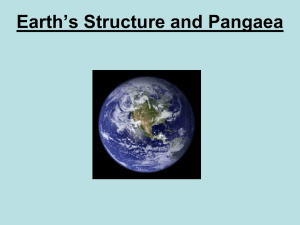
Continental Drift and Sea-Floor Spreading 7.2
... Continental Drift Theory • Continental Drift states that the continents were once a single landmass (Pangaea), broke apart, and “drifted” to their current locations. • Proposed by Alfred Wegener (1915). He had evidence that Pangaea existed… ...
... Continental Drift Theory • Continental Drift states that the continents were once a single landmass (Pangaea), broke apart, and “drifted” to their current locations. • Proposed by Alfred Wegener (1915). He had evidence that Pangaea existed… ...

The Rock Cycle
... Created by the following geological processes: generation and movement of magma weathering erosion transportation deposition of sediment metamorphism of preexisting rocks. ...
... Created by the following geological processes: generation and movement of magma weathering erosion transportation deposition of sediment metamorphism of preexisting rocks. ...
Geology of Great Britain

The geology of Great Britain is renowned for its diversity. As a result of its eventful geological history, Great Britain shows a rich variety of landscapes across the constituent countries of England, Wales and Scotland. Rocks of almost all geological ages are represented at outcrop, from the Archaean onwards.