
2.4 Plate Tectonics - Northside Middle School
... different directions further cracking the crust. ...
... different directions further cracking the crust. ...

© UKRIGS Education Project: Earth Science On-Site
... several places this igneous intrusion is guided by fault lines, some of which seem to have occurred as the intrusions happened. The faults are normal faults, which are caused by tension, and result from brittle fracture during a stretching of the crust. This period of extension coincided with the pe ...
... several places this igneous intrusion is guided by fault lines, some of which seem to have occurred as the intrusions happened. The faults are normal faults, which are caused by tension, and result from brittle fracture during a stretching of the crust. This period of extension coincided with the pe ...
The Disadvantages of Volcanoes
... In volcanic areas water can be pumped into the hot rocks and heated to provide energy. In Iceland nearly 90% of homes are heated by this method. Tourism A volcano is an interesting tourist attraction: Sell cooled lava as souvenirs Sell rock as souvenirs Guided tour of the volcano Volcano merchandise ...
... In volcanic areas water can be pumped into the hot rocks and heated to provide energy. In Iceland nearly 90% of homes are heated by this method. Tourism A volcano is an interesting tourist attraction: Sell cooled lava as souvenirs Sell rock as souvenirs Guided tour of the volcano Volcano merchandise ...

1-2 Notes: Continental Drift Continents Join Together and Split Apart
... What evidence is there for continental drift? There are ____ main kinds of evidence for continental drift: fossils, climate, and geology. Fossils Mesosaurus is an ancient reptile whose fossils are found ONLY in South America and Western _____________________. There are many other fossils fou ...
... What evidence is there for continental drift? There are ____ main kinds of evidence for continental drift: fossils, climate, and geology. Fossils Mesosaurus is an ancient reptile whose fossils are found ONLY in South America and Western _____________________. There are many other fossils fou ...

The earth`s layers: http://mediatheek
... Now click on Metamorphic Rock. What did these rocks use to be? ____________________________________________________________________ How are these rocks transformed into a new kind of rock? ____________________________________________________________________ Finally, click on Igneous Rock. Which of t ...
... Now click on Metamorphic Rock. What did these rocks use to be? ____________________________________________________________________ How are these rocks transformed into a new kind of rock? ____________________________________________________________________ Finally, click on Igneous Rock. Which of t ...
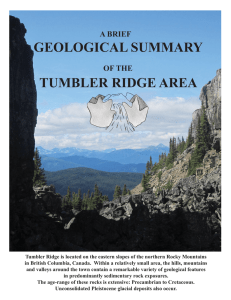
Geological Summary of the Tumbler Ridge Area
... continent into eastern and western parts. Sea levels rose and sank, and the Tumbler Ridge area would repeatedly alternate between shallow underwater habitat, coastal plain, and shoreline habitat. As the new mountains eroded, extensive estuaries would develop at the coast, then be swamped with the ne ...
... continent into eastern and western parts. Sea levels rose and sank, and the Tumbler Ridge area would repeatedly alternate between shallow underwater habitat, coastal plain, and shoreline habitat. As the new mountains eroded, extensive estuaries would develop at the coast, then be swamped with the ne ...


Rock Formations: How Igneous, Sedimentary, and Metamorphic
... Rock Formations: How Igneous, Sedimentary, and Metamorphic Rock Types are Formed Investigating how the 3 basic rock types are created. There are 3 basic types of rock: igneous, sedimentary, and metamorphic rocks. Igneous rock Igneous rock is formed by the cooling and solidification of magma or lava, ...
... Rock Formations: How Igneous, Sedimentary, and Metamorphic Rock Types are Formed Investigating how the 3 basic rock types are created. There are 3 basic types of rock: igneous, sedimentary, and metamorphic rocks. Igneous rock Igneous rock is formed by the cooling and solidification of magma or lava, ...


Erth 16 Lecture 3: Grand Canyon - geologic history and canyon
... • With sediments, we have used two basic methods to establish the relative age of units: superposition and faunal succession. In the more general case with igneous, metamorphic or sedimentary rocks we have some additional tools for establishing relative time. • How do we tell whether the igneous or ...
... • With sediments, we have used two basic methods to establish the relative age of units: superposition and faunal succession. In the more general case with igneous, metamorphic or sedimentary rocks we have some additional tools for establishing relative time. • How do we tell whether the igneous or ...


The United kingdom of great britain
... of the lasting influence of the Roman Empire over European markets. 3. Which of the following was a major result of the Industrial Revolution? a. Exports of manufactured goods to the British colonies increased. b. Exports of agricultural goods declined. c. Ireland became the new “workshop of the wor ...
... of the lasting influence of the Roman Empire over European markets. 3. Which of the following was a major result of the Industrial Revolution? a. Exports of manufactured goods to the British colonies increased. b. Exports of agricultural goods declined. c. Ireland became the new “workshop of the wor ...

Lecture#5: Rocks
... • Two ways of forming: – from overburden pressure as particles of sediment are deposited out of air, ice; – chemical precipitates (water flows carrying the particles in suspension), eg. carbonate-rich sediments ...
... • Two ways of forming: – from overburden pressure as particles of sediment are deposited out of air, ice; – chemical precipitates (water flows carrying the particles in suspension), eg. carbonate-rich sediments ...

Bal Bharati Public School Class – 7 Subject
... 9. How are different landforms created in earth ? Weathering is the breaking up of the rocks on the earth’s surface. Erosion is the wearing away of the landscape by different agents like water, wind and ice. The eroded material is carried away or transported by water, wind, etc. and eventually depo ...
... 9. How are different landforms created in earth ? Weathering is the breaking up of the rocks on the earth’s surface. Erosion is the wearing away of the landscape by different agents like water, wind and ice. The eroded material is carried away or transported by water, wind, etc. and eventually depo ...

Sedimentary Rocks 1
... mineral compositions and/or lithic clasts; Mature sedimentary rocks have restricted mineralogies dominated by mineral species resistant to weathering and erosional processes ...
... mineral compositions and/or lithic clasts; Mature sedimentary rocks have restricted mineralogies dominated by mineral species resistant to weathering and erosional processes ...

rocks and minerals and the rock
... Minerals are naturally formed crystals that are com posed of one or m ore chem ical elem ents. They are disting uished from other natural solid m ate rials by their crysta lline structure. S om e natu ral solid m ate rials form ed in ro ck s are not m inerals bec aus e they lack a crystalline stru c ...
... Minerals are naturally formed crystals that are com posed of one or m ore chem ical elem ents. They are disting uished from other natural solid m ate rials by their crysta lline structure. S om e natu ral solid m ate rials form ed in ro ck s are not m inerals bec aus e they lack a crystalline stru c ...

summing-up - Zanichelli online
... transgression and the formation of new sedimentary rocks, unconformally on the older ones. Over billions of years, the traces of numerous cycles, similar to that described, can be seen in the rocks in the Earth’s crust. ...
... transgression and the formation of new sedimentary rocks, unconformally on the older ones. Over billions of years, the traces of numerous cycles, similar to that described, can be seen in the rocks in the Earth’s crust. ...

8th Grade Science Final - Union Beach School District
... inner core, outer core, mantle and crust 2. Which layer is the thickest? the mantle 3. Which layers make up the tectonic plates? lithosphere – all of the crust and the upper mantle ...
... inner core, outer core, mantle and crust 2. Which layer is the thickest? the mantle 3. Which layers make up the tectonic plates? lithosphere – all of the crust and the upper mantle ...

A1980JF47100001
... closer constraints on their origin than had been possible previously. [The SCI ® indicates that this paper has been cited over 105 times since ...
... closer constraints on their origin than had been possible previously. [The SCI ® indicates that this paper has been cited over 105 times since ...

What type? - El Camino College
... • Plate boundaries: main location for Earth’s volcanic and earthquake activity. This is main place where mountains are created. • Type of plate boundary determines activity. • 3 types – diverging (spreading) – converging (colliding) – transform (sliding past each other) ...
... • Plate boundaries: main location for Earth’s volcanic and earthquake activity. This is main place where mountains are created. • Type of plate boundary determines activity. • 3 types – diverging (spreading) – converging (colliding) – transform (sliding past each other) ...

Plate Tectonics and Continental Drift
... • With sonar, scientists determined that the ocean floor was composed of mountains and deep valleys. • Harry Hess authored the Sea Floor Spreading Theory to explain that the ocean floor is constantly spreading along the MidAtlantic Ridge. ...
... • With sonar, scientists determined that the ocean floor was composed of mountains and deep valleys. • Harry Hess authored the Sea Floor Spreading Theory to explain that the ocean floor is constantly spreading along the MidAtlantic Ridge. ...

Rock Cycle - Prairie Spirit Blogs
... Sediments: loose materials such as rock fragments and mineral grains that have been transported by wind, water, or glacier Weathering: the breaking of rocks into smaller pieces, either mechanically or chemically Erosion: the process that moves weathered rocks from one location to another Deposition: ...
... Sediments: loose materials such as rock fragments and mineral grains that have been transported by wind, water, or glacier Weathering: the breaking of rocks into smaller pieces, either mechanically or chemically Erosion: the process that moves weathered rocks from one location to another Deposition: ...

Week 6 Quiz- Weathering, Soil, Plate Tectonics Name
... A. sea floor spreading and continental drift C. continental drift and fossil theory B. sea floor spreading and tidal theory D. continental drift and Big Bang theory ____25. Large pieces of the lithosphere that float on the asthenosphere are called: A. asthenosphere B. the mid-ocean ridge C. deep-sea ...
... A. sea floor spreading and continental drift C. continental drift and fossil theory B. sea floor spreading and tidal theory D. continental drift and Big Bang theory ____25. Large pieces of the lithosphere that float on the asthenosphere are called: A. asthenosphere B. the mid-ocean ridge C. deep-sea ...
Geology of Great Britain

The geology of Great Britain is renowned for its diversity. As a result of its eventful geological history, Great Britain shows a rich variety of landscapes across the constituent countries of England, Wales and Scotland. Rocks of almost all geological ages are represented at outcrop, from the Archaean onwards.