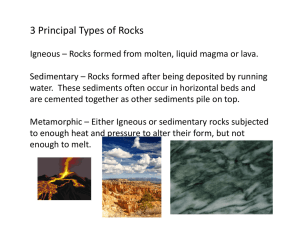
3 Principal Types of Rocks
... 3 Principal Types of Rocks Igneous – Rocks formed from molten, liquid magma or lava. Sedimentary – Rocks formed after being deposited by running water. These sediments often occur in horizontal beds and are cemented together as other sediments pile on top. Metamorphic – Either Igneous or sediment ...
... 3 Principal Types of Rocks Igneous – Rocks formed from molten, liquid magma or lava. Sedimentary – Rocks formed after being deposited by running water. These sediments often occur in horizontal beds and are cemented together as other sediments pile on top. Metamorphic – Either Igneous or sediment ...
DOC - Northwest Creation Network
... Description: The talk first discusses what the Bible says about how the Floodwater drained from off the continents. Then geological evidence for parts of the Earth’s crust rising and parts descending to drain the Floodwater is presented. Geological evidence of sheet currents flowing off the continen ...
... Description: The talk first discusses what the Bible says about how the Floodwater drained from off the continents. Then geological evidence for parts of the Earth’s crust rising and parts descending to drain the Floodwater is presented. Geological evidence of sheet currents flowing off the continen ...

Sedimentary Rocks
... sedimentary rock) and evaporates such as halite and gypsum. The depositional environment for these rocks would be marine or evaporite basins (Boggs, 1995). Plate tectonics not only affects sedimentation and the formation of sedimentary rocks, but it is used to describe how rocks move through the ro ...
... sedimentary rock) and evaporates such as halite and gypsum. The depositional environment for these rocks would be marine or evaporite basins (Boggs, 1995). Plate tectonics not only affects sedimentation and the formation of sedimentary rocks, but it is used to describe how rocks move through the ro ...

Outstanding geologic feature of Pennsylvania—Lehigh
... that flowed northwest from highlands to the southeast. It is thought that a 3- to 4-mile-thick sequence of rock was deposited above these units. ...
... that flowed northwest from highlands to the southeast. It is thought that a 3- to 4-mile-thick sequence of rock was deposited above these units. ...

ROCKS AND MINERALS
... INTRUSIVE IGNEOUS ROCKS COOL SLOWLY IN THE CRUST (MAGMA) EXTRUSIVE IGNEOUS ROCKS COOL RAPIDLY AT THE SURFACE (LAVA) WHICH WILL HAVE THE LARGE ...
... INTRUSIVE IGNEOUS ROCKS COOL SLOWLY IN THE CRUST (MAGMA) EXTRUSIVE IGNEOUS ROCKS COOL RAPIDLY AT THE SURFACE (LAVA) WHICH WILL HAVE THE LARGE ...

? Use your lab manual, text book, rock ID booklet and rock
... Use your lab manual, text book, rock ID booklet and rock classification handout (blue sheet) to identify the available samples. ...
... Use your lab manual, text book, rock ID booklet and rock classification handout (blue sheet) to identify the available samples. ...

Rocks
... ___ 6. Lichens are a symbiotic association between _______________________________. A. a fungus and a bacteria B. a fungus and a plant C. a plant and an algae D. a fungus and an algae ___ 7. Lichens are used as a bioindicator of ________________________. A. air quality B. water quality C. soil chemi ...
... ___ 6. Lichens are a symbiotic association between _______________________________. A. a fungus and a bacteria B. a fungus and a plant C. a plant and an algae D. a fungus and an algae ___ 7. Lichens are used as a bioindicator of ________________________. A. air quality B. water quality C. soil chemi ...

Chapter 2: The need for Earth Heritage Conservation
... and the evolution and extinction of plants and animals – contributes to understanding the problems of the present. We may be able to use this knowledge to forecast volcanic activity, earthquakes or changes in climate. For example, by studying the dynamics of natural systems, such as rivers and coast ...
... and the evolution and extinction of plants and animals – contributes to understanding the problems of the present. We may be able to use this knowledge to forecast volcanic activity, earthquakes or changes in climate. For example, by studying the dynamics of natural systems, such as rivers and coast ...

Chapter 4
... Chapter 4- Review 1) What is indirect evidence? 2) What are seismic waves? 3) How do geologist know about the Earth’s interior? 4) What happens to pressure and temperature as one descends through the Earth? 5) What is pressure? 6) Identify the four layers of the Earth from the outside and moving in. ...
... Chapter 4- Review 1) What is indirect evidence? 2) What are seismic waves? 3) How do geologist know about the Earth’s interior? 4) What happens to pressure and temperature as one descends through the Earth? 5) What is pressure? 6) Identify the four layers of the Earth from the outside and moving in. ...

Metamorphic Rock by Leila, John*S, and Samantha
... grains are formed. For example, Schist rocks have grains that go the same way as the layers. Some Metamorphic rocks are layered while others are made up of grains. Another way is to compare the rocks to ones on the internet or in a book. Slate is grey and purple. Schist looks like flakes and is sliv ...
... grains are formed. For example, Schist rocks have grains that go the same way as the layers. Some Metamorphic rocks are layered while others are made up of grains. Another way is to compare the rocks to ones on the internet or in a book. Slate is grey and purple. Schist looks like flakes and is sliv ...

SOL_5.7_Earth
... Rocks are classified based on how they were formed. The three types of rocks are sedimentary, igneous, and metamorphic. Igneous rocks can be formed in two ways. -Magma under the surface cools and hardens creating intrusive igneous rocks. Example is granite -Lava on the surface cools and hardens cre ...
... Rocks are classified based on how they were formed. The three types of rocks are sedimentary, igneous, and metamorphic. Igneous rocks can be formed in two ways. -Magma under the surface cools and hardens creating intrusive igneous rocks. Example is granite -Lava on the surface cools and hardens cre ...

Rocks PowerPoint
... Extrusive rocks- igneous rocks formed from lava (ex: basalt) Intrusive rocks- igneous rocks formed from magma (ex: granite) ...
... Extrusive rocks- igneous rocks formed from lava (ex: basalt) Intrusive rocks- igneous rocks formed from magma (ex: granite) ...

Sedimentary rock
... B-Fossils remains or traces of organisms that lived long ago. 1-Fossils form when a dead plant, animal, or footprint in mud, is covered by sediment that later hardens into rock. a-Almost all fossils are found in sedimentary rock ...
... B-Fossils remains or traces of organisms that lived long ago. 1-Fossils form when a dead plant, animal, or footprint in mud, is covered by sediment that later hardens into rock. a-Almost all fossils are found in sedimentary rock ...

SGES 1302 Lecture16
... angular, gravel-sized particles. The angularity indicates that the sediments from which they formed did not have time to become rounded. This suggests that the particles were transported only a short distance and deposited close to their source. ...
... angular, gravel-sized particles. The angularity indicates that the sediments from which they formed did not have time to become rounded. This suggests that the particles were transported only a short distance and deposited close to their source. ...

geotime1
... 5. A new series of sediments deposited in horizontal layers on the erosion surface. 6. The complicated sequence of tilted and horizontal rocks was again uplifted, exposing them to erosion and producing the outcrop we see today. ...
... 5. A new series of sediments deposited in horizontal layers on the erosion surface. 6. The complicated sequence of tilted and horizontal rocks was again uplifted, exposing them to erosion and producing the outcrop we see today. ...

CHAPTER 6_Sed_Rocks
... and lithify to form biochemical sedimentary rocks. Important examples are most types of limestone and bedded, biogenic chert. 6. Organic sedimentary rocks include coal—the altered remains of trees and other plants that lived in swampy environments (which allow organic matter to accumulate without to ...
... and lithify to form biochemical sedimentary rocks. Important examples are most types of limestone and bedded, biogenic chert. 6. Organic sedimentary rocks include coal—the altered remains of trees and other plants that lived in swampy environments (which allow organic matter to accumulate without to ...

Moon Rocks - DouglasSpaceWeek
... Digging at a rate of one foot per minute, it would take you 87 years to tunnel all the way through Earth. ...
... Digging at a rate of one foot per minute, it would take you 87 years to tunnel all the way through Earth. ...

File - Bruner science
... Early maps of the world caused Wegener, in the early 20th century, to propose the continental drift theory. the theory that _________________________________ ...
... Early maps of the world caused Wegener, in the early 20th century, to propose the continental drift theory. the theory that _________________________________ ...

Geology Practice Test 2012 Minerals – use your mineral flow chart
... 9. ______ A rock that has been changed by heat and pressure. 10. ______ The type of rock that forms from the compaction of sediments. 11. ______ What type of bedrock is found in the Twin Cities area? 12. _____Where most sedimentary rocks form. 13. _____Does sandstone form in deep or shallow water? 1 ...
... 9. ______ A rock that has been changed by heat and pressure. 10. ______ The type of rock that forms from the compaction of sediments. 11. ______ What type of bedrock is found in the Twin Cities area? 12. _____Where most sedimentary rocks form. 13. _____Does sandstone form in deep or shallow water? 1 ...

The Rock Cycle ws File
... you find at the beach are sediments from broken down rock, transported there from somewhere else. Over a very long time, layers of sediment build up at the bottom of ...
... you find at the beach are sediments from broken down rock, transported there from somewhere else. Over a very long time, layers of sediment build up at the bottom of ...

EarthComm_c3_esyl
... dark black to dark green basaltic rock is indicative of the melting of oceanic crust. Clastic sedimentary rocks contain fragments of rocks and minerals that have been physically transported and deposited and converted into rock. Organic sedimentary rocks contain the remains of plants and animals tha ...
... dark black to dark green basaltic rock is indicative of the melting of oceanic crust. Clastic sedimentary rocks contain fragments of rocks and minerals that have been physically transported and deposited and converted into rock. Organic sedimentary rocks contain the remains of plants and animals tha ...

Hypothesis:
... Rocks that have changed because of changes in temperature and pressure or the presence of hot watery fluids ...
... Rocks that have changed because of changes in temperature and pressure or the presence of hot watery fluids ...


Rock types Soil-forming factor 1: Parent material
... of Africa. Lithology describes the mineral composition and structure of geological material which is based on rock formation (i.e. whether it is igneous, sedimentary, metamorphic) and mineralogy (e.g. carbonate, silicic, mafic). This map is a good proxy for soil parent material as it only reflects s ...
... of Africa. Lithology describes the mineral composition and structure of geological material which is based on rock formation (i.e. whether it is igneous, sedimentary, metamorphic) and mineralogy (e.g. carbonate, silicic, mafic). This map is a good proxy for soil parent material as it only reflects s ...

Geology of Great Britain

The geology of Great Britain is renowned for its diversity. As a result of its eventful geological history, Great Britain shows a rich variety of landscapes across the constituent countries of England, Wales and Scotland. Rocks of almost all geological ages are represented at outcrop, from the Archaean onwards.