Exam #2 - MSU Billings
... a. Because we know how old the fossils are b. Because terrestrial sedimentary rocks such as those formed in rivers, contain many dinosaur species, which only existed before 65 million years ago c. Because fossil-rich beds contain many thin volcanic beds that erupted about every 600,000 years d. Beca ...
... a. Because we know how old the fossils are b. Because terrestrial sedimentary rocks such as those formed in rivers, contain many dinosaur species, which only existed before 65 million years ago c. Because fossil-rich beds contain many thin volcanic beds that erupted about every 600,000 years d. Beca ...

8.1 Earth has several layers
... matched rocks are found in different areas and different continents ...
... matched rocks are found in different areas and different continents ...

KEY How Earth`s Rocks Were Formed Three Families of Rocks A
... geological processes now operating on Earth were also active in the past ...
... geological processes now operating on Earth were also active in the past ...

Rock on! - is1105rocks
... are eroded and weathered and transported by wind and water to eventually settle in the bottom of rivers, lakes or oceans. - Layer after layer of eroded earth are deposited on top of each other. - These layers are compressed over time, until the bottom layers slowly turn into rock under great pressur ...
... are eroded and weathered and transported by wind and water to eventually settle in the bottom of rivers, lakes or oceans. - Layer after layer of eroded earth are deposited on top of each other. - These layers are compressed over time, until the bottom layers slowly turn into rock under great pressur ...

part – i (mcq) (compulsory)
... The asthenosphere is: (a) that portion of Earth where rocks behave as brittle solids (b) that portion of Earth where rocks behave as plastic solids (c) that portion of Earth where rocks behave as fluids (d) that portion of Earth where rocks can be found (e) None of these (xii) Which of the following ...
... The asthenosphere is: (a) that portion of Earth where rocks behave as brittle solids (b) that portion of Earth where rocks behave as plastic solids (c) that portion of Earth where rocks behave as fluids (d) that portion of Earth where rocks can be found (e) None of these (xii) Which of the following ...

WELCOME BACK! - Year 6 and 7 Mathematics, Science and
... The Theory of Continental Drift: Continental Drift – The continents have not always been in their present positions, but have drifted to these locations over millions of years. ...
... The Theory of Continental Drift: Continental Drift – The continents have not always been in their present positions, but have drifted to these locations over millions of years. ...

Science Chapter 3 - Plymouth Christian School
... • minerals – natural, non-living substances that make up rocks ...
... • minerals – natural, non-living substances that make up rocks ...

LPS Math-Science Partnership Grant
... Listric thrust faults and hanging-wall anticlines developed in the sedimentary rocks of the basin. These features contrast with conventional interpretations of Pennsylvanian structures as the result of predominantly vertical movements along high-angle faults, and they suggest that Pennsylvanian dow ...
... Listric thrust faults and hanging-wall anticlines developed in the sedimentary rocks of the basin. These features contrast with conventional interpretations of Pennsylvanian structures as the result of predominantly vertical movements along high-angle faults, and they suggest that Pennsylvanian dow ...

ALPS
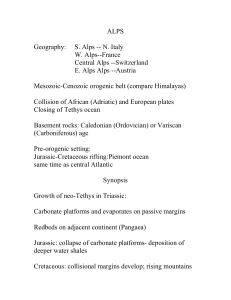
... Cretaceous: Alpine flysch deposits during subduction Flysch: deep water turbidite deposits- Bouma sequences: erosion of uplands. Molasse: non-marine deposits: erosion of thrust sheets (foreland basins) Date tectonic movements: Oligocene (35 Ma)-Miocene (15 Ma)-Pliocene (5 Ma) Miocene (10 Ma)- Medite ...
... Cretaceous: Alpine flysch deposits during subduction Flysch: deep water turbidite deposits- Bouma sequences: erosion of uplands. Molasse: non-marine deposits: erosion of thrust sheets (foreland basins) Date tectonic movements: Oligocene (35 Ma)-Miocene (15 Ma)-Pliocene (5 Ma) Miocene (10 Ma)- Medite ...

Chapter 6.2: Igneous Rocks
... • A mixture of large and small crystals • Magma rises slowly through the crust before erupting to the surface – Within the crust, large crystals can grow – On the surface, cooling stops any more crystals from growing ...
... • A mixture of large and small crystals • Magma rises slowly through the crust before erupting to the surface – Within the crust, large crystals can grow – On the surface, cooling stops any more crystals from growing ...

GCSE Geology revision workbook part 1 stu
... Britain was originally south of the equator as Figure 12 below shows. How do we know this? Figure 13 is a log of two boreholes drilled into Carboniferous sediments: a swampy delta and a shallow tropical sea. ...
... Britain was originally south of the equator as Figure 12 below shows. How do we know this? Figure 13 is a log of two boreholes drilled into Carboniferous sediments: a swampy delta and a shallow tropical sea. ...

Erosion Vocabulary and Tasks
... Erosion Vocabulary Abrasion – erosion caused by wearing away of cliffs by sediment (sand, shells, rocks etc) flung by breaking waves Arch – wave-eroded passage through a headland Attrition –when rocks in the waves bump into each other and become smaller pieces Backwash – the return of the water to t ...
... Erosion Vocabulary Abrasion – erosion caused by wearing away of cliffs by sediment (sand, shells, rocks etc) flung by breaking waves Arch – wave-eroded passage through a headland Attrition –when rocks in the waves bump into each other and become smaller pieces Backwash – the return of the water to t ...
Argyll and the Islands - Scottish Natural Heritage
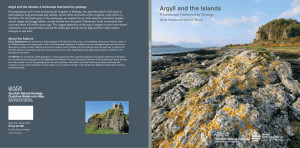
... are around 1,800 million years old, much older than the Dalradian rocks, but not as old as the oldest rocks on the British Isles, the Lewisian gneisses of the Outer Hebrides and North-west Highlands. The rocks of the Rhinns are also gneisses; they are coarsely crystalline and have a strongly banded ...
... are around 1,800 million years old, much older than the Dalradian rocks, but not as old as the oldest rocks on the British Isles, the Lewisian gneisses of the Outer Hebrides and North-west Highlands. The rocks of the Rhinns are also gneisses; they are coarsely crystalline and have a strongly banded ...

Geologic History
... • Sometimes layers of rock are missing • There is a break or gap of geologic time not represented by the layers in an area. The gap represents an unknown length of time • No way of knowing exactly what happened but we do know UPLIFT exposed rocks to weathering and erosion. • Rocks above unconformity ...
... • Sometimes layers of rock are missing • There is a break or gap of geologic time not represented by the layers in an area. The gap represents an unknown length of time • No way of knowing exactly what happened but we do know UPLIFT exposed rocks to weathering and erosion. • Rocks above unconformity ...

Skye: A landscape fashioned by geology
... The quartz grains of the sandstones are often cemented together by calcium carbonate which can result in some very strange and fascinating weathering characteristics. At Valtos, for example, the sandstones have been weathered by the elements into large cannonballs which can be up to a metre in diame ...
... The quartz grains of the sandstones are often cemented together by calcium carbonate which can result in some very strange and fascinating weathering characteristics. At Valtos, for example, the sandstones have been weathered by the elements into large cannonballs which can be up to a metre in diame ...

Unit 3 Study Guide Name
... 2. ______________ of plants and animals have been found on other continents that they would normally not be. Ex. _________________ animal fossils can be found on cold continents and vice versa. Continents also fit like a _________________. ...
... 2. ______________ of plants and animals have been found on other continents that they would normally not be. Ex. _________________ animal fossils can be found on cold continents and vice versa. Continents also fit like a _________________. ...

Plate Evidence 09
... together • Hypothesized that continents were once together and had drifted apart • Idea was called “Continental Drift” ...
... together • Hypothesized that continents were once together and had drifted apart • Idea was called “Continental Drift” ...

Historical Geology
... In 1962, Harry Hess proposed the hypothesis that midocean ridges represent narrow zones where ocean crust forms. Seafloor spreading is a part of the theory of plate tectonics. At the Mid-Atlantic Ridge (and other places), material from the mantle rises through the faults between oceanic plates to f ...
... In 1962, Harry Hess proposed the hypothesis that midocean ridges represent narrow zones where ocean crust forms. Seafloor spreading is a part of the theory of plate tectonics. At the Mid-Atlantic Ridge (and other places), material from the mantle rises through the faults between oceanic plates to f ...

(1) the distribution of fossils on different continents
... There is a variety of evidence that supports the claims that plate tectonics accounts for: 1. Distribution of fossils on different continents 2. Occurrence of earthquakes 3. Continental and ocean floor features (including mountains, volcanoes, faults and trenches) ...
... There is a variety of evidence that supports the claims that plate tectonics accounts for: 1. Distribution of fossils on different continents 2. Occurrence of earthquakes 3. Continental and ocean floor features (including mountains, volcanoes, faults and trenches) ...

Stream transport
... Mountains. Distributed downslope by mass wasting and streams/rivers. Starts here, not at the present-day location of the beach ...
... Mountains. Distributed downslope by mass wasting and streams/rivers. Starts here, not at the present-day location of the beach ...
Geology of Great Britain

The geology of Great Britain is renowned for its diversity. As a result of its eventful geological history, Great Britain shows a rich variety of landscapes across the constituent countries of England, Wales and Scotland. Rocks of almost all geological ages are represented at outcrop, from the Archaean onwards.