
EARTH SYSTEMS (Plate Tectonics) KUD
... northern portion of the state to over 3,000 meters in the south. The source of most of these underlying sediments is from the continuing weathering and erosion of the Appalachian Mountains. This has been occurring for over the last 400 million years. These ...
... northern portion of the state to over 3,000 meters in the south. The source of most of these underlying sediments is from the continuing weathering and erosion of the Appalachian Mountains. This has been occurring for over the last 400 million years. These ...

Magma Genesis in Orogenic Belts
... DIAPIRS which rise into upper crust As more and more diapirs rise, over-riding plate heats up Heating leads to partial melting of early formed diorites, producing GRANITIC magmas Low density (2.4-2.6) viscous granitic magmas rise slowly through denser crust (2.9) Magma reaches equilibrium around 3-5 ...
... DIAPIRS which rise into upper crust As more and more diapirs rise, over-riding plate heats up Heating leads to partial melting of early formed diorites, producing GRANITIC magmas Low density (2.4-2.6) viscous granitic magmas rise slowly through denser crust (2.9) Magma reaches equilibrium around 3-5 ...

GCSE GEOLOGY REVISION WORK BOOKLET Part 1 Contents
... Britain was originally south of the equator as Figure 12 below shows. How do we know this? Figure 13 is a log of two boreholes drilled into Carboniferous sediments: a swampy delta and a shallow tropical sea. ...
... Britain was originally south of the equator as Figure 12 below shows. How do we know this? Figure 13 is a log of two boreholes drilled into Carboniferous sediments: a swampy delta and a shallow tropical sea. ...

under pressure
... Metamorphism is classed as low, medium, or high grade, depending on how extreme the conditions are that produce the rock. Low-grade metamorphosed rocks are often fine-grained, while high-grade metamorphosed rocks are coarse-grained. The graph shown here is often used by geologists to identify typica ...
... Metamorphism is classed as low, medium, or high grade, depending on how extreme the conditions are that produce the rock. Low-grade metamorphosed rocks are often fine-grained, while high-grade metamorphosed rocks are coarse-grained. The graph shown here is often used by geologists to identify typica ...

chapter 2 - earthjay science
... 1. Rifting generally precedes the separation of continental crustal segments. Examples of Mesozoic rifting include Triassic rifting of eastern North America and Gondwanaland and the Jurassic-Cretaceous rifting of South America and Africa. 2. The Triassic Newark Group of the east coast of North Ameri ...
... 1. Rifting generally precedes the separation of continental crustal segments. Examples of Mesozoic rifting include Triassic rifting of eastern North America and Gondwanaland and the Jurassic-Cretaceous rifting of South America and Africa. 2. The Triassic Newark Group of the east coast of North Ameri ...

1 Final Exam, Earth 50 Fall 2006
... the east side of the Atlantic), yet are common in the Caribbean and SE United States. Why are there more hurricanes in the western tropical Atlantic than anywhere else in the Atlantic basins? Western tropical basins have warmer surface waters than the eastern basins (where cold water upwelling preva ...
... the east side of the Atlantic), yet are common in the Caribbean and SE United States. Why are there more hurricanes in the western tropical Atlantic than anywhere else in the Atlantic basins? Western tropical basins have warmer surface waters than the eastern basins (where cold water upwelling preva ...
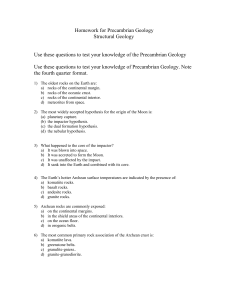
2 Precambrian Geology Homework a
... 14) The largest belt of folded rocks indicating Proterozoic continental collisions is called the: a) Grenville Orogen. b) Trans-Hudson Orogen.. c) Mazatal Orogen. d) Wopmay Orogen 15) The last major Proterozoic collision before assembly of Rodinia is recorded by rocks in the: a) Grenville Orogen.. ...
... 14) The largest belt of folded rocks indicating Proterozoic continental collisions is called the: a) Grenville Orogen. b) Trans-Hudson Orogen.. c) Mazatal Orogen. d) Wopmay Orogen 15) The last major Proterozoic collision before assembly of Rodinia is recorded by rocks in the: a) Grenville Orogen.. ...

Notes: Sediments and Sedimentary Rocks
... 3. Salt Wedging: As water fills joints and evaporates away it leaves behind salt grains. Over enough time the salt can build up to the point where it fills the joint and stars to force it to open more. 4. Thermal Expansion: When the heat of an intense forest fire bakes a rock, the outer layer of the ...
... 3. Salt Wedging: As water fills joints and evaporates away it leaves behind salt grains. Over enough time the salt can build up to the point where it fills the joint and stars to force it to open more. 4. Thermal Expansion: When the heat of an intense forest fire bakes a rock, the outer layer of the ...

Types of Rocks - Sikkimsprings
... Sedimentary rocks: Rocks formed from the weathering, erosion and deposition & compaction of rock material through agents like wind, water, ice and chemical precipitation. ...
... Sedimentary rocks: Rocks formed from the weathering, erosion and deposition & compaction of rock material through agents like wind, water, ice and chemical precipitation. ...

Coastal Map Reading
... Durdle Door (arch) and Lulworth Cove (bay) – two major landscape features of the Dorset coastline. What other erosion features can you see? ...
... Durdle Door (arch) and Lulworth Cove (bay) – two major landscape features of the Dorset coastline. What other erosion features can you see? ...


Sedimentary Rocks
... Chemical sedimentary rocks forms when dissolved minerals precipitate from water solutions The precipitation generally occurs when water ...
... Chemical sedimentary rocks forms when dissolved minerals precipitate from water solutions The precipitation generally occurs when water ...

Unit 2 Chapter 6 - McGann
... 2. Cross-beds and Graded Beds Cross bedding - bedding layers formed near or on sand dunes or river delta's - not flat but slanted Graded Beds - different types of materials deposited within a layer 3. Ripple Marks Caused when wind or water left a mark on the sandy surface and hardened. 4. Mud Cracks ...
... 2. Cross-beds and Graded Beds Cross bedding - bedding layers formed near or on sand dunes or river delta's - not flat but slanted Graded Beds - different types of materials deposited within a layer 3. Ripple Marks Caused when wind or water left a mark on the sandy surface and hardened. 4. Mud Cracks ...

Rocks, Part II: the rock "cycle"
... have to go through the temperatures at which any sedimentary rock would be metamorphosed. Thus there's no upper inside loop in the diagram – but that's the only track that's missing. ...
... have to go through the temperatures at which any sedimentary rock would be metamorphosed. Thus there's no upper inside loop in the diagram – but that's the only track that's missing. ...

Unit 4 Chapter 10
... together and have since moved away from each other. According to Wegener, the super continent started breaking up about 200 million years ago. ...
... together and have since moved away from each other. According to Wegener, the super continent started breaking up about 200 million years ago. ...

Geologic Principles and Relative Dating
... Geologic Principles and Relative Dating 1. How old is the Earth? a. ________________________________________________________ b. Much of its history is recorded in the rock. c. Observations of fossils, rock types, evidence of faulting, uplifts and folding as well as __________________________________ ...
... Geologic Principles and Relative Dating 1. How old is the Earth? a. ________________________________________________________ b. Much of its history is recorded in the rock. c. Observations of fossils, rock types, evidence of faulting, uplifts and folding as well as __________________________________ ...

Slide 1
... During the last ice-age, water was held back from re-entering the oceans as it remained frozen on the land. This eustatic fall in sea level resulted in a drop of between 100- 150 metres compared to present sea level. At the same time, the great weight of ice that accumulated (many kilometres thick i ...
... During the last ice-age, water was held back from re-entering the oceans as it remained frozen on the land. This eustatic fall in sea level resulted in a drop of between 100- 150 metres compared to present sea level. At the same time, the great weight of ice that accumulated (many kilometres thick i ...

(with Death Valley) Geoscience 10: Geology of The National Parks
... to break. The breaks often slant down, and one side slides down along the other, making an earthquake fault; ...
... to break. The breaks often slant down, and one side slides down along the other, making an earthquake fault; ...

Rocks and Minerals Prep
... The scale ranking minerals from softest to hardest is called? Hard Rock ratings Durability scale ...
... The scale ranking minerals from softest to hardest is called? Hard Rock ratings Durability scale ...

Document
... E. an age range 14. In the field, a geologist notices igneous rock below parallel sedimentary layers. The igneous rock has pieces of limestone from the first sedimentary layer contained within it. What can be said about the age of the limestone? A. The limestone was deposited simultaneous as the emp ...
... E. an age range 14. In the field, a geologist notices igneous rock below parallel sedimentary layers. The igneous rock has pieces of limestone from the first sedimentary layer contained within it. What can be said about the age of the limestone? A. The limestone was deposited simultaneous as the emp ...

File
... The earth's surface is constantly being eroded. This means that rocks are broken up into smaller pieces by weathering agents such as wind, water, and ice. These small pieces of rock turn into pebbles, gravel, sand, and clay. They tumble down rivers and streams. These pieces settle in a new place and ...
... The earth's surface is constantly being eroded. This means that rocks are broken up into smaller pieces by weathering agents such as wind, water, and ice. These small pieces of rock turn into pebbles, gravel, sand, and clay. They tumble down rivers and streams. These pieces settle in a new place and ...

First Hour Exam, Fall, 1998
... 8. The classification of all rocks into three major groups is based on their a. mode of origin c. silica content b. mineral composition d. relative densities 9. How readily a magma will flow, how a volcano will erupt, and the ultimate shape of the volcano, are ALL a result of all of the following fa ...
... 8. The classification of all rocks into three major groups is based on their a. mode of origin c. silica content b. mineral composition d. relative densities 9. How readily a magma will flow, how a volcano will erupt, and the ultimate shape of the volcano, are ALL a result of all of the following fa ...

Diapositiva 1
... After compaction and cementation the sedimentary sequence has changed into a sedimentary rock. Sedimentary rocks like sandstone, shale and limestone differ from other rocks in that they: 1. Are formed from layers of sediment built up over many years. ...
... After compaction and cementation the sedimentary sequence has changed into a sedimentary rock. Sedimentary rocks like sandstone, shale and limestone differ from other rocks in that they: 1. Are formed from layers of sediment built up over many years. ...

3.3 * Classifying Rocks
... Rock-forming minerals are the approximately 20 minerals that make up most of the rocks of Earth’s crust. Color alone is not enough to classify a rock. Silica Level High ...
... Rock-forming minerals are the approximately 20 minerals that make up most of the rocks of Earth’s crust. Color alone is not enough to classify a rock. Silica Level High ...

REGIONAL GEOLOGY AND MINERALIZATION
... characterized by extensive folding. Tectonic events caused areas to be folded, faulted, metamorphosed and subjected to igneous activity, sedimentary and erosion processes, resulting in a series of gold belts. The lavas are primarily of basaltic composition with the presence of andesitic, dacitic and ...
... characterized by extensive folding. Tectonic events caused areas to be folded, faulted, metamorphosed and subjected to igneous activity, sedimentary and erosion processes, resulting in a series of gold belts. The lavas are primarily of basaltic composition with the presence of andesitic, dacitic and ...
Geology of Great Britain

The geology of Great Britain is renowned for its diversity. As a result of its eventful geological history, Great Britain shows a rich variety of landscapes across the constituent countries of England, Wales and Scotland. Rocks of almost all geological ages are represented at outcrop, from the Archaean onwards.