
ROCKS notes - St. Raymond High School for Boys
... Particles will become rounded & smooth as they bang & rub against each other= abrasion The > the distance traveled, the smoother & rounder the particles become The > the velocity of a stream, the > the particles they can transport 3. Deposition of Sediment occurs when a stream slows down… a) Enters ...
... Particles will become rounded & smooth as they bang & rub against each other= abrasion The > the distance traveled, the smoother & rounder the particles become The > the velocity of a stream, the > the particles they can transport 3. Deposition of Sediment occurs when a stream slows down… a) Enters ...

Rocks and Minerals 3 Sedimentary
... remains of once living organisms. • Coal is formed from the compression of dead plants. • Limestone is formed from the remaining shells of dead sea-life. ...
... remains of once living organisms. • Coal is formed from the compression of dead plants. • Limestone is formed from the remaining shells of dead sea-life. ...

File - Vagabond Geology
... But first a word about the earth’s crust Oceanic Crust: Under all of the deep seas About 5 miles thick Continental Crust: Comprises all continents About 20 to 50 miles thick ...
... But first a word about the earth’s crust Oceanic Crust: Under all of the deep seas About 5 miles thick Continental Crust: Comprises all continents About 20 to 50 miles thick ...

A Little Geology Lesson - Department of Earth Sciences
... chemical abundance and the rate of cooling of magma typically forms a sequence known as Bowen's reaction series, after the Canadian petrologist Norman L. Bowen. Most major igneous rocks are found along this scale. About 64.7% of the Earth's crust by volume consists of igneous rocks; making it the mo ...
... chemical abundance and the rate of cooling of magma typically forms a sequence known as Bowen's reaction series, after the Canadian petrologist Norman L. Bowen. Most major igneous rocks are found along this scale. About 64.7% of the Earth's crust by volume consists of igneous rocks; making it the mo ...

sundown area - Geological Society of Australia
... more massive nature of the granite meant that erosion could only occur by chemical weathering ...
... more massive nature of the granite meant that erosion could only occur by chemical weathering ...

Abstract
... peninsula of Michigan, is one of the world’s most prolific base metal provinces. It is host to a large number of volcanogenic massive sulfide (VMS) deposits and prospects, including the world-class Crandon deposit that comprises an estimated 65.8 million metric tons of polymetallic massive sulfide o ...
... peninsula of Michigan, is one of the world’s most prolific base metal provinces. It is host to a large number of volcanogenic massive sulfide (VMS) deposits and prospects, including the world-class Crandon deposit that comprises an estimated 65.8 million metric tons of polymetallic massive sulfide o ...

Marine Sediments - Rudy Marmolejo`s E
... found around margins of the continents, where it is constantly moved by high-energy currents along the shoreline and in deeper turbidity currents. ...
... found around margins of the continents, where it is constantly moved by high-energy currents along the shoreline and in deeper turbidity currents. ...

Geology of Tarnagulla area
... slipped down under the Gondwanaland continent. As it did so, the softer layers of sediment which were around 12 to 15 km thick and on top of hard layers of basalt, were jammed up against the hard Gondwanaland continent and started to crumple. Think of them as being like layers of wet paper on top of ...
... slipped down under the Gondwanaland continent. As it did so, the softer layers of sediment which were around 12 to 15 km thick and on top of hard layers of basalt, were jammed up against the hard Gondwanaland continent and started to crumple. Think of them as being like layers of wet paper on top of ...
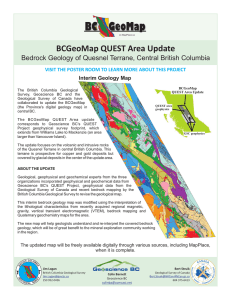
BCGeoMap QUEST Area Update
... Geological Survey of Canada and recent bedrock mapping by the British Columbia Geological Survey to revise the geological map. This interim bedrock geology map was modified using the interpretation of the lithological characteristics from recently acquired regional magnetic, gravity, vertical transi ...
... Geological Survey of Canada and recent bedrock mapping by the British Columbia Geological Survey to revise the geological map. This interim bedrock geology map was modified using the interpretation of the lithological characteristics from recently acquired regional magnetic, gravity, vertical transi ...

GEOLOGY
... ANS: Paleozoic Era spans from around 541 to 252 million years ago and is the longest of the Phanerozoic areas. This era experienced some dramatic and drastic changes on geological, climatic and evolutionary fronts. Modern phyla first appeared during this era and there was the evolution of fish, arth ...
... ANS: Paleozoic Era spans from around 541 to 252 million years ago and is the longest of the Phanerozoic areas. This era experienced some dramatic and drastic changes on geological, climatic and evolutionary fronts. Modern phyla first appeared during this era and there was the evolution of fish, arth ...


Stratigraphic Principles
... is loose, unconsolidated (not cemented together into a solid rock), soil or sediments, eroded, deposited, and reshaped by water in some form in a non-marine setting. ...
... is loose, unconsolidated (not cemented together into a solid rock), soil or sediments, eroded, deposited, and reshaped by water in some form in a non-marine setting. ...

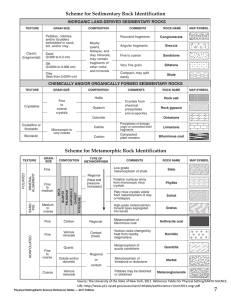
“changed rocks” – can form from: sedimentary, igneous or other
... Degrees of Metamorphism: * shows in rock’s texture or mineral make-up Low grade: subjected to relatively mild heat or pressure often hard to distinguish from original rock i.e. shale (igneous) → slate (meta.) ...
... Degrees of Metamorphism: * shows in rock’s texture or mineral make-up Low grade: subjected to relatively mild heat or pressure often hard to distinguish from original rock i.e. shale (igneous) → slate (meta.) ...

Earth Science Chapter 21: Fossils and the Rock Record Chapter
... the past existence of a wide variety of life forms, most of which have become extinct. The fossil record also provides evidence that populations have undergone change throughout time in response to changes in their environment. This change in populations as a result of environmental change is called ...
... the past existence of a wide variety of life forms, most of which have become extinct. The fossil record also provides evidence that populations have undergone change throughout time in response to changes in their environment. This change in populations as a result of environmental change is called ...

Practice20m
... 16) All of the following are mechanisms for growth of Archean continents EXCEPT: a) collision of large continents.. b) accretion of terranes to the continental margins. c) intermediate and felsic magmas intruded the edges of miniature plates. d) oceanic sediments welded to the continental margin by ...
... 16) All of the following are mechanisms for growth of Archean continents EXCEPT: a) collision of large continents.. b) accretion of terranes to the continental margins. c) intermediate and felsic magmas intruded the edges of miniature plates. d) oceanic sediments welded to the continental margin by ...

PDF
... The sedimentary rocks are those formed by the accumulation of materials or particles, by chemical precipitation or by the growth of organisms, subaerial, under sea or lake-water conditions: the sediments. Generally these are deposited in horizontal layers: the strata. As they are buried, the sedimen ...
... The sedimentary rocks are those formed by the accumulation of materials or particles, by chemical precipitation or by the growth of organisms, subaerial, under sea or lake-water conditions: the sediments. Generally these are deposited in horizontal layers: the strata. As they are buried, the sedimen ...

11NESRT Mapping Lab
... 3. Will the North Star be higher in the sky when viewed from Riverhead or Old Forge? Explain. ______________________________________________________________________________________ 4. In which city would Polaris appear at an altitude of 42 degrees? _________________________________ 5. At approximate ...
... 3. Will the North Star be higher in the sky when viewed from Riverhead or Old Forge? Explain. ______________________________________________________________________________________ 4. In which city would Polaris appear at an altitude of 42 degrees? _________________________________ 5. At approximate ...

Part A KEY - Belmont Secondary Home Page
... as 18 million years old. How should we interpret this age? A. It represents the time that the clasts of the conglomerate accumulated at the surface. B. It represents the time that the clasts of the conglomerate were lithified (stuck together) beneath the surface. C. It represents the time at which t ...
... as 18 million years old. How should we interpret this age? A. It represents the time that the clasts of the conglomerate accumulated at the surface. B. It represents the time that the clasts of the conglomerate were lithified (stuck together) beneath the surface. C. It represents the time at which t ...

Plate Tectonics and Continental Drift
... 2. What is the evidence that Continents move? 3. What are the forces that drive plate tectonics? 4. What happens at the boundaries between plates? 5. How do the different types of plate boundaries impact the regional geology and geomorphology? 6. How has continental drift affected the positions of t ...
... 2. What is the evidence that Continents move? 3. What are the forces that drive plate tectonics? 4. What happens at the boundaries between plates? 5. How do the different types of plate boundaries impact the regional geology and geomorphology? 6. How has continental drift affected the positions of t ...

ROCKS and how to identify them
... identified by its sandy texture – which often translates into a gritty feel. Environments in which sandstones form include beaches, sand bars, deltas and dunes. ...
... identified by its sandy texture – which often translates into a gritty feel. Environments in which sandstones form include beaches, sand bars, deltas and dunes. ...
- Torquay Museum
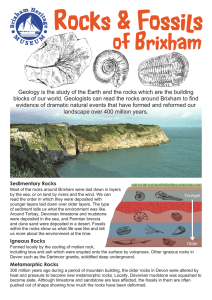
... Most of the rocks around Brixham date from the Devonian Period. They are sedimentary rocks laid down in the sea at a time when Devon lay on the coast of Euramerica, an ancient continent which lay in the tropics just south of the equator. At this time life in the seas included corals, brachiopods (la ...
... Most of the rocks around Brixham date from the Devonian Period. They are sedimentary rocks laid down in the sea at a time when Devon lay on the coast of Euramerica, an ancient continent which lay in the tropics just south of the equator. At this time life in the seas included corals, brachiopods (la ...
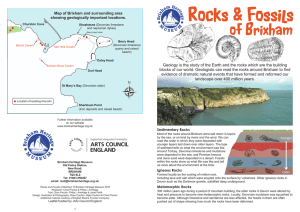
- Torquay Museum
... There are no rocks left in the landscape around Brixham from the time between the end of the Permian and the Quaternary Periods. To work out what happened during this time geologists have to look at places nearby, where rocks from these ages are preserved. Desert conditions continued into the Triass ...
... There are no rocks left in the landscape around Brixham from the time between the end of the Permian and the Quaternary Periods. To work out what happened during this time geologists have to look at places nearby, where rocks from these ages are preserved. Desert conditions continued into the Triass ...

the geology of the moon
... The Apollo astronauts brought back 381.69kg of rock and soil samples referred to as regolith. Regolith is the geological term for loose, solid material that covers the bedrock of a planet type body; in this case the Moon. The original 2,196 samples collected have now been separated into 35,600 sampl ...
... The Apollo astronauts brought back 381.69kg of rock and soil samples referred to as regolith. Regolith is the geological term for loose, solid material that covers the bedrock of a planet type body; in this case the Moon. The original 2,196 samples collected have now been separated into 35,600 sampl ...

Formation of metamorphic rocks in Ireland | sample answer
... The first type of metamorphism is Thermal metamorphism, this is when rocks are changed as a result of great heat, a common place to see this is around volcanic eruptions. The Sugar Loaf mountain found in Wicklow, Ireland is comprised of the metamorphic rock called quartzite, quartzite was formed by ...
... The first type of metamorphism is Thermal metamorphism, this is when rocks are changed as a result of great heat, a common place to see this is around volcanic eruptions. The Sugar Loaf mountain found in Wicklow, Ireland is comprised of the metamorphic rock called quartzite, quartzite was formed by ...
Geology of Great Britain

The geology of Great Britain is renowned for its diversity. As a result of its eventful geological history, Great Britain shows a rich variety of landscapes across the constituent countries of England, Wales and Scotland. Rocks of almost all geological ages are represented at outcrop, from the Archaean onwards.