


view the Lecture Presentation
... marine – Fines predominate far from land sources. Skeletons of planktonic organisms make chalk or chert. Fine silts and clays turn to shale. ...
... marine – Fines predominate far from land sources. Skeletons of planktonic organisms make chalk or chert. Fine silts and clays turn to shale. ...

continental-drift-and-the-theory-of-plate-tectonics-fran-et-al
... The size of the earth was much smaller than it is today and so all continents were together as a single huge land mass (called Pangea) then and as earth continued grow in size all these continents looked like as if they are moving apart whereas they actually have just reached their current positions ...
... The size of the earth was much smaller than it is today and so all continents were together as a single huge land mass (called Pangea) then and as earth continued grow in size all these continents looked like as if they are moving apart whereas they actually have just reached their current positions ...

جمهورية العراق وزارة الصناعة والمعادن ا
... used in ceramic industry. Experimental testing proved that these Kaolinitic claystones may be used to produce alumina by the lime- sinter process. Flint – clay: These are associated with bauxite deposits and the reserves are about 10 m.t. , mainly used in white cement industry. ...
... used in ceramic industry. Experimental testing proved that these Kaolinitic claystones may be used to produce alumina by the lime- sinter process. Flint – clay: These are associated with bauxite deposits and the reserves are about 10 m.t. , mainly used in white cement industry. ...

Sedimentary Rocks
... include geodes (top left), ripple marks (center left), concretions (bottom left), fossils (top right), and mud cracks (bottom right). ...
... include geodes (top left), ripple marks (center left), concretions (bottom left), fossils (top right), and mud cracks (bottom right). ...

Chapter 3 - Government of New Brunswick
... For another several hundred million years, the plates skimmed the globe, driven by intense heat and convection currents beneath earth’s crust. Their movements resembled a very slow geological dance in which the plates repeatedly drifted apart and then collided with each other over time. The boundari ...
... For another several hundred million years, the plates skimmed the globe, driven by intense heat and convection currents beneath earth’s crust. Their movements resembled a very slow geological dance in which the plates repeatedly drifted apart and then collided with each other over time. The boundari ...

Unconformity-Associated U - Ministry of Energy and Mines
... close to basement granitic rocks with a high U clarke. GENETIC ...
... close to basement granitic rocks with a high U clarke. GENETIC ...
KCSE ONLINE GEOGRAPHY PP1 MARKING SCHEME SECTION A
... process by which wind eddies scoop out loose,dry unconsoladated materials like dust, fine sand particles fro the desert surface. the materials are scooped and lifted up in air ii) attrition the materials which are airborne constantly knock against each other and collide thereby gradually reducing in ...
... process by which wind eddies scoop out loose,dry unconsoladated materials like dust, fine sand particles fro the desert surface. the materials are scooped and lifted up in air ii) attrition the materials which are airborne constantly knock against each other and collide thereby gradually reducing in ...

Rocks and Minerals (rocksandminerals)
... 6. When limestone is exposed to enough heat and pressure, it goes through physical changes. These changes can turn limestone into a different kind of rock called marble. Which of these BEST describes marble? A. It is an igneous rock. B. It is a synthetic rock. C. It is a sedimentary rock. D. It is a ...
... 6. When limestone is exposed to enough heat and pressure, it goes through physical changes. These changes can turn limestone into a different kind of rock called marble. Which of these BEST describes marble? A. It is an igneous rock. B. It is a synthetic rock. C. It is a sedimentary rock. D. It is a ...

Unit E section-1.0-1.3
... Note: What makes up the crust - - covered with vegetation, fresh and saltwater areas, BUT these only form a thick layer most of the crust is made up of solid rock ...
... Note: What makes up the crust - - covered with vegetation, fresh and saltwater areas, BUT these only form a thick layer most of the crust is made up of solid rock ...
Nugget
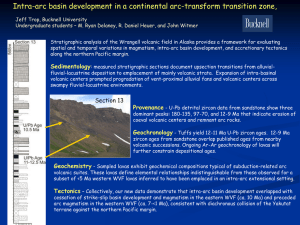
... dominant peaks: 180-135, 97-70, and 12-9 Ma that indicate erosion of coeval volcanic centers and remnant arc rocks. ...
... dominant peaks: 180-135, 97-70, and 12-9 Ma that indicate erosion of coeval volcanic centers and remnant arc rocks. ...

Carbonate rocks
... • Rarely in areas where there is a significant input of terrigenous material • Mostly at depths of less than a few tens of metres, but in some cases in deeper water (up to 4000 m max.) ...
... • Rarely in areas where there is a significant input of terrigenous material • Mostly at depths of less than a few tens of metres, but in some cases in deeper water (up to 4000 m max.) ...

Earth Science Reference Tables
... CAMBRIAN and EARLY ORDOVICIAN sandstones and dolostones Moderately to intensely metamorphosed east of the Hudson River. CAMBRIAN and ORDOVICIAN (undifferentiated) quartzites, dolostones, marbles, and schists Intensely metamorphosed; includes portions of the Taconic Sequence and Cortlandt Complex. TA ...
... CAMBRIAN and EARLY ORDOVICIAN sandstones and dolostones Moderately to intensely metamorphosed east of the Hudson River. CAMBRIAN and ORDOVICIAN (undifferentiated) quartzites, dolostones, marbles, and schists Intensely metamorphosed; includes portions of the Taconic Sequence and Cortlandt Complex. TA ...

UNIT 2 INTERNAL ENERGY AND LANSFORMS The movement of
... the continental collision orogens, volcanoes are hardly created, seismic activity covers a wide area and deformation and metamorphism of rocks is greater. 1) The continents begin to collide 2) The orogen begins to form and subduction stops. 3) The orogen takes on a definite structure and, with erosi ...
... the continental collision orogens, volcanoes are hardly created, seismic activity covers a wide area and deformation and metamorphism of rocks is greater. 1) The continents begin to collide 2) The orogen begins to form and subduction stops. 3) The orogen takes on a definite structure and, with erosi ...

sedimentary2
... Bituminous coal Anthracite (a metamorphic rock) http://geoinfo.nmt.edu/education/litegeology/images/coal.gif ...
... Bituminous coal Anthracite (a metamorphic rock) http://geoinfo.nmt.edu/education/litegeology/images/coal.gif ...
Chap-4-Sec-2-Evidence-Supporting-Continental
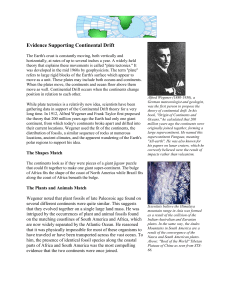
... refers to large rigid blocks of the Earth's surface which appear to move as a unit. These plates may include both oceans and continents. When the plates move, the continents and ocean floor above them move as well. Continential Drift occurs when the continents change position in relation to each oth ...
... refers to large rigid blocks of the Earth's surface which appear to move as a unit. These plates may include both oceans and continents. When the plates move, the continents and ocean floor above them move as well. Continential Drift occurs when the continents change position in relation to each oth ...

meet some rocks and minerals
... thousands of years! Slow cooling can give individual atoms time to “line up” and form definite patterns called crystalline structures. This allows large, beautiful crystals to form. Granite is an example of a rock with large crystals that grew slowly because of slow, steady cooling. When molten rock ...
... thousands of years! Slow cooling can give individual atoms time to “line up” and form definite patterns called crystalline structures. This allows large, beautiful crystals to form. Granite is an example of a rock with large crystals that grew slowly because of slow, steady cooling. When molten rock ...

Types of Rocks
... Metamorphic rocks are formed under the surface of the earth from the metamorphosis (change) that occurs due to intense heat and pressure (squeezing). The rocks that result from these processes often have ribbonlike layers and may have shiny crystals, formed by minerals growing slowly over time, on t ...
... Metamorphic rocks are formed under the surface of the earth from the metamorphosis (change) that occurs due to intense heat and pressure (squeezing). The rocks that result from these processes often have ribbonlike layers and may have shiny crystals, formed by minerals growing slowly over time, on t ...


MCQ - tcspgnn
... Which is TRUE about igneous rocks? [8h-39] ? fast cooling of lava makes small crystal grains ? formed from the effects of heat and pressure on metamorphic rocks ? soft and readily weathered ? fast cooling of lava underground makes pumice stone ...
... Which is TRUE about igneous rocks? [8h-39] ? fast cooling of lava makes small crystal grains ? formed from the effects of heat and pressure on metamorphic rocks ? soft and readily weathered ? fast cooling of lava underground makes pumice stone ...

The Rock Cycle - Union Academy
... sedimentary rocks can change into metamorphic rocks, and a metamorphic rock can change into another type of metamorphic rock. Heat and pressure do not change the chemical makeup of the parent rocks but they do change the mineral structure and physical properties of those rocks. ...
... sedimentary rocks can change into metamorphic rocks, and a metamorphic rock can change into another type of metamorphic rock. Heat and pressure do not change the chemical makeup of the parent rocks but they do change the mineral structure and physical properties of those rocks. ...

Homework 1 Due: 4/20/07 RELATIVE DATING
... rocks (flat-lying). This type of unconformity implies: 1) formation of the older igneous or metamorphic rocks, 2) uplift and erosion to create a flat surface across these igneous/metamorphic rocks, and 3) deposition of younger sediments (usually accompanied by subsidence). Disconformity: Older sedim ...
... rocks (flat-lying). This type of unconformity implies: 1) formation of the older igneous or metamorphic rocks, 2) uplift and erosion to create a flat surface across these igneous/metamorphic rocks, and 3) deposition of younger sediments (usually accompanied by subsidence). Disconformity: Older sedim ...

PowerPoint
... • 7. How does the transport of sediments (weathering products) by wind and water result in the different sedimentary rocks having different compositions? ...
... • 7. How does the transport of sediments (weathering products) by wind and water result in the different sedimentary rocks having different compositions? ...
Geology of Great Britain

The geology of Great Britain is renowned for its diversity. As a result of its eventful geological history, Great Britain shows a rich variety of landscapes across the constituent countries of England, Wales and Scotland. Rocks of almost all geological ages are represented at outcrop, from the Archaean onwards.