

The Geology of Grahamstown: the Regional Setting
... These rocks rest directly on top of the upper Witteberg shales, and consist of boulders, cobbles and pebbles of a variety of older rocks in a very-fine-grained bluegrey matrix. The rock is a “lithic boulder-clay”, and is referred to as the Dwyka Tillite. It was deposited by glaciers (see Figure 5) d ...
... These rocks rest directly on top of the upper Witteberg shales, and consist of boulders, cobbles and pebbles of a variety of older rocks in a very-fine-grained bluegrey matrix. The rock is a “lithic boulder-clay”, and is referred to as the Dwyka Tillite. It was deposited by glaciers (see Figure 5) d ...

WEATHERING AND SEDIMENTARY ROCKS
... minerals. Often tends to split into flat sheets due to the mica-like cleavage of clay minerals. 2. Nonclastic (chemical) - Grains are interlocked through crystallization. Has igneous appearing texture with very little open space. Limestone - Formed by the precipitation of calcite from seawater. Most ...
... minerals. Often tends to split into flat sheets due to the mica-like cleavage of clay minerals. 2. Nonclastic (chemical) - Grains are interlocked through crystallization. Has igneous appearing texture with very little open space. Limestone - Formed by the precipitation of calcite from seawater. Most ...

Chapter 3 The Origin of Ocean Basins LEARNING OBJECTIVES 1
... 1. Currently, the Pacific Ocean basin is shrinking as other ocean basins expand. 2. Destruction of sea floor occurs in subduction zones. 3. Seismicity is the frequency, magnitude, and distribution of earthquakes. - Earthquakes are concentrated along oceanic ridges, transform faults, trenches and isl ...
... 1. Currently, the Pacific Ocean basin is shrinking as other ocean basins expand. 2. Destruction of sea floor occurs in subduction zones. 3. Seismicity is the frequency, magnitude, and distribution of earthquakes. - Earthquakes are concentrated along oceanic ridges, transform faults, trenches and isl ...

Early Paleozoic Geology 1.
... TIPPECANOE in Ordovician/Silurian time. OROGENIES Mostly resulting from plate convergence and continentcontinent collisions. Mountain chains were constructed along craton margins, consisting of uplifted, folded, metamorphosed marine and terrestrial deposits - often accompanied by intrusive and extru ...
... TIPPECANOE in Ordovician/Silurian time. OROGENIES Mostly resulting from plate convergence and continentcontinent collisions. Mountain chains were constructed along craton margins, consisting of uplifted, folded, metamorphosed marine and terrestrial deposits - often accompanied by intrusive and extru ...


Y10 Earthquakes - Learning on the Loop
... Sedimentary – formed from eroded sediments off other rocks that are washed down into river, lakes and oceans, deposited on the sea floor. Pressure and chemicals cement them ...
... Sedimentary – formed from eroded sediments off other rocks that are washed down into river, lakes and oceans, deposited on the sea floor. Pressure and chemicals cement them ...

Chapter 6 - Sedimentary Rock
... • Windblown dunes are typically composed – of well-sorted, well-rounded sand – with cross-beds meters to tens of meters high – land-dwelling plants and animals make up any ...
... • Windblown dunes are typically composed – of well-sorted, well-rounded sand – with cross-beds meters to tens of meters high – land-dwelling plants and animals make up any ...
PwrPt - University of Minnesota Duluth
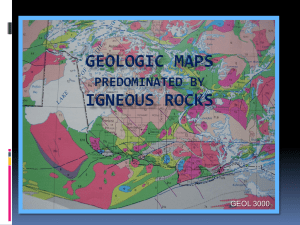
... Map Attributes of Volcanic and Volcaniclastic Rocks Volcanic Rocks- crystallized from lava flows Volcaniclastic Rocks – air-fall accumulations of lava, ash and preexisting volcanic rock ; Rock types: tuff, lahar, agglomerates) ...
... Map Attributes of Volcanic and Volcaniclastic Rocks Volcanic Rocks- crystallized from lava flows Volcaniclastic Rocks – air-fall accumulations of lava, ash and preexisting volcanic rock ; Rock types: tuff, lahar, agglomerates) ...

Unit 4: The Rock Cycle - Ann Arbor Earth Science
... Descriptions and identifications of metamorphic rocks are often based on the parent rock, mineral content, and texture. Foliation – the tendency of a rock to form bands of minerals or split along parallel layers (also used to identify and classify metamorphic rocks). Example: gneiss Nonfoliated rock ...
... Descriptions and identifications of metamorphic rocks are often based on the parent rock, mineral content, and texture. Foliation – the tendency of a rock to form bands of minerals or split along parallel layers (also used to identify and classify metamorphic rocks). Example: gneiss Nonfoliated rock ...

PRÁCTICA CON PREGUNTAS GEOLOGÍA Read the text below and
... An igneous rock is any of various crystalline or glassy rocks formed by the cooling and solidification of molten earth material. Igneous rocks comprise one of the three principal classes of rocks, the others being metamorphic and sedimentary. Igneous rocks are formed from the solidification of magma ...
... An igneous rock is any of various crystalline or glassy rocks formed by the cooling and solidification of molten earth material. Igneous rocks comprise one of the three principal classes of rocks, the others being metamorphic and sedimentary. Igneous rocks are formed from the solidification of magma ...

Vocabulary Chapter 14
... The impact did not kill all species, but with the extreme global climate change only species that could adjust to the change survived including avian and reptilian descendents, many marine invertebrates, and numerous plant species ...
... The impact did not kill all species, but with the extreme global climate change only species that could adjust to the change survived including avian and reptilian descendents, many marine invertebrates, and numerous plant species ...

Bowdoinham 25 Quad Sidebar - 2006
... present. These strongly deformed rocks must have intruded before the main phase of metamorphism. During metamorphism, high temperatures caused partial melting of some rocks, producing granite layers within other rocks throughout the quadrangle (Photo 1, for example). After the main metamorphism, bod ...
... present. These strongly deformed rocks must have intruded before the main phase of metamorphism. During metamorphism, high temperatures caused partial melting of some rocks, producing granite layers within other rocks throughout the quadrangle (Photo 1, for example). After the main metamorphism, bod ...

Modeling the Rock Cycle - Science
... Modeling the Rock Cycle Problem: To model the changes that occur during the tock cycle. Background information: the term 'rock cycle' refers to the constant recycling of material in the crust Z Mountains are worn down by weathering and erosion, and the pieces of eroded rock may eventually be deposit ...
... Modeling the Rock Cycle Problem: To model the changes that occur during the tock cycle. Background information: the term 'rock cycle' refers to the constant recycling of material in the crust Z Mountains are worn down by weathering and erosion, and the pieces of eroded rock may eventually be deposit ...

geology of corridor h - Geological Society of Washington
... initiating a growing chain of volcanic islands. As subduction consumed the oceanic crust on the fringe of the North American plate, the volcanic island arc got closer and closer to the future Mid-Atlantic region. This volcanic archipelago collided with the edge of the ancestral North American contin ...
... initiating a growing chain of volcanic islands. As subduction consumed the oceanic crust on the fringe of the North American plate, the volcanic island arc got closer and closer to the future Mid-Atlantic region. This volcanic archipelago collided with the edge of the ancestral North American contin ...

01 - Katie O`Ryan
... 1.Which kind of rock is formed from weathering, erosion, deposition, compaction, and cementation (WEDCC)? a. metamorphic b. metasedimentary c. sedimentary d. igneous ORIGINS OF SEDIMENTARY ROCK ...
... 1.Which kind of rock is formed from weathering, erosion, deposition, compaction, and cementation (WEDCC)? a. metamorphic b. metasedimentary c. sedimentary d. igneous ORIGINS OF SEDIMENTARY ROCK ...

GeologicTimePPT
... the processes that act on the Earth’s surface today are the same as the processes that have acted on the Earth’s surface in the past ...
... the processes that act on the Earth’s surface today are the same as the processes that have acted on the Earth’s surface in the past ...

Overheads for background on mantle minerals
... (calcium carbonate) and dolomite (calcium-magnesium carbonate) • As low pressure minerals are squeezed, they may suddenly transform to a denser high-pressure phase. ...
... (calcium carbonate) and dolomite (calcium-magnesium carbonate) • As low pressure minerals are squeezed, they may suddenly transform to a denser high-pressure phase. ...

The Paleozoic World
... • Sugar forms cellulose or wood: C6H10O5 + H2O • Wood changes to peat, lignite, bituminous coal, and anthracite under heat and pressure: C6 + 5H2O • Anthracite is almost pure carbon ...
... • Sugar forms cellulose or wood: C6H10O5 + H2O • Wood changes to peat, lignite, bituminous coal, and anthracite under heat and pressure: C6 + 5H2O • Anthracite is almost pure carbon ...

The Rock Cycle - PAMS
... 3. Volcanic igneous rocks: formed from molten rock that cooled quickly on or near the earth's surface. 4. Plutonic igneous rocks: are the result of the slow cooling of molten rock far beneath the surface of the earth. ...
... 3. Volcanic igneous rocks: formed from molten rock that cooled quickly on or near the earth's surface. 4. Plutonic igneous rocks: are the result of the slow cooling of molten rock far beneath the surface of the earth. ...
Geology of Dubbo - Dubbo Field Nats Home
... deeper water. Rocks of this episode are exposed in a strip 20 km long, running north from Wellington and lying between Maryvale and Bodangora. The rocks are mostly andesite and andesite breccia with some conglomerate and fine-grained shale. Occasional limestone lenses are evidence of algal and coral ...
... deeper water. Rocks of this episode are exposed in a strip 20 km long, running north from Wellington and lying between Maryvale and Bodangora. The rocks are mostly andesite and andesite breccia with some conglomerate and fine-grained shale. Occasional limestone lenses are evidence of algal and coral ...
Marine Geology
... floors were dull expanses of mudfeatureless and flat. For centuries , naturalists also thought that the oldest rocks on Earth were on the ocean floors . They believed that the present-day ocean basins formed at the very beginning of the Earth 's history and throughout time they had slowly been filli ...
... floors were dull expanses of mudfeatureless and flat. For centuries , naturalists also thought that the oldest rocks on Earth were on the ocean floors . They believed that the present-day ocean basins formed at the very beginning of the Earth 's history and throughout time they had slowly been filli ...

Continental Drift
... • THEORY: A broad explanation for many observations, supported by a large body of evidence • A theory is NOT a “guess” or “hunch”!! ...
... • THEORY: A broad explanation for many observations, supported by a large body of evidence • A theory is NOT a “guess” or “hunch”!! ...

importance of sedimentary rock
... Shales often contain fine laminations which helps impart fissility to the rock. Fissility is a term used to describe layered laminations formed by compression forces exerted over long-time periods. Shale usually contains about 50% silt, 35% clay, and 15% chemical materials, many shales may also cont ...
... Shales often contain fine laminations which helps impart fissility to the rock. Fissility is a term used to describe layered laminations formed by compression forces exerted over long-time periods. Shale usually contains about 50% silt, 35% clay, and 15% chemical materials, many shales may also cont ...

I. Destructive Forces Notes: A. Weathering: the breaking down of
... the rock-cycle by bringing rocks to the surface to form new landforms like islands. All of the Hawaiian Islands were created by volcanoes. There is even a new island forming right now. 4. Another example of a volcanoes' constructive force is that if there are enough eruptions or a constant lava flow ...
... the rock-cycle by bringing rocks to the surface to form new landforms like islands. All of the Hawaiian Islands were created by volcanoes. There is even a new island forming right now. 4. Another example of a volcanoes' constructive force is that if there are enough eruptions or a constant lava flow ...
Geology of Great Britain

The geology of Great Britain is renowned for its diversity. As a result of its eventful geological history, Great Britain shows a rich variety of landscapes across the constituent countries of England, Wales and Scotland. Rocks of almost all geological ages are represented at outcrop, from the Archaean onwards.