
Geology and Minerals
... hills. All these hills have a ‘tail’ to the east (lee) side forming a feature known as a ‘crag and tail’; the best examples being Edinburgh Castle and the Royal Mile and Blackford Hill. 12.18 The ice sheets left extensive areas of glacial debris called till or boulder clay, a mixture of tough clay, ...
... hills. All these hills have a ‘tail’ to the east (lee) side forming a feature known as a ‘crag and tail’; the best examples being Edinburgh Castle and the Royal Mile and Blackford Hill. 12.18 The ice sheets left extensive areas of glacial debris called till or boulder clay, a mixture of tough clay, ...

Earth Science Final Exam Study Guide
... 52. P-waves from a seismic event can be detected on the other side of the globe, but S-waves from the same disturbance cannot be detected on the other side of the globe. This indicates to geologists that. a. S-waves are slower than P-waves b. the continents are drifting apart c. the middle of Earth ...
... 52. P-waves from a seismic event can be detected on the other side of the globe, but S-waves from the same disturbance cannot be detected on the other side of the globe. This indicates to geologists that. a. S-waves are slower than P-waves b. the continents are drifting apart c. the middle of Earth ...

Geology Paper III
... and magnesium, c) silicon and aluminum, d) magnesiumand aluminum, e) magnesiumand silicon. ...
... and magnesium, c) silicon and aluminum, d) magnesiumand aluminum, e) magnesiumand silicon. ...

Bedrock Geology Glossary
... Basalt: A black or dark grey volcanic rock that consists mainly of microscopic crystals of plagioclase feldspar, pyroxene, and perhaps olivine. Diorite: A plutonic igneous rock intermediate in composition between granite and gabbro. Gabbro: A dark igneous rock consisting mainly of plagioclase and py ...
... Basalt: A black or dark grey volcanic rock that consists mainly of microscopic crystals of plagioclase feldspar, pyroxene, and perhaps olivine. Diorite: A plutonic igneous rock intermediate in composition between granite and gabbro. Gabbro: A dark igneous rock consisting mainly of plagioclase and py ...

The Rocks Cry Out
... Why did the early geologists conclude that … • The earth must be very old? (at least many millions of years) • The creation of life took place over many years? • The early earth had no (visible) life? • Life developed gradually and with increased complexity from its beginnings to the present? • Man ...
... Why did the early geologists conclude that … • The earth must be very old? (at least many millions of years) • The creation of life took place over many years? • The early earth had no (visible) life? • Life developed gradually and with increased complexity from its beginnings to the present? • Man ...

7.0 GEOLOGIC SETTING 7.1 Regional Geologic Setting 7.2
... information is available about these deposits. The UN development program also evaluated several iron ore and limestone deposits. At Belinga in northeast Gabon, a stratiform iron deposit contains several hundred million tonnes of 64 percent Fe, but with high phosphorus content (+0.1% P). This deposi ...
... information is available about these deposits. The UN development program also evaluated several iron ore and limestone deposits. At Belinga in northeast Gabon, a stratiform iron deposit contains several hundred million tonnes of 64 percent Fe, but with high phosphorus content (+0.1% P). This deposi ...

The Rock Cycle - Science A 2 Z
... Metamorphic rock is any rock that has been changed from its original condition by heat, pressure and the chemical activity of fluids, as in marble and slate. This change usually occurs under the Earth’s surface and when conditions are right, heat and pressure cause the mineral composition and/or te ...
... Metamorphic rock is any rock that has been changed from its original condition by heat, pressure and the chemical activity of fluids, as in marble and slate. This change usually occurs under the Earth’s surface and when conditions are right, heat and pressure cause the mineral composition and/or te ...

Chapter 5 Sediment and Sedimentary Rocks Transportation and
... Sediments, sedimentary rocks and the materials they contain have many uses. 1. Petroleum and Natural Gas are hydrocarbons formed from the remains of microscopic plants and animals. The organic matter has been preserved in sediments (the source rock) by rapid burial. With burial, heat and chemical re ...
... Sediments, sedimentary rocks and the materials they contain have many uses. 1. Petroleum and Natural Gas are hydrocarbons formed from the remains of microscopic plants and animals. The organic matter has been preserved in sediments (the source rock) by rapid burial. With burial, heat and chemical re ...

Lecture 5
... the minor bedding or lamination which lie at an angle to the planes of general stratification. This structure is found in shallow water and wind formed deposits. ...
... the minor bedding or lamination which lie at an angle to the planes of general stratification. This structure is found in shallow water and wind formed deposits. ...

1. THE COLORADO PLATEAU
... The geology of the United States has been divided into a number of geographical provinces based on structure and perceived geologic history. Much of the area to be considered in this guide is in what is known as the Colorado Plateau Geological Province. This plateau radiates out from the Four Corner ...
... The geology of the United States has been divided into a number of geographical provinces based on structure and perceived geologic history. Much of the area to be considered in this guide is in what is known as the Colorado Plateau Geological Province. This plateau radiates out from the Four Corner ...

Rock Cycle PowerPoint
... • The Earth is constantly changing. Even the very rocks around you may have changed many times throughout their history! • The Rock Cycle explains the evolution of these igneous, sedimentary, and metamorphic rocks that make up the Earth’s crust. • Many processes, such as volcanic activity, movement ...
... • The Earth is constantly changing. Even the very rocks around you may have changed many times throughout their history! • The Rock Cycle explains the evolution of these igneous, sedimentary, and metamorphic rocks that make up the Earth’s crust. • Many processes, such as volcanic activity, movement ...

rocks - Warren County Schools
... were formed. Ripple marks formed in the sand will appear in the rock formed from the sand deposits. ...
... were formed. Ripple marks formed in the sand will appear in the rock formed from the sand deposits. ...

The Classification Ability with Naked Eyes According to the
... This study aimed to investigate the classification ability with naked eyes according to the understanding level about rocks of pre-service science teachers. We developed a questionnaire concerning misconception about minerals and rocks. The participant were 132 pre-service science teachers. Data wer ...
... This study aimed to investigate the classification ability with naked eyes according to the understanding level about rocks of pre-service science teachers. We developed a questionnaire concerning misconception about minerals and rocks. The participant were 132 pre-service science teachers. Data wer ...

27Jan05_lec
... recrystallization, and cementation. Together, these changes are commonly referred to as diagenesis. ...
... recrystallization, and cementation. Together, these changes are commonly referred to as diagenesis. ...


Introduction to Sedimentation and Stratigraphy
... recrystallization, and cementation. Together, these changes are commonly referred to as diagenesis. ...
... recrystallization, and cementation. Together, these changes are commonly referred to as diagenesis. ...

Al project rock cycle
... • Igneous rocks are categorized into two groups: extrusive igneous rocks and intrusive igneous rocks. • When magma comes to the surface of the Earth as a result of some volcanic activity and solidifies to become a rock, this rock is referred to as an extrusive igneous rock. • When magma seeps in bet ...
... • Igneous rocks are categorized into two groups: extrusive igneous rocks and intrusive igneous rocks. • When magma comes to the surface of the Earth as a result of some volcanic activity and solidifies to become a rock, this rock is referred to as an extrusive igneous rock. • When magma seeps in bet ...

The Rock cycle
... of all sedimentary rocks. Shale forms when mud and clay harden. Because the clay sediments are extremely small, they settle out slowly. In fact, shale formations can take about 5 million years to form. ...
... of all sedimentary rocks. Shale forms when mud and clay harden. Because the clay sediments are extremely small, they settle out slowly. In fact, shale formations can take about 5 million years to form. ...

Chapter 4
... 16. Chemical weathering – weathering caused by chemicals breaking down rocks 17. Erosion – process which weathered rock is moved from one place to another 18. Glacier- a large mass of slowly flowing ice 19. Deposition –process by which eroded materials are dropped off in another place 20. Meander – ...
... 16. Chemical weathering – weathering caused by chemicals breaking down rocks 17. Erosion – process which weathered rock is moved from one place to another 18. Glacier- a large mass of slowly flowing ice 19. Deposition –process by which eroded materials are dropped off in another place 20. Meander – ...

UNCONFORMITY-ASSOCIATED U 116
... close to basement granitic rocks with a high U clarke. GENETIC ...
... close to basement granitic rocks with a high U clarke. GENETIC ...

Unit #5 - Blue Valley Schools
... O Uniformitarianism states that geologic processes occurring today have been occurring since Earth ...
... O Uniformitarianism states that geologic processes occurring today have been occurring since Earth ...
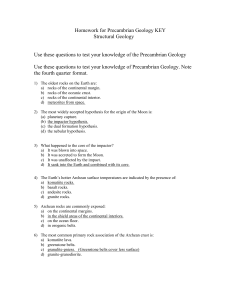
T2 Precambrian Geology Homework KEY
... (c) the Sun’s radiation pressure, i.e. the solar wind. (d) action of plate tectonics. 21) Earth’s first permanent atmosphere was mostly formed by: (a) the Earth’s magnetic field. (b) volcanic outgassing. (c) the Sun’s radiation pressure. (d) asteroid collision. ...
... (c) the Sun’s radiation pressure, i.e. the solar wind. (d) action of plate tectonics. 21) Earth’s first permanent atmosphere was mostly formed by: (a) the Earth’s magnetic field. (b) volcanic outgassing. (c) the Sun’s radiation pressure. (d) asteroid collision. ...


The Rock Cycle
... If the magma crystallized on the surface of the crust (on land), it is called extrusive igneous rock. If the magma crystallized while still in the crust (underground), it is called intrusive igneous rock. ...
... If the magma crystallized on the surface of the crust (on land), it is called extrusive igneous rock. If the magma crystallized while still in the crust (underground), it is called intrusive igneous rock. ...
Geology of Great Britain

The geology of Great Britain is renowned for its diversity. As a result of its eventful geological history, Great Britain shows a rich variety of landscapes across the constituent countries of England, Wales and Scotland. Rocks of almost all geological ages are represented at outcrop, from the Archaean onwards.