
5.12 A interpret how land forms are the result of a combination of
... C. Mass movement occurs as a result of gravity pulling rocks and soil downward. D. A Volcanic eruption deposit s lava and ash that hardens into rock, not sand. ...
... C. Mass movement occurs as a result of gravity pulling rocks and soil downward. D. A Volcanic eruption deposit s lava and ash that hardens into rock, not sand. ...

Name: 1 GEOL 104 Dinosaurs: A Natural History Geology
... Part I: Environments of Deposition Geologists can use various clues in sedimentary rocks to interpret their environment of deposition: that is, the type of conditions that were present when they were laid down. Some aspects of the environment of deposition are revealed by the type of sedimentary roc ...
... Part I: Environments of Deposition Geologists can use various clues in sedimentary rocks to interpret their environment of deposition: that is, the type of conditions that were present when they were laid down. Some aspects of the environment of deposition are revealed by the type of sedimentary roc ...

Geology Introduction Assessment Give questions at beginning of
... 16. It is thought that there was once a single continent on earth. Which of the following statements best describes what happened to this continent? A. The Earth lost heat over time and cracked, causing the continent to break into smaller pieces B. Meteors hit the Earth causing the continent to brea ...
... 16. It is thought that there was once a single continent on earth. Which of the following statements best describes what happened to this continent? A. The Earth lost heat over time and cracked, causing the continent to break into smaller pieces B. Meteors hit the Earth causing the continent to brea ...

The History of Life: Study Guide
... 14. Index fossils have a wide geographical distribution, and existed on the Earth for a relatively short period of time 16. If fossils are rare and unconformities are hard to find then lithostratigraphy is probably the best method used for correlation. 22. Marine sedimentary rock layers are deposite ...
... 14. Index fossils have a wide geographical distribution, and existed on the Earth for a relatively short period of time 16. If fossils are rare and unconformities are hard to find then lithostratigraphy is probably the best method used for correlation. 22. Marine sedimentary rock layers are deposite ...

Rocks
... processes that formed them. Three types of rocks: igneous sedimentary metamorphic 1. Igneous rocks: formed from molten magma (latin ignis = "fire") plutonic rock (named after Pluto, the Roman god of the underworld) : magma cools and crystallises slowly within the Earth's crust volcanic r ...
... processes that formed them. Three types of rocks: igneous sedimentary metamorphic 1. Igneous rocks: formed from molten magma (latin ignis = "fire") plutonic rock (named after Pluto, the Roman god of the underworld) : magma cools and crystallises slowly within the Earth's crust volcanic r ...

Slide 1
... at the Earth's surface. It pours out over the Earth's surface in a volcanic eruption. This process is called extrusion. The rocks that form from extruded magma are called extrusive igneous rocks. Basalt and pumice are extrusive igneous rocks. The type of rock that forms depends on the ...
... at the Earth's surface. It pours out over the Earth's surface in a volcanic eruption. This process is called extrusion. The rocks that form from extruded magma are called extrusive igneous rocks. Basalt and pumice are extrusive igneous rocks. The type of rock that forms depends on the ...

MEET SOME ROCKS AND MINERALS
... thousands of years! Slow cooling can give individual atoms time to “line up” and form definite patterns called crystalline structures. This allows large, beautiful crystals to form. Granite is an example of a rock with large crystals that grew slowly because of slow, steady cooling. When molten rock ...
... thousands of years! Slow cooling can give individual atoms time to “line up” and form definite patterns called crystalline structures. This allows large, beautiful crystals to form. Granite is an example of a rock with large crystals that grew slowly because of slow, steady cooling. When molten rock ...

instructor`s syllabus
... 1. Differentiate between rocks and minerals and describe the formation of igneous, sedimentary, and metamorphic rocks, and classify rocks as igneous, sedimentary, or metamorphic. 2. Outline the importance and abundance of various elements in the earth's crust. 3. Identify and describe batholiths, si ...
... 1. Differentiate between rocks and minerals and describe the formation of igneous, sedimentary, and metamorphic rocks, and classify rocks as igneous, sedimentary, or metamorphic. 2. Outline the importance and abundance of various elements in the earth's crust. 3. Identify and describe batholiths, si ...

instructor`s syllabus
... 6. Explain what is meant by seafloor spreading. 7. Describe convergent, divergent, and transform types of plate boundaries. 8. Recognize and diagram normal, reverse, thrust, and strike-slip (transform) faults. 9. Describe the processes and effects of physical (mechanical), chemical, and biological w ...
... 6. Explain what is meant by seafloor spreading. 7. Describe convergent, divergent, and transform types of plate boundaries. 8. Recognize and diagram normal, reverse, thrust, and strike-slip (transform) faults. 9. Describe the processes and effects of physical (mechanical), chemical, and biological w ...

Sorting - HCC Learning Web
... b. Most common in arid and semi-arid regions with rapid erosion. c. Sediment is coarse, poorly- sorted gravel and sand. ...
... b. Most common in arid and semi-arid regions with rapid erosion. c. Sediment is coarse, poorly- sorted gravel and sand. ...

WEEK 10: IGNEOUS ROCKS
... b. Because they cool slowly these rocks are large crystals. Their grain size will be larger than 1mm. They will have a coarse or very coarse texture. EXTRUSIVE igneous rocks; a. Cool quickly above ground in just minutes VOLCANIC b. Because they cooled quickly these rocks have very small crystals. ...
... b. Because they cool slowly these rocks are large crystals. Their grain size will be larger than 1mm. They will have a coarse or very coarse texture. EXTRUSIVE igneous rocks; a. Cool quickly above ground in just minutes VOLCANIC b. Because they cooled quickly these rocks have very small crystals. ...
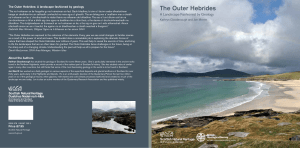
The Outer Hebrides - Scottish Natural Heritage
... from the surrounding high ground. These rivers carried sand and pebbles, which were deposited along the valley margins, forming fan-shaped piles of sediment. Tiny particles of iron-rich material in the sand were exposed to the air and so became oxidised (rusted), giving the resulting rocks a red-bro ...
... from the surrounding high ground. These rivers carried sand and pebbles, which were deposited along the valley margins, forming fan-shaped piles of sediment. Tiny particles of iron-rich material in the sand were exposed to the air and so became oxidised (rusted), giving the resulting rocks a red-bro ...
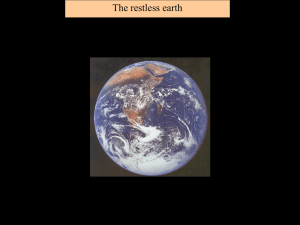
C1b 6.2 The restless earth
... 2. Eventually all mountains should be eroded and all dips filled in and be of a similar age 3. Where did all the eroded river sediment go? - 500 million tons of it each year! - a 20km high!coverage around the planet ! ...
... 2. Eventually all mountains should be eroded and all dips filled in and be of a similar age 3. Where did all the eroded river sediment go? - 500 million tons of it each year! - a 20km high!coverage around the planet ! ...

101 The Earth - BegaTAFE-GeneralEd-CGVE
... Millions of years ago, many areas on Earth were affected by a climate that was much wetter and warmer than is experienced today. Many coastal basins and deltas were poorly drained and these areas supported dense swamps and forests. Over time, plants in these forests and swamps grew, died and fell do ...
... Millions of years ago, many areas on Earth were affected by a climate that was much wetter and warmer than is experienced today. Many coastal basins and deltas were poorly drained and these areas supported dense swamps and forests. Over time, plants in these forests and swamps grew, died and fell do ...
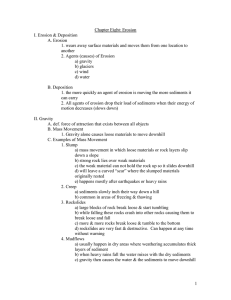
Chapter Seven: Erosion
... b) heavier sediments are deposited closer to a glacier while smaller ones move farther away. c) esker: a winding ridge of sand & gravel deposited in tunnels beneath a glacier d) outwash plain: flat areas of deposited materials in front of a retreating (melting) glacier 4. Erratics a) large rock frag ...
... b) heavier sediments are deposited closer to a glacier while smaller ones move farther away. c) esker: a winding ridge of sand & gravel deposited in tunnels beneath a glacier d) outwash plain: flat areas of deposited materials in front of a retreating (melting) glacier 4. Erratics a) large rock frag ...

Ontstaan en hoogtepunten
... The oldest section of New Zealand’s landmass was formed during the Cambrian through to the Devonian periods, some 540 to 360 million years ago. They originally consisted of sediments deposited on the sea floor offshore from the parts of Gondwana that would later become Antarctica and Australia Austr ...
... The oldest section of New Zealand’s landmass was formed during the Cambrian through to the Devonian periods, some 540 to 360 million years ago. They originally consisted of sediments deposited on the sea floor offshore from the parts of Gondwana that would later become Antarctica and Australia Austr ...
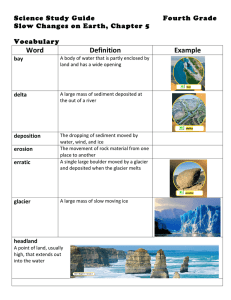
Glaciers
... A fan shaped land mass that forms after a river rushes down a steep slope and slows over a flat plain ...
... A fan shaped land mass that forms after a river rushes down a steep slope and slows over a flat plain ...

Why is Earth Unique? - Bakersfield College
... • The accretion of Pangaea resulted in: • collision of northern Europe with Greenland Caledonian Mountains-A • joining of northern Asia (Siberia) and Europe Ural Mountains- B • Joining of North Africa and Eastern U.S. Appalachian Mountains- C During the formation of the Appalachian Mountains, ...
... • The accretion of Pangaea resulted in: • collision of northern Europe with Greenland Caledonian Mountains-A • joining of northern Asia (Siberia) and Europe Ural Mountains- B • Joining of North Africa and Eastern U.S. Appalachian Mountains- C During the formation of the Appalachian Mountains, ...

Relative Age Dating
... Before the theory of evolution was proposed by Charles Darwin in 1859, geologists had already noticed that fossil assemblages changed from one stratum to the next (i.e. through time). This concept is termed faunal succession. For example, geologists noticed that the abundance of mammal fossils occur ...
... Before the theory of evolution was proposed by Charles Darwin in 1859, geologists had already noticed that fossil assemblages changed from one stratum to the next (i.e. through time). This concept is termed faunal succession. For example, geologists noticed that the abundance of mammal fossils occur ...

Relative Dating: Which Rock Layer Formed First
... Before the theory of evolution was proposed by Charles Darwin in 1859, geologists had already noticed that fossil assemblages changed from one stratum to the next (i.e. through time). This concept is termed faunal succession. For example, geologists noticed that the abundance of mammal fossils occur ...
... Before the theory of evolution was proposed by Charles Darwin in 1859, geologists had already noticed that fossil assemblages changed from one stratum to the next (i.e. through time). This concept is termed faunal succession. For example, geologists noticed that the abundance of mammal fossils occur ...

Name: 1 GEOL 104 Dinosaurs: A Natural History Geology
... Part I: Environments of Deposition Geologists can use various clues in sedimentary rocks to interpret their environment of deposition: that is, the type of conditions that were present when they were laid down. ...
... Part I: Environments of Deposition Geologists can use various clues in sedimentary rocks to interpret their environment of deposition: that is, the type of conditions that were present when they were laid down. ...

Second Circular and Call for Abstracts AGS Colloquium Delta
... A significant advance was made to the understanding of the geodynamics of the Appalachian orogen with the introduction of four lithotectonic zones defined on the island of Newfoundland by Hank Williams in the early 1960s. The plate tectonic evolution of these zones was interpreted in terms of a simp ...
... A significant advance was made to the understanding of the geodynamics of the Appalachian orogen with the introduction of four lithotectonic zones defined on the island of Newfoundland by Hank Williams in the early 1960s. The plate tectonic evolution of these zones was interpreted in terms of a simp ...

Abstract - Geological Society of America
... Cameron thrust fault, a major NE/SW trending structural feature in the area. The rocks occurring west of Cameron thrust are known as Manhattan Formation and to the east are known as Hartland Formation (Fig. 1, Shah and others, 1998). Both these lithotectonic units have undergone polyphase deformatio ...
... Cameron thrust fault, a major NE/SW trending structural feature in the area. The rocks occurring west of Cameron thrust are known as Manhattan Formation and to the east are known as Hartland Formation (Fig. 1, Shah and others, 1998). Both these lithotectonic units have undergone polyphase deformatio ...

Folding/Faulting: Topographic Expression of Folded Strata
... Joints occur where a rock breaks but there is no displacement or faulting associated with the break. Joints are not singular features, but they occur in sets within a given type or area of a rock. Fractures are breaks in rocks that are often singular more random features and are not associated with ...
... Joints occur where a rock breaks but there is no displacement or faulting associated with the break. Joints are not singular features, but they occur in sets within a given type or area of a rock. Fractures are breaks in rocks that are often singular more random features and are not associated with ...

Name Earth Revealed : Metamorphic Rocks 1. The process of
... metamorphic texture known as _____________________. ...
... metamorphic texture known as _____________________. ...
Geology of Great Britain

The geology of Great Britain is renowned for its diversity. As a result of its eventful geological history, Great Britain shows a rich variety of landscapes across the constituent countries of England, Wales and Scotland. Rocks of almost all geological ages are represented at outcrop, from the Archaean onwards.