Part 2 - Mahopac Voyagers!
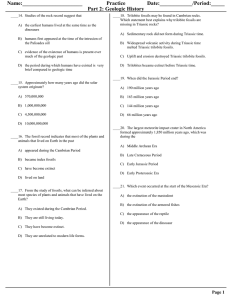
... D) Early Proterozoic Era D) lived on land ____21. Which event occurred at the start of the Mesozoic Era? ____17. From the study of fossils, what can be inferred about most species of plants and animals that have lived on the Earth? ...
... D) Early Proterozoic Era D) lived on land ____21. Which event occurred at the start of the Mesozoic Era? ____17. From the study of fossils, what can be inferred about most species of plants and animals that have lived on the Earth? ...
13. Deformation and Mountain Building
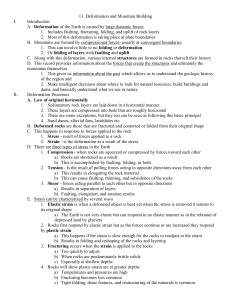
... (1) This is where the oceanic crust is being subducted beneath the continent (2) The Andes are the best example (3) This was once a passive margin 200 Ma like the East Coast of North America (4) Subduction started when the Atlantic spreading ridge pushed the continents into the Pacific Plate and cau ...
... (1) This is where the oceanic crust is being subducted beneath the continent (2) The Andes are the best example (3) This was once a passive margin 200 Ma like the East Coast of North America (4) Subduction started when the Atlantic spreading ridge pushed the continents into the Pacific Plate and cau ...

Microsoft PowerPoint - file.in [jen pro \350ten\355]
... In 1962, Harry Hess proposed the hypothesis that midocean ridges represent narrow zones where ocean crust forms. Seafloor spreading is a part of the theory of plate tectonics. At the Mid-Atlantic Ridge (and other places), material from the mantle rises through the faults between oceanic plates to f ...
... In 1962, Harry Hess proposed the hypothesis that midocean ridges represent narrow zones where ocean crust forms. Seafloor spreading is a part of the theory of plate tectonics. At the Mid-Atlantic Ridge (and other places), material from the mantle rises through the faults between oceanic plates to f ...

Weathering Weathering - Surface processes that work to break
... Chemical Weathering – occurs when chemical reactions dissolve or alter the minerals in rocks or change them into different minerals. Changes the chemical composition 1) Natural Acids – Carbonic acid reacts with minerals such as calcite, which is the main mineral that makes up limestone. Over many th ...
... Chemical Weathering – occurs when chemical reactions dissolve or alter the minerals in rocks or change them into different minerals. Changes the chemical composition 1) Natural Acids – Carbonic acid reacts with minerals such as calcite, which is the main mineral that makes up limestone. Over many th ...

Caledonian Structures of the Southern Uplands
... north-western margin, the arguments for NWdirected subduction in the Southern Uplands have been strengthened by the stratigraphical, sedimentological, and large-scale structural evidence. The distinctive stratigraphical and structural arrangement of these rocks has been used to argue, very persuasiv ...
... north-western margin, the arguments for NWdirected subduction in the Southern Uplands have been strengthened by the stratigraphical, sedimentological, and large-scale structural evidence. The distinctive stratigraphical and structural arrangement of these rocks has been used to argue, very persuasiv ...

petrology of continental rocks
... ridge. The measured rate of spreading is about 1 cm per annum — extrapolation back to zero ocean width gives 190 Myr. The mechanism of this movement may be understood by studying the sequence of crustal layers beneath the oceans; it is markedly different from that beneath the continents, and is quit ...
... ridge. The measured rate of spreading is about 1 cm per annum — extrapolation back to zero ocean width gives 190 Myr. The mechanism of this movement may be understood by studying the sequence of crustal layers beneath the oceans; it is markedly different from that beneath the continents, and is quit ...

Practice Test – Geology 106, Chapter 17 from The Changing Earth
... 4. Ask a question; Collect data (make observations); Form a hypothesis; Test the hypothesis (if the test fails, re-hypothesize and test again until the hypothesis is validated); Form a conclusion. 5. The Law of Uniformitarianism, proposed by James Hutton (often called the “Father of Modern Geology”) ...
... 4. Ask a question; Collect data (make observations); Form a hypothesis; Test the hypothesis (if the test fails, re-hypothesize and test again until the hypothesis is validated); Form a conclusion. 5. The Law of Uniformitarianism, proposed by James Hutton (often called the “Father of Modern Geology”) ...

Massachusetts - Swampscott Middle School
... Diagram of something learned What must have been in Massachusetts at some point for these rocks to exist? ...
... Diagram of something learned What must have been in Massachusetts at some point for these rocks to exist? ...

Survey of Biology Quarter 4 Significant Task Rock Pocket Mice
... A typical rock pocket mouse from its nose to the end of its tail is shorter than a pencil. This tiny mouse weighs about as much as a handful of paper clips. Rock pocket mice, however, have had an enormous impact on science. You can find populations of rock pocket mice all over the Sonoran Desert in ...
... A typical rock pocket mouse from its nose to the end of its tail is shorter than a pencil. This tiny mouse weighs about as much as a handful of paper clips. Rock pocket mice, however, have had an enormous impact on science. You can find populations of rock pocket mice all over the Sonoran Desert in ...

Answers
... (bottom 4 rocks). Mineral alignment is found in the first three rocks, and the mineral pyroxene is found in schist and gneiss. Since the question states that the rock does not have banding it is not Gneiss and must by Schist. 2. (3) Looking at the Rock Cycle chart on page 6 of the ESRT, the type of ...
... (bottom 4 rocks). Mineral alignment is found in the first three rocks, and the mineral pyroxene is found in schist and gneiss. Since the question states that the rock does not have banding it is not Gneiss and must by Schist. 2. (3) Looking at the Rock Cycle chart on page 6 of the ESRT, the type of ...

the significance of the volcanic rocks in the fossil creek area, arizona
... represent a part of the ancestral Mogollon Rim, are exposed to an elevation of more than 6,000 feet. Here the volcanic rocks are absent, or occur only as a thin cap rock. The change from volcanic rocks west of Fossil Springs to sedimentary rocks of Paleozoic age east of the springs occurs in a later ...
... represent a part of the ancestral Mogollon Rim, are exposed to an elevation of more than 6,000 feet. Here the volcanic rocks are absent, or occur only as a thin cap rock. The change from volcanic rocks west of Fossil Springs to sedimentary rocks of Paleozoic age east of the springs occurs in a later ...

Chapter 2 - Minerals and Rocks Extra Credit
... 13. A mixture containing a solvent and at least one solute that has the same properties throughout a mixture in which one substance is dissolved in another. 15. The chemical and physical processes that break down rock and other substances. 17. Small, solid pieces of material that come from rocks or ...
... 13. A mixture containing a solvent and at least one solute that has the same properties throughout a mixture in which one substance is dissolved in another. 15. The chemical and physical processes that break down rock and other substances. 17. Small, solid pieces of material that come from rocks or ...

Rocks - earthjay science
... grains imply a higher energy environment (steeper, faster stream or high-energy wave zones). Sandstone type is an indicator of environment. Well-sorted, quartz sandstone indicate long transport of sediment and are often associated with a Passive Tectonic Margin (not convergent). Feldspar-rich and Mu ...
... grains imply a higher energy environment (steeper, faster stream or high-energy wave zones). Sandstone type is an indicator of environment. Well-sorted, quartz sandstone indicate long transport of sediment and are often associated with a Passive Tectonic Margin (not convergent). Feldspar-rich and Mu ...

G2S15Lesson2 SedMet
... grains imply a higher energy environment (steeper, faster stream or high-energy wave zones). Sandstone type is an indicator of environment. Well-sorted, quartz sandstone indicate long transport of sediment and are often associated with a Passive Tectonic Margin (not convergent). Feldspar-rich and ...
... grains imply a higher energy environment (steeper, faster stream or high-energy wave zones). Sandstone type is an indicator of environment. Well-sorted, quartz sandstone indicate long transport of sediment and are often associated with a Passive Tectonic Margin (not convergent). Feldspar-rich and ...

Formation of Tasmania
... Permian & Triassic 300 - 200 million years ago Glaciers, fossils and swamps Newly formed mountains to the north west, the result of the collision of continents, were again subject to erosional processes. The eroded material was deposited in what is known as the Tasmania Basin. The Tasmania Basin cov ...
... Permian & Triassic 300 - 200 million years ago Glaciers, fossils and swamps Newly formed mountains to the north west, the result of the collision of continents, were again subject to erosional processes. The eroded material was deposited in what is known as the Tasmania Basin. The Tasmania Basin cov ...

Slide 1
... • The accretion of Pangaea resulted in: • collision of northern Europe with Greenland Caledonian Mountains-A • joining of northern Asia (Siberia) and Europe Ural Mountains- B • Joining of North Africa and Eastern U.S. Appalachian Mountains- C During the formation of the Appalachian Mountains, ...
... • The accretion of Pangaea resulted in: • collision of northern Europe with Greenland Caledonian Mountains-A • joining of northern Asia (Siberia) and Europe Ural Mountains- B • Joining of North Africa and Eastern U.S. Appalachian Mountains- C During the formation of the Appalachian Mountains, ...

Rock Cycle - PowerPoint Notes Pages File
... As pebbles/clasts are moved by wind or water they clash against each other. The further they travel the more rounded they become. These pebbles came from volcanic rocks erupted during the Upper Proterozoic over 560 million years ago. Water carried them and caused them to become rounded. During Perm ...
... As pebbles/clasts are moved by wind or water they clash against each other. The further they travel the more rounded they become. These pebbles came from volcanic rocks erupted during the Upper Proterozoic over 560 million years ago. Water carried them and caused them to become rounded. During Perm ...

Document
... SEDIMENTARY, AND IGNEOUS ROCKS. IT CAN DATE OLDER ROCKS BUT MAY ALSO DATE ROCKS AS YOUNG AS 50,000 ...
... SEDIMENTARY, AND IGNEOUS ROCKS. IT CAN DATE OLDER ROCKS BUT MAY ALSO DATE ROCKS AS YOUNG AS 50,000 ...

Methods and Equipment Used by Marine Geologists
... In the 1960's the unifying theory of plate tectonics was proposed to explain many regional and global geologic phenomena, including drifting continents, spreading seafloors, and the worldwide distribution of mountains, earthquakes, and volcanoes. According to the plate tectonic model, the Earth's ou ...
... In the 1960's the unifying theory of plate tectonics was proposed to explain many regional and global geologic phenomena, including drifting continents, spreading seafloors, and the worldwide distribution of mountains, earthquakes, and volcanoes. According to the plate tectonic model, the Earth's ou ...

History of the Earth and its structure
... about 4.5 billion years ago from a cloud or clouds of dust. The dust was the remains of a huge cosmic explosion which is estimated to have occurred about 15 billion years ago. ...
... about 4.5 billion years ago from a cloud or clouds of dust. The dust was the remains of a huge cosmic explosion which is estimated to have occurred about 15 billion years ago. ...

Midterm Review 2
... Stability of many siliciclastic minerals is the reverse of Bowen’s reaction series, i.e., the first minerals to form at high T are the first to weather at the lower temperatures of the Earth’s surface ...
... Stability of many siliciclastic minerals is the reverse of Bowen’s reaction series, i.e., the first minerals to form at high T are the first to weather at the lower temperatures of the Earth’s surface ...

here - Gloucestershire Geology Trust
... They consist mainly of sandstones and the finer grained siltstones. They belong to the same formation as the rocks in Site 1. The rocks were deposited by rivers flowing into the sea. The variation in the grain sizes of the rocks varied depending on the depth of the sea at the time and the size of ri ...
... They consist mainly of sandstones and the finer grained siltstones. They belong to the same formation as the rocks in Site 1. The rocks were deposited by rivers flowing into the sea. The variation in the grain sizes of the rocks varied depending on the depth of the sea at the time and the size of ri ...

GEO Evolution Vocab
... 6. Geology – the study of Earth’s history, processes, and structures 7. Geologic time scale – a timeline that organizes major events in the Earth’s history 8. Fossil – the preserved remains or evidence of an organism that lived in a past age 9. Index fossil – a fossil that is useful for dating geolo ...
... 6. Geology – the study of Earth’s history, processes, and structures 7. Geologic time scale – a timeline that organizes major events in the Earth’s history 8. Fossil – the preserved remains or evidence of an organism that lived in a past age 9. Index fossil – a fossil that is useful for dating geolo ...

Sedimentology and Sedimentary Processes
... the continents, a considerable amount of sediment is transported from the continental margins by turbidity currents. • As the current moves across the deep-ocean floor its velocity gradually decreases, and sediment carried in suspension settles out. • The resulting deposit is a widespread layer of s ...
... the continents, a considerable amount of sediment is transported from the continental margins by turbidity currents. • As the current moves across the deep-ocean floor its velocity gradually decreases, and sediment carried in suspension settles out. • The resulting deposit is a widespread layer of s ...

Geology of Great Britain

The geology of Great Britain is renowned for its diversity. As a result of its eventful geological history, Great Britain shows a rich variety of landscapes across the constituent countries of England, Wales and Scotland. Rocks of almost all geological ages are represented at outcrop, from the Archaean onwards.