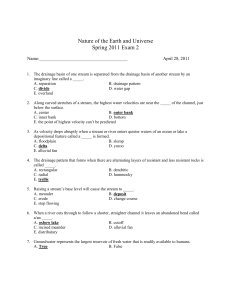
Nature of the Earth and Universe Spring 2011 Exam 2 Name: April
... D. throughout the whole or entire mantle E. all of the above 21. The "Ring of Fire" is an area of earthquake and volcanic activity that encircles the Pacific ...
... D. throughout the whole or entire mantle E. all of the above 21. The "Ring of Fire" is an area of earthquake and volcanic activity that encircles the Pacific ...

A Trip Through Earths History
... 65 million to present • Early in Tertiary period, India collided with Asia to form Himalayas, Africa and Europe collided to form Alps; Cascades and Sierra Nevadas began to form in North America • new grasses and flowering plants dominated ...
... 65 million to present • Early in Tertiary period, India collided with Asia to form Himalayas, Africa and Europe collided to form Alps; Cascades and Sierra Nevadas began to form in North America • new grasses and flowering plants dominated ...

Student Handout Rock Unit Descriptions
... Bena Gravel Fm [Tbg] – Extremely coarse pebbles and cobbles mixed with sand; poorly sorted; deposited in a non-marine environment very close to the Sierra Nevada; pebbles and cobbles are igneous and metamorphic; contains few, if any, fossils except for petrified wood. Age: Miocene (6-16 m.y.) Chanac ...
... Bena Gravel Fm [Tbg] – Extremely coarse pebbles and cobbles mixed with sand; poorly sorted; deposited in a non-marine environment very close to the Sierra Nevada; pebbles and cobbles are igneous and metamorphic; contains few, if any, fossils except for petrified wood. Age: Miocene (6-16 m.y.) Chanac ...

Word
... 13. Into what category of sedimentary rocks does the type of rock fall that forms by the evaporation of water and consequent precipitation of minerals like halite? A. gypsum B. detrital C. clastic D. chemical E. biochemical 13. Which of the following is NOT a mineral commonly produced by evaporation ...
... 13. Into what category of sedimentary rocks does the type of rock fall that forms by the evaporation of water and consequent precipitation of minerals like halite? A. gypsum B. detrital C. clastic D. chemical E. biochemical 13. Which of the following is NOT a mineral commonly produced by evaporation ...

Geol 101: Physical Geology PAST EXAM QUESTIONS LECTURE
... 13. Into what category of sedimentary rocks does the type of rock fall that forms by the evaporation of water and consequent precipitation of minerals like halite? A. gypsum B. detrital C. clastic D. chemical E. biochemical 13. Which of the following is NOT a mineral commonly produced by evaporation ...
... 13. Into what category of sedimentary rocks does the type of rock fall that forms by the evaporation of water and consequent precipitation of minerals like halite? A. gypsum B. detrital C. clastic D. chemical E. biochemical 13. Which of the following is NOT a mineral commonly produced by evaporation ...

Volcanoes and Igneous Activity Earth - Chapter 4
... The remains of small skeleton building organisms Inorganic crystals that precipitate from solution ...
... The remains of small skeleton building organisms Inorganic crystals that precipitate from solution ...
Igneous Rocks
... Igneous rocks are also formed when volcanoes erupt, casing the magma to rise above the earth's surface. When magma appears above the earth, it is called lava. Igneous rocks are formed as the lava cools above ground. ...
... Igneous rocks are also formed when volcanoes erupt, casing the magma to rise above the earth's surface. When magma appears above the earth, it is called lava. Igneous rocks are formed as the lava cools above ground. ...
Abby Murray Geology 11 Final Project December 20, 2007 Geologic
... the rocks in the wedge are ductile. They are stretched and sheared into mylonite, a rock indicative of a shear zone. Shearing causes foliation but does not change the minerals in the rock. Within the folds of an orogenic belt there would have been occurrences of mylonite because of the shear inheren ...
... the rocks in the wedge are ductile. They are stretched and sheared into mylonite, a rock indicative of a shear zone. Shearing causes foliation but does not change the minerals in the rock. Within the folds of an orogenic belt there would have been occurrences of mylonite because of the shear inheren ...


Rocks: Lesson 3: Thinkinb Map Completed
... This rock is formed when rock sediments are transported from one place to another. Eventually these sediments deposit into layers. Over time they begin to be compacted and cemented together. Forms at the Earth’s surface with out heat and pressure. Strata- the layers found in sedimentary ro ...
... This rock is formed when rock sediments are transported from one place to another. Eventually these sediments deposit into layers. Over time they begin to be compacted and cemented together. Forms at the Earth’s surface with out heat and pressure. Strata- the layers found in sedimentary ro ...

137 Amazing Facts of Earth Science
... 66. Limestone morphs into marble. Sandstone morphs into quartzite. 67. Sedimentary rocks form from rock fragments, organic material, or chemical precipitation through compaction and cementation. 68. Sedimentary are found in flat layers or strata. Fossils are found in these layers. 69. Sedimentary su ...
... 66. Limestone morphs into marble. Sandstone morphs into quartzite. 67. Sedimentary rocks form from rock fragments, organic material, or chemical precipitation through compaction and cementation. 68. Sedimentary are found in flat layers or strata. Fossils are found in these layers. 69. Sedimentary su ...

Chemical sedimentary rocks
... temperatures and pressures. Changes that take place while the rock is still solid are called metamorphism. Metamorphic changes start at about 150oC (equivalent to a depth within the Earth of 5 km) and cease around 800oC where the rocks start to melt. ...
... temperatures and pressures. Changes that take place while the rock is still solid are called metamorphism. Metamorphic changes start at about 150oC (equivalent to a depth within the Earth of 5 km) and cease around 800oC where the rocks start to melt. ...

Slide 1
... • The Earth is constantly changing. Even the very rocks around you may have changed many times throughout their history! • The Rock Cycle explains the evolution of these igneous, sedimentary, and metamorphic rocks that make up the Earth’s crust. • Many processes, such as volcanic activity, movement ...
... • The Earth is constantly changing. Even the very rocks around you may have changed many times throughout their history! • The Rock Cycle explains the evolution of these igneous, sedimentary, and metamorphic rocks that make up the Earth’s crust. • Many processes, such as volcanic activity, movement ...

Geology Log File - Learn District 196
... 1. Who proposed the hypothesis of continental drift? _______________________ 2. Scientists believe the continents were joined in a single large landmass called __________________. 3. ____________________________takes place at mid-ocean ridges. 4. Younger rocks are generally closer to the ___________ ...
... 1. Who proposed the hypothesis of continental drift? _______________________ 2. Scientists believe the continents were joined in a single large landmass called __________________. 3. ____________________________takes place at mid-ocean ridges. 4. Younger rocks are generally closer to the ___________ ...

RocksEarth`sMemorySticks
... more → Magnesium more → ← more Aluminum ← more as a result… Granite ...
... more → Magnesium more → ← more Aluminum ← more as a result… Granite ...
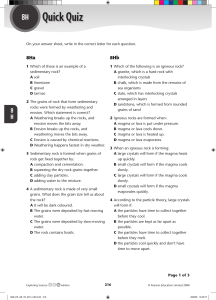
8H Quick Quiz
... B magma cooling underground, floods C landslides, sediments being compressed to form rocks D earthquakes, lava flowing from a volcano 3 Which list shows rock-cycle processes that all happen slowly? A volcanoes erupting, landslides B sediments being compressed to form rocks, weathering of rocks C flo ...
... B magma cooling underground, floods C landslides, sediments being compressed to form rocks D earthquakes, lava flowing from a volcano 3 Which list shows rock-cycle processes that all happen slowly? A volcanoes erupting, landslides B sediments being compressed to form rocks, weathering of rocks C flo ...

Chapter 9
... Around 570 million years ago, rifting began again, and South America began to separate from North America, forming the Iapetus Ocean (or proto-Atlantic Ocean). The rift ran along what is now the Blue Ridge province. Basaltic lava flows formed the Catoctin Formation. As the Iapetus Ocean opened, sand ...
... Around 570 million years ago, rifting began again, and South America began to separate from North America, forming the Iapetus Ocean (or proto-Atlantic Ocean). The rift ran along what is now the Blue Ridge province. Basaltic lava flows formed the Catoctin Formation. As the Iapetus Ocean opened, sand ...

Geologic History of NC
... Dysertsville Tonalite), volcanism(Poor Mountain Formation) and widespread metamorphism. The Precordillera Terrane docked with the western Gondwana margin of Argentina. East dipping subduction of oceanic crust near eastern Laurentia marked the formation of arc complexes of the Dahlonega gold belt, Co ...
... Dysertsville Tonalite), volcanism(Poor Mountain Formation) and widespread metamorphism. The Precordillera Terrane docked with the western Gondwana margin of Argentina. East dipping subduction of oceanic crust near eastern Laurentia marked the formation of arc complexes of the Dahlonega gold belt, Co ...

Correlation of rock layers
... thought that the Earth was only 6,000 years old. This mindset was based on biblical references. ...
... thought that the Earth was only 6,000 years old. This mindset was based on biblical references. ...

Sedimentary rocks are composed of
... physical and biological processes • Integrate observations via the scientific method to understand rock genesis and post-depositional history ...
... physical and biological processes • Integrate observations via the scientific method to understand rock genesis and post-depositional history ...

Sediments and Sedimentary Rocks
... crust comprises only the outer 0.3% of the radius of the earth, and sedimentary rocks make up a relatively minor proportion of the crust. Nevertheless, sediments cover more than 80% of the Earth’s surface and they record important information on surface conditions and processes over Earth history. I ...
... crust comprises only the outer 0.3% of the radius of the earth, and sedimentary rocks make up a relatively minor proportion of the crust. Nevertheless, sediments cover more than 80% of the Earth’s surface and they record important information on surface conditions and processes over Earth history. I ...

MODEL QUESTION PAPER
... b. Is not affected c. Increases d. Cannot be determined 8. Igneous rocks that crystallize from magma and are composed almost entirely of quartz and feldspars have a(n) a. Granitic composition b. Ultramafic composition c. Andesitic composition d. Basaltic composition 9. Why can two igneous rocks have ...
... b. Is not affected c. Increases d. Cannot be determined 8. Igneous rocks that crystallize from magma and are composed almost entirely of quartz and feldspars have a(n) a. Granitic composition b. Ultramafic composition c. Andesitic composition d. Basaltic composition 9. Why can two igneous rocks have ...

scimod_32 CC 1
... BRITT ARGOW: Well, Joe, scientists believe that at the time these mountains were forming, Clay Point was near a plate boundary. Geologists have determined that the age of Clay Point rocks is about 500 million years old. Using data from rocks around the world, scientists can model what the surface of ...
... BRITT ARGOW: Well, Joe, scientists believe that at the time these mountains were forming, Clay Point was near a plate boundary. Geologists have determined that the age of Clay Point rocks is about 500 million years old. Using data from rocks around the world, scientists can model what the surface of ...


Bedrock v7 - University of Michigan
... Rift and Archean and Proterozoic basement rocks. The Michigan Basin is an important source of crude oil, natural gas, salt, gypsum, and limestone, as well as brines containing bromine, magnesium and other elements that are the basis for much of the chemical industry in the state. The Michigan Basin ...
... Rift and Archean and Proterozoic basement rocks. The Michigan Basin is an important source of crude oil, natural gas, salt, gypsum, and limestone, as well as brines containing bromine, magnesium and other elements that are the basis for much of the chemical industry in the state. The Michigan Basin ...
Geology of Great Britain

The geology of Great Britain is renowned for its diversity. As a result of its eventful geological history, Great Britain shows a rich variety of landscapes across the constituent countries of England, Wales and Scotland. Rocks of almost all geological ages are represented at outcrop, from the Archaean onwards.