The Sevier Orogeny The Sevier orogeny took place at about the
... The Sevier orogeny took place at about the same time as the Laramide orogeny towards the end of the Cretacious and into the Tertiary from ~70-35 Ma. The Sevier orogeny happened largely due to the same regional stresses that created the Laramide. What distinguishes the Sevier from the Laramide, howev ...
... The Sevier orogeny took place at about the same time as the Laramide orogeny towards the end of the Cretacious and into the Tertiary from ~70-35 Ma. The Sevier orogeny happened largely due to the same regional stresses that created the Laramide. What distinguishes the Sevier from the Laramide, howev ...

ES2 Sea floor spreading Name: Introduction: About 30 years ago
... the magnetic field of the Earth. Rocks forming today point North, but at times in the past they pointed South. On either side of the midocean ridge is a mirror image of magnetic patterns and ages of rock. This gave evidence for Sea Floor spreading and plate tectonics. While new crust is created at d ...
... the magnetic field of the Earth. Rocks forming today point North, but at times in the past they pointed South. On either side of the midocean ridge is a mirror image of magnetic patterns and ages of rock. This gave evidence for Sea Floor spreading and plate tectonics. While new crust is created at d ...

Geologic Resources at Golden Gate
... American tectonic plate and flanking the Pacific plate. Whether formed from the interaction of ocean crust and mantle rocks under heat and extreme pressure like serpentine, or built by millions of microscopic sea creatures under pressure and over time like radiolarian chert, our park has anything a ...
... American tectonic plate and flanking the Pacific plate. Whether formed from the interaction of ocean crust and mantle rocks under heat and extreme pressure like serpentine, or built by millions of microscopic sea creatures under pressure and over time like radiolarian chert, our park has anything a ...

Presentation
... Fossil Pattern: Fossils of the same plant and animal species are found on continents that are on different side of the Atlantic. Rocks: Rock formations and rock dating showed that these rocks and formations were the same age, thus leading scientists to believe that they were once connected into simi ...
... Fossil Pattern: Fossils of the same plant and animal species are found on continents that are on different side of the Atlantic. Rocks: Rock formations and rock dating showed that these rocks and formations were the same age, thus leading scientists to believe that they were once connected into simi ...


Rocks and Minerals - LCS Essentially Science
... Rocks are made of minerals Minerals are made from elements Elements are made of atoms Atoms are made of electrons, protons and neutrons ...
... Rocks are made of minerals Minerals are made from elements Elements are made of atoms Atoms are made of electrons, protons and neutrons ...

Earth History Benchmark Study Guide 2014 Sedimentary Rocks
... glacial ice combined with the force of gravity can cause erosion. The youngest (top) layers of sediments usually get eroded first. The driving force behind erosion is GRAVITY! There are several types of erosion: Water: water running (due to gravity) takes weathered rock and deposits it elsewhere. Wi ...
... glacial ice combined with the force of gravity can cause erosion. The youngest (top) layers of sediments usually get eroded first. The driving force behind erosion is GRAVITY! There are several types of erosion: Water: water running (due to gravity) takes weathered rock and deposits it elsewhere. Wi ...

What are the processes that cause the Earth`s surface to wear down?
... rocks breaks more particles loosen. ...
... rocks breaks more particles loosen. ...

Relative Dating - Cloudfront.net
... Bedrock outcrops A and B are located at two different locations along the Provo River. Rock layers 1, 2, and 4 are the same in both outcrops. ...
... Bedrock outcrops A and B are located at two different locations along the Provo River. Rock layers 1, 2, and 4 are the same in both outcrops. ...

Lesson Outline for Teaching Lesson 1: The Erosion
... e. If a pile of sediment erodes quickly, it is less likely to be well sorted than if the pile erodes slowly. 3. Running water, wind, glaciers, and gravity lay down sediments during deposition. a. Deposition occurs as the agents of deposition slow down and lose energy. b. The location where sediment ...
... e. If a pile of sediment erodes quickly, it is less likely to be well sorted than if the pile erodes slowly. 3. Running water, wind, glaciers, and gravity lay down sediments during deposition. a. Deposition occurs as the agents of deposition slow down and lose energy. b. The location where sediment ...

31.3 Sedimentary Rocks Blanket Most of the Earth`s Surface
... Two kinds of weathering Mechanical– physically breaks rocks into smaller pieces chemical- chemical reactions that involve water and decompose rock into smaller pieces Erosion- process that removes weathered rock particles and transports them by wind, water, or ice ...
... Two kinds of weathering Mechanical– physically breaks rocks into smaller pieces chemical- chemical reactions that involve water and decompose rock into smaller pieces Erosion- process that removes weathered rock particles and transports them by wind, water, or ice ...

here - Zandrivier farm
... The deformed and folded rocks that you can see whilst driving through Seweweekspoort are some of the best examples of intensely folded rocks of the Belt. The main compressional force came from the south resulting in the roughly east-west trend of the mountain chain. This can be seen in the image be ...
... The deformed and folded rocks that you can see whilst driving through Seweweekspoort are some of the best examples of intensely folded rocks of the Belt. The main compressional force came from the south resulting in the roughly east-west trend of the mountain chain. This can be seen in the image be ...

Geology of the Roque Island Archipelago
... Part of Coastal Volcanic Belt Stretches from Massachusetts to New Brunswick Canada Represents portion of Avalonia that accreted to Laurentia during Acadian Orogeny Originally dated as Early Devonian Lisa Churchill-Dickson in 2004 published paper dating it as Silurian from U-Pb Zircon dating and diff ...
... Part of Coastal Volcanic Belt Stretches from Massachusetts to New Brunswick Canada Represents portion of Avalonia that accreted to Laurentia during Acadian Orogeny Originally dated as Early Devonian Lisa Churchill-Dickson in 2004 published paper dating it as Silurian from U-Pb Zircon dating and diff ...

Lesson 2 Power Point - Plain Local Schools
... Sedimentary Rocks 2 types of Sedimentary Rocks Clastic or chemical Clastic-glued together by other rocks Example:Sandstone Chemical- what is left over after being in dissolved water Example:Halite ...
... Sedimentary Rocks 2 types of Sedimentary Rocks Clastic or chemical Clastic-glued together by other rocks Example:Sandstone Chemical- what is left over after being in dissolved water Example:Halite ...
An Introduction to Geology - e
... a. killed thousands of people; b. created giant sea waves; c. produced spectacular sunsets around the world; d. caused a global cooling of about 0.5ºC; e. all of these. 9. Geologists engage in a variety of occupations, the main ones being exploration for mineral and energy resources. They are also b ...
... a. killed thousands of people; b. created giant sea waves; c. produced spectacular sunsets around the world; d. caused a global cooling of about 0.5ºC; e. all of these. 9. Geologists engage in a variety of occupations, the main ones being exploration for mineral and energy resources. They are also b ...


Gouiza et al - NSERC
... contains the highest grade uranium deposits in the world. The basin and the underlying deformed and metamorphosed Archean and Paleoproterozoic rocks of the Hearne and Rae Provinces host unconformity-type uranium deposits which are spatially associated with faults that cut the unconformity between th ...
... contains the highest grade uranium deposits in the world. The basin and the underlying deformed and metamorphosed Archean and Paleoproterozoic rocks of the Hearne and Rae Provinces host unconformity-type uranium deposits which are spatially associated with faults that cut the unconformity between th ...

3.2 3.3 3.4 Rock Types
... 1. What are the building blocks of rocks? 2. Minerals that form from magma form as the result of _______________________. 3. Why is color not a useful identification property? 4. What is a mineral’s streak? 5. What is the most common mineral group? ...
... 1. What are the building blocks of rocks? 2. Minerals that form from magma form as the result of _______________________. 3. Why is color not a useful identification property? 4. What is a mineral’s streak? 5. What is the most common mineral group? ...

9 Geography Investigating Australia`s Physical Environments Term 1
... more) continents. This shows that the two areas would have had to have a similar climate (and so a similar latitude and longitude). An example is Antarctic Beech. Fossil evidence has also shown that areas of land which were previously underwater or at least at a low altitude have been uplifted. Foss ...
... more) continents. This shows that the two areas would have had to have a similar climate (and so a similar latitude and longitude). An example is Antarctic Beech. Fossil evidence has also shown that areas of land which were previously underwater or at least at a low altitude have been uplifted. Foss ...
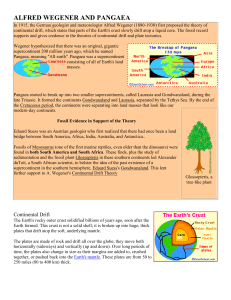
ALFRED WEGENER AND PANGAEA In 1915, the German geologist
... Pangaea started to break up into two smaller supercontinents, called Laurasia and Gondwanaland, during the late Triassic. It formed the continents Gondwanaland and Laurasia, separated by the Tethys Sea. By the end of the Cretaceous period, the continents were separating into land masses that look li ...
... Pangaea started to break up into two smaller supercontinents, called Laurasia and Gondwanaland, during the late Triassic. It formed the continents Gondwanaland and Laurasia, separated by the Tethys Sea. By the end of the Cretaceous period, the continents were separating into land masses that look li ...

Geology of the New Jersey Highlands and Valley and Ridge Provinces
... ~ 2 million to 800,000 years ~130,000 years ~21,000 years ...
... ~ 2 million to 800,000 years ~130,000 years ~21,000 years ...

GEOL 1403 Physical Geology Lecture Topics
... This course is designed to introduce the science of geology, emphasizing plate tectonics, rocks, minerals, geological processes, structural geology, and landforms. The following is a list of topics that should be covered as part of the lecture component of the course. Please refer to the GEOL 1403 P ...
... This course is designed to introduce the science of geology, emphasizing plate tectonics, rocks, minerals, geological processes, structural geology, and landforms. The following is a list of topics that should be covered as part of the lecture component of the course. Please refer to the GEOL 1403 P ...

The Late Oligocene-Early Miocene Petrified Forest in Evros and its
... Rhodope massif and Circum Rhodope Belt. New K/Ar ages of volcanic rocks in this area range from 33.5 to 19.6 Ma, establishing an Oligocene and a Lower Miocene period of magmatic activity. The lower series starts with a basal-clastic formation, composed of conglomerates and sandstones which continues ...
... Rhodope massif and Circum Rhodope Belt. New K/Ar ages of volcanic rocks in this area range from 33.5 to 19.6 Ma, establishing an Oligocene and a Lower Miocene period of magmatic activity. The lower series starts with a basal-clastic formation, composed of conglomerates and sandstones which continues ...
Geology of Great Britain

The geology of Great Britain is renowned for its diversity. As a result of its eventful geological history, Great Britain shows a rich variety of landscapes across the constituent countries of England, Wales and Scotland. Rocks of almost all geological ages are represented at outcrop, from the Archaean onwards.