
Transcript: Climbing the Canyon
... really, helicopter geology came in, that people realized that, in fact, some of those channels have little bits of limestone in them called the Surprise Canyon. The sea had gone out, it came back and put that down, it goes out, and there's erosion again. And then sitting on top of this, we get the g ...
... really, helicopter geology came in, that people realized that, in fact, some of those channels have little bits of limestone in them called the Surprise Canyon. The sea had gone out, it came back and put that down, it goes out, and there's erosion again. And then sitting on top of this, we get the g ...

Sedimentary Rock Notes
... Slide 2. Rock Cycle Diagram. Read the notes section (under the slide). You will have to scroll in the notes section for most of the slides to get the answers/notes. ...
... Slide 2. Rock Cycle Diagram. Read the notes section (under the slide). You will have to scroll in the notes section for most of the slides to get the answers/notes. ...

Geological map interpretation
... Using the principles stated below, list the sequence of geological events that has happened in this area. 1. Identify the major rock types and their ages. The sequence of events can be identified by referring to the geological time period when they were formed. 2. Identify the structural symbols on ...
... Using the principles stated below, list the sequence of geological events that has happened in this area. 1. Identify the major rock types and their ages. The sequence of events can be identified by referring to the geological time period when they were formed. 2. Identify the structural symbols on ...


History of the Disciplines
... Hutton explains that the present is the key to the past • The earth is dynamic, so as rocks are eroded and weathered, so are there new rocks are created. • Therefore, the geologic process observe today were at work in the past… even the distant past. HOWEVER – those processes may have happened at di ...
... Hutton explains that the present is the key to the past • The earth is dynamic, so as rocks are eroded and weathered, so are there new rocks are created. • Therefore, the geologic process observe today were at work in the past… even the distant past. HOWEVER – those processes may have happened at di ...
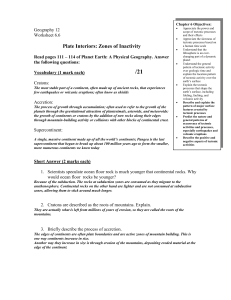
Geography 12
... scope of tectonic processes and their effects Appreciate the slowness of tectonic processes based on a human time scale Understand that the lithosphere is an everchanging part of a dynamic planet Understand the general pattern of tectonic activity over geologic time and explain the location pattern ...
... scope of tectonic processes and their effects Appreciate the slowness of tectonic processes based on a human time scale Understand that the lithosphere is an everchanging part of a dynamic planet Understand the general pattern of tectonic activity over geologic time and explain the location pattern ...

igneous rocks - Cloudfront.net
... Layers of Sedimentary Rock The layers that were deposited first will be on the bottom. So, oldest layers of rock are on the bottom and the newest layers of rock are on the top Layers of rock can be dated and can tell us a lot of information about the conditions and the species the lived when ...
... Layers of Sedimentary Rock The layers that were deposited first will be on the bottom. So, oldest layers of rock are on the bottom and the newest layers of rock are on the top Layers of rock can be dated and can tell us a lot of information about the conditions and the species the lived when ...

Notes: Rocks
... -cool quickly & have gas holes ex. pumice -cool at 2 speeds & have large & small crystals Formed from weathering of rocks into sediments that “cement” & harden together creating visible layering of sediments ( bedding), cracks , ripple marks & fossils. sediments that have been compacted & cemented t ...
... -cool quickly & have gas holes ex. pumice -cool at 2 speeds & have large & small crystals Formed from weathering of rocks into sediments that “cement” & harden together creating visible layering of sediments ( bedding), cracks , ripple marks & fossils. sediments that have been compacted & cemented t ...

Mid-Atlantic Ridge
... Continents have not always been in their present locations but have “drifted” there over millions of years. ...
... Continents have not always been in their present locations but have “drifted” there over millions of years. ...

Chapter 14 Geology and Earth Resources
... When sulfide ores are exposed to air and water, they produce sulfuric acid. Vast quantities of ore must be crushed and washed to obtain small quantities of metal; enormous amounts of freshwater are thereby contaminated with acid, arsenic, heavy metal. ...
... When sulfide ores are exposed to air and water, they produce sulfuric acid. Vast quantities of ore must be crushed and washed to obtain small quantities of metal; enormous amounts of freshwater are thereby contaminated with acid, arsenic, heavy metal. ...

Plate Tectonics – Study Guide
... 3. A ______ plant fossil found in a currently polar region is evidence that the _____ region was once tropical. 4. Identical fossils of species found on different continents may indicate those __________ were once joined. ...
... 3. A ______ plant fossil found in a currently polar region is evidence that the _____ region was once tropical. 4. Identical fossils of species found on different continents may indicate those __________ were once joined. ...

Plate Tectonics
... How Continents Grow • Magmatic differentiation: magma transferred to continents at subduction zones ...
... How Continents Grow • Magmatic differentiation: magma transferred to continents at subduction zones ...
The evolution of Life in the History of Earth
... Sedimentary rock – forms through compaction, cementation) lithification (e.g. compaction, Sedimentary rocks cover approximately 75% of the Earth’s surface (Sweden being an exception) ...
... Sedimentary rock – forms through compaction, cementation) lithification (e.g. compaction, Sedimentary rocks cover approximately 75% of the Earth’s surface (Sweden being an exception) ...

Nanaimo Group
... During the latter part of the Cretaceous Period (from around 85 to 65 million years ago), clastic sediments were deposited in a long trough-shaped basin extending from south of Duncan to north of Campbell River. Deposition probably began just after the micro-continent of Wrangellia - which comprises ...
... During the latter part of the Cretaceous Period (from around 85 to 65 million years ago), clastic sediments were deposited in a long trough-shaped basin extending from south of Duncan to north of Campbell River. Deposition probably began just after the micro-continent of Wrangellia - which comprises ...

Document
... 14.What is sea floor spreading? 15.What is the name of the plate we are located on and what type of boundary is associated with California. ...
... 14.What is sea floor spreading? 15.What is the name of the plate we are located on and what type of boundary is associated with California. ...

Rock and Roll
... 161. During the Paleozoic Era, the continents were joined together in a huge landmass called: a. Panthalassa b. Laurasia c. Pangaea d. Australia 162. The layers of limestone and shale in the Grand Canyon indicate that the area was once covered by a: a. shallow sea b. desert c. glacier d. forest 163. ...
... 161. During the Paleozoic Era, the continents were joined together in a huge landmass called: a. Panthalassa b. Laurasia c. Pangaea d. Australia 162. The layers of limestone and shale in the Grand Canyon indicate that the area was once covered by a: a. shallow sea b. desert c. glacier d. forest 163. ...

Rock and Mineral Targets
... I can identify and classify sedimentary rocks based on their properties. ...
... I can identify and classify sedimentary rocks based on their properties. ...

General Geology
... 2. DESCRIPTION OF THE COURSE: Includes the study of the origin and evolution of the Earth, the rocks and minerals which compose it, the processes which are constantly changing it, the concepts of relative and absolute time, the risks associated with geologic hazards, and the role of geology in shapi ...
... 2. DESCRIPTION OF THE COURSE: Includes the study of the origin and evolution of the Earth, the rocks and minerals which compose it, the processes which are constantly changing it, the concepts of relative and absolute time, the risks associated with geologic hazards, and the role of geology in shapi ...

Here - the Geological Society of Glasgow
... Lycopod ‘trees’ grew on a swampy river floodplain. In places the stumps of Lycopods, complete with roots, have been preserved. At Fossil Grove, a ‘grove’ of fossilised Lycopod stumps was excavated in the Limestone Coal Formation during mining. The fossils were preserved in-situ on their excavation i ...
... Lycopod ‘trees’ grew on a swampy river floodplain. In places the stumps of Lycopods, complete with roots, have been preserved. At Fossil Grove, a ‘grove’ of fossilised Lycopod stumps was excavated in the Limestone Coal Formation during mining. The fossils were preserved in-situ on their excavation i ...

Sedimentary Rocks and Depositional Environments
... Sediment has traveled far from source, so well rounded Common rocks: sandstone ...
... Sediment has traveled far from source, so well rounded Common rocks: sandstone ...

Chapter 14 text
... and water, they produce sulfuric acid. Vast quantities of ore must be crushed and washed to obtain small quantities of metal; enormous amounts of freshwater are thereby contaminated with acid, arsenic, heavy metal. ...
... and water, they produce sulfuric acid. Vast quantities of ore must be crushed and washed to obtain small quantities of metal; enormous amounts of freshwater are thereby contaminated with acid, arsenic, heavy metal. ...

Rocks
... Wind and water break down the earth Bits of earth settle in lakes and rivers Layers are formed and build up Pressure and time turn the layers to rock ...
... Wind and water break down the earth Bits of earth settle in lakes and rivers Layers are formed and build up Pressure and time turn the layers to rock ...

12.1 Evidence for Continental Drift
... continental shelves (original shorelines that are now underwater) The ...
... continental shelves (original shorelines that are now underwater) The ...

Webelos Earth Rocks Appalachian Geology Booklet
... Department of Geology * www.mckinneymuseum.appstate.edu * Appalachian State University (Boone, NC) ...
... Department of Geology * www.mckinneymuseum.appstate.edu * Appalachian State University (Boone, NC) ...

Unit1continetaldrift 3.40MB 2017-03-29 12:41:28
... As Wegener developed his ideas on the movement of continents it became clear that about 300 million years ago the continents were a single landmass called Pangaea. Over the next 100 million years this landmass drifted apart forming two distinct regions: Laurasia – In the Northern Hemisphere, made ...
... As Wegener developed his ideas on the movement of continents it became clear that about 300 million years ago the continents were a single landmass called Pangaea. Over the next 100 million years this landmass drifted apart forming two distinct regions: Laurasia – In the Northern Hemisphere, made ...
Geology of Great Britain

The geology of Great Britain is renowned for its diversity. As a result of its eventful geological history, Great Britain shows a rich variety of landscapes across the constituent countries of England, Wales and Scotland. Rocks of almost all geological ages are represented at outcrop, from the Archaean onwards.