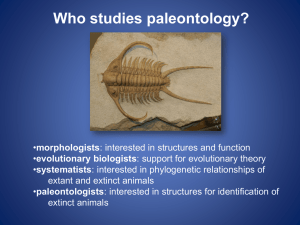
Biodiversity and Paleontology One: PowerPoint Presentation
... •Marine environments: e.g., continental shelf, carbonate platform, continental slope and rise, deep-ocean basin, evaporite environments. Paleoenvironmental interpretations are based upon the evidence found in the rocks, e.g., organisms, niche, habitat, water depth, etc. Different environmental setti ...
... •Marine environments: e.g., continental shelf, carbonate platform, continental slope and rise, deep-ocean basin, evaporite environments. Paleoenvironmental interpretations are based upon the evidence found in the rocks, e.g., organisms, niche, habitat, water depth, etc. Different environmental setti ...

rock cycle_pangea - Northside Middle School
... away from each other, and large faults form when plates slide past each other. ...
... away from each other, and large faults form when plates slide past each other. ...

How The Earth Works
... 35 minutes to birth of Christ 1 hour+ to pyramids 3 hours to retreat of glaciers from Wisconsin 12 days = 1 million years 2 years to extinction of dinosaurs 14 years to age of Niagara Escarpment 31 years = 1 billion years ...
... 35 minutes to birth of Christ 1 hour+ to pyramids 3 hours to retreat of glaciers from Wisconsin 12 days = 1 million years 2 years to extinction of dinosaurs 14 years to age of Niagara Escarpment 31 years = 1 billion years ...
Geol 201 - American University of Beirut
... This course is designed to provide the basic principles, and fundamental concepts of the various aspects of geological sciences. Emphasis will be on the internal structure of the Earth, properties of minerals, mineral groups, formation and behaviour of earth materials, description, classification, a ...
... This course is designed to provide the basic principles, and fundamental concepts of the various aspects of geological sciences. Emphasis will be on the internal structure of the Earth, properties of minerals, mineral groups, formation and behaviour of earth materials, description, classification, a ...

Earth: Chapter 1
... 2. form in ______________ and at high __________, where it is so cold _______ stays on the ground all year round B. ________________________ = form in mountainous areas 1. carve out rugged features in the ___________ rocks through which they flow a. horn = sharp ______ formed when _______ or more gl ...
... 2. form in ______________ and at high __________, where it is so cold _______ stays on the ground all year round B. ________________________ = form in mountainous areas 1. carve out rugged features in the ___________ rocks through which they flow a. horn = sharp ______ formed when _______ or more gl ...

A Head
... The fossils on some continents show that their climate must have been very different in the past. ...
... The fossils on some continents show that their climate must have been very different in the past. ...

What is the Earth System?
... b. Sedimentary - the accumulation/layering & compacting of small broken off pieces of preexisting rocks; sandstone, limestone, shale c. Metamorphic – rocks subjected to different temperatures & pressures to “change form”; ex. marble, slate, quartzite ...
... b. Sedimentary - the accumulation/layering & compacting of small broken off pieces of preexisting rocks; sandstone, limestone, shale c. Metamorphic – rocks subjected to different temperatures & pressures to “change form”; ex. marble, slate, quartzite ...


Practice Test-1 - Florida International University
... 11. The direction of magnetism in the sequence of geologic formations in the cross section (not a map) below indicates that this land ……. A) was near the south pole 100 million years ago and moved near the equator now B) was near the equator 100 million years ago and had moved to the north pole now. ...
... 11. The direction of magnetism in the sequence of geologic formations in the cross section (not a map) below indicates that this land ……. A) was near the south pole 100 million years ago and moved near the equator now B) was near the equator 100 million years ago and had moved to the north pole now. ...

Slide 1
... During this process, the oceanic crust and the continental crust push against each other. The oceanic crust is heavier, so it passes below the continental crust. Cracks in the continental crust are formed, and hot magma from the mantle is expelled out in the form of lava! ...
... During this process, the oceanic crust and the continental crust push against each other. The oceanic crust is heavier, so it passes below the continental crust. Cracks in the continental crust are formed, and hot magma from the mantle is expelled out in the form of lava! ...

Southwest Scotland: A landscape fashioned by geology
... Some of the rocks derived from great depth consist of minerals that are not very stable at the Earth's surface and so have been altered to 'serpentinite', so-called because of the sinuous patterns of red, green and brown that run through the rock and which were thought to be reminiscent of snake ski ...
... Some of the rocks derived from great depth consist of minerals that are not very stable at the Earth's surface and so have been altered to 'serpentinite', so-called because of the sinuous patterns of red, green and brown that run through the rock and which were thought to be reminiscent of snake ski ...

There are 4 main layers – the crust, the mantle, the outer core, and
... the magma cools to form the rock. The slower it takes to cool the more mineral grains will form. If it cools quickly, the rock will have a smoother, glassy texture. ...
... the magma cools to form the rock. The slower it takes to cool the more mineral grains will form. If it cools quickly, the rock will have a smoother, glassy texture. ...
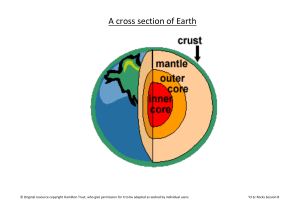
Cross section of the Earth
... The Earth is a sphere with a diameter of 12,700m. As we go deeper and deeper into the Earth the temperature & pressure rises. Considering the size of the planet, the Crust is very thin. We live on this outer layer. It is made of hard rocks that have been wrinkled & bent to make mountains and val ...
... The Earth is a sphere with a diameter of 12,700m. As we go deeper and deeper into the Earth the temperature & pressure rises. Considering the size of the planet, the Crust is very thin. We live on this outer layer. It is made of hard rocks that have been wrinkled & bent to make mountains and val ...

File
... ____10. Oceanic J. Having to do with volcanoes, having to do with something angry or violent Part II: How to use our vocabulary words (all words will be used, no words will be repeated). 1-3. Sedimentary rocks often occur in layers because of the processes that form them like, _____________, when se ...
... ____10. Oceanic J. Having to do with volcanoes, having to do with something angry or violent Part II: How to use our vocabulary words (all words will be used, no words will be repeated). 1-3. Sedimentary rocks often occur in layers because of the processes that form them like, _____________, when se ...

THE ZOLLVEREIN COAL MINE INDUSTRIAL COMPLEX
... sandstones with intercalated beds of bituminous coal. With the onset of orogenesis towards the end of the Carboniferous, deposition ceased and the rocks were subsequently broken, folded, and faulted into numerous grabens and horsts. Carboniferous beds crop out in the southern city area and along bot ...
... sandstones with intercalated beds of bituminous coal. With the onset of orogenesis towards the end of the Carboniferous, deposition ceased and the rocks were subsequently broken, folded, and faulted into numerous grabens and horsts. Carboniferous beds crop out in the southern city area and along bot ...

Rock Cycle {PowerPoint}
... The student knows that cycles exist in Earth systems. The student is expected to A ...
... The student knows that cycles exist in Earth systems. The student is expected to A ...

Geology of the Kingston Area – 1.1 Billion Years of History
... end of the outcrop, the rock is a very resistant quartzite, which stands higher than the south end which is predominantly softer gneiss that more easily eroded away. At the very south end of the outcrop is a prominent angled layer of boulders, overlain by flat-lying layers of limestone from about 47 ...
... end of the outcrop, the rock is a very resistant quartzite, which stands higher than the south end which is predominantly softer gneiss that more easily eroded away. At the very south end of the outcrop is a prominent angled layer of boulders, overlain by flat-lying layers of limestone from about 47 ...

Outstanding geologic feature of Pennsylvania—Midway
... Burgoon Sandstone, a coarse-grained, crossbedded sedimentary rock that originated as sand carried by streams more than 330 million years ago from weathering highlands to the southeast. The sand included a scattering of white quartz pebbles. Over time, these sediments were buried and turned to rock. ...
... Burgoon Sandstone, a coarse-grained, crossbedded sedimentary rock that originated as sand carried by streams more than 330 million years ago from weathering highlands to the southeast. The sand included a scattering of white quartz pebbles. Over time, these sediments were buried and turned to rock. ...

Rocks - Fort Thomas Independent Schools
... o Foliated -- aligned sheet or plate-like layered structure (gneiss and schist) o Non-foliated – non aligned layers (marble and slate) ...
... o Foliated -- aligned sheet or plate-like layered structure (gneiss and schist) o Non-foliated – non aligned layers (marble and slate) ...

Rocks - Fort Thomas Independent Schools
... • Classified based on texture • Foliated -- aligned sheet or plate-like layered structure (gneiss and schist) • Non-foliated – non aligned layers (marble and slate) ...
... • Classified based on texture • Foliated -- aligned sheet or plate-like layered structure (gneiss and schist) • Non-foliated – non aligned layers (marble and slate) ...

Rocks and Minerals Study Guide
... What does foliated mean? What are vesicles, and what type of rock has them? Explain how granite would be turned to sanstone. What causes the uplift, folding and faulting that moves rocks through the rock cycle? What is the texture of slate? What two terms are used to describe the texture of metamorp ...
... What does foliated mean? What are vesicles, and what type of rock has them? Explain how granite would be turned to sanstone. What causes the uplift, folding and faulting that moves rocks through the rock cycle? What is the texture of slate? What two terms are used to describe the texture of metamorp ...


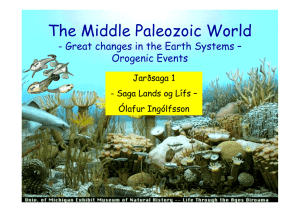
The Middle Paleozoic World - Age of the Fishes and the land Plants
... and Europe led to mountain building and associated sedimentation across most of Ireland, Wales, northern England, Scotland and Norway. This orogeny is parallel in timing and cause to the Acadian Orogeny of the northern Appalachians during the Devonian. A large landmass--the so-called Old Red Contine ...
... and Europe led to mountain building and associated sedimentation across most of Ireland, Wales, northern England, Scotland and Norway. This orogeny is parallel in timing and cause to the Acadian Orogeny of the northern Appalachians during the Devonian. A large landmass--the so-called Old Red Contine ...

Rocks
... 1. How does an igneous rock change into a sedimentary rock? 2. How does a sedimentary rock change into a metamorphic rock? 3. How does a metamorphic rock change into an igneous rock? 4. What is an index mineral? 5. How are metamorphic rocks classified? ...
... 1. How does an igneous rock change into a sedimentary rock? 2. How does a sedimentary rock change into a metamorphic rock? 3. How does a metamorphic rock change into an igneous rock? 4. What is an index mineral? 5. How are metamorphic rocks classified? ...
Geology of Great Britain

The geology of Great Britain is renowned for its diversity. As a result of its eventful geological history, Great Britain shows a rich variety of landscapes across the constituent countries of England, Wales and Scotland. Rocks of almost all geological ages are represented at outcrop, from the Archaean onwards.