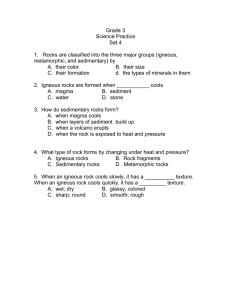
Science Practice set 4
... 1. Rocks are classified into the three major groups (igneous, metamorphic, and sedimentary) by A. their color B. their size C. their formation d. the types of minerals in them 2. Igneous rocks are formed when ___________ cools. A. magma B. sediment C. water D. stone 3. How do sedimentary rocks form? ...
... 1. Rocks are classified into the three major groups (igneous, metamorphic, and sedimentary) by A. their color B. their size C. their formation d. the types of minerals in them 2. Igneous rocks are formed when ___________ cools. A. magma B. sediment C. water D. stone 3. How do sedimentary rocks form? ...

Plate Movements and Continental Growth
... a plate boundary today. Geologic evidence indicates that each range formed in the distant past at a plate boundary that no longer exists. The Appalachian Mountains formed when North America collided with Africa hundreds of millions of years ago. The Ural Mountains formed when separate lithospheric p ...
... a plate boundary today. Geologic evidence indicates that each range formed in the distant past at a plate boundary that no longer exists. The Appalachian Mountains formed when North America collided with Africa hundreds of millions of years ago. The Ural Mountains formed when separate lithospheric p ...

Instructor Copy
... Instructor’s Copy Rocks How can rocks be identified? Rocks may show ripple marks, mudcracks, raindrops and fossils. Can often see sand, pebbles, or stones in the rock. ...
... Instructor’s Copy Rocks How can rocks be identified? Rocks may show ripple marks, mudcracks, raindrops and fossils. Can often see sand, pebbles, or stones in the rock. ...

Week 11 – SEDIMENTARY ROCKS
... Sedimentary rocks hold clues to past life and to past environments. a. Sedimentary rocks may contain FOSSILS (evidence of past life). i. The fossils hold clues to past environment. ii. The fact that fossil shark teeth have been found on the summit of Mt. Everest tells us that those rocks were formed ...
... Sedimentary rocks hold clues to past life and to past environments. a. Sedimentary rocks may contain FOSSILS (evidence of past life). i. The fossils hold clues to past environment. ii. The fact that fossil shark teeth have been found on the summit of Mt. Everest tells us that those rocks were formed ...

Earth materials
... been found for Wegeners theory • The Earths North and South pole have flipped many times • These leaves magnetic ‘stripes’ in rock containing iron minerals ...
... been found for Wegeners theory • The Earths North and South pole have flipped many times • These leaves magnetic ‘stripes’ in rock containing iron minerals ...

3 Types of Rocks – PowerPoint Igneous Rocks are formed by: They
... Likely to form in these areas: 2 Groups: Clastic are made of ____________ of other ______________ that have been ______________________ or ___________________. How are they grouped? Mudrock has Sandstone has Conglomerates have Biochemical rocks form from Chemical precipitates form in What conditions ...
... Likely to form in these areas: 2 Groups: Clastic are made of ____________ of other ______________ that have been ______________________ or ___________________. How are they grouped? Mudrock has Sandstone has Conglomerates have Biochemical rocks form from Chemical precipitates form in What conditions ...
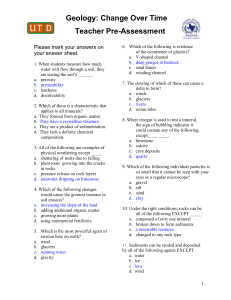
Teacher Pre-assessment
... a. the cementation of rock fragments b. the carrying away of sediment c. the development of mineral crystals d. the decomposition of organisms 24. Fossils are generally found in what type of rocks? a. rocks from volcanoes b. sedimentary rocks c. metamorphic rocks d. rocks containing quartz 25. Which ...
... a. the cementation of rock fragments b. the carrying away of sediment c. the development of mineral crystals d. the decomposition of organisms 24. Fossils are generally found in what type of rocks? a. rocks from volcanoes b. sedimentary rocks c. metamorphic rocks d. rocks containing quartz 25. Which ...

Metamorphic Igneous Sedimentary 3 Major Groups of Rocks
... Rock-forming and rock-destroying processes have been active for billions of years. Today, in the Guadalupe Mountains of western Texas, one can stand on limestone, a sedimentary rock, that was a coral reef in a tropical sea about 250 million years ago. In fact, Texas contains mostly sedimentary rock ...
... Rock-forming and rock-destroying processes have been active for billions of years. Today, in the Guadalupe Mountains of western Texas, one can stand on limestone, a sedimentary rock, that was a coral reef in a tropical sea about 250 million years ago. In fact, Texas contains mostly sedimentary rock ...

Geology of Vermont by Brewster Baldwin
... faster than the ice itself was oozing south. By 5,000 years ago the ice had largely melted from the mountains of Vermont, but one lobe remained in the Champlain Valley. Weight of the ice had depressed the crust so that ancient Lake Vermont formed against the south end of the lobe. The lake drained s ...
... faster than the ice itself was oozing south. By 5,000 years ago the ice had largely melted from the mountains of Vermont, but one lobe remained in the Champlain Valley. Weight of the ice had depressed the crust so that ancient Lake Vermont formed against the south end of the lobe. The lake drained s ...

Mgr. Petr Schnabl - Dissertation Paleomagnetism and
... is to determine the history of the Earths’ magnetic field from the Silurian to the present. Two lithostratigraphic formations are defined in the Jičín volcanic field on the basis of volcanology, paleomagnetism and radiometric dating. The Trosky Formation (24.6?/18.3 – 15.7 Ma) is composed of several ...
... is to determine the history of the Earths’ magnetic field from the Silurian to the present. Two lithostratigraphic formations are defined in the Jičín volcanic field on the basis of volcanology, paleomagnetism and radiometric dating. The Trosky Formation (24.6?/18.3 – 15.7 Ma) is composed of several ...

8.4 Plate Movement and Continental Growth
... tectonics, igneous activity, and deposition in the formation of continental land masses. ...
... tectonics, igneous activity, and deposition in the formation of continental land masses. ...
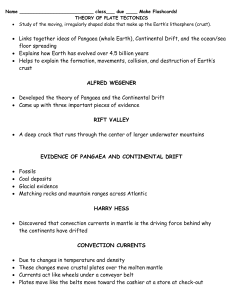
PLATE TECHTONICS
... Links together ideas of Pangaea (whole Earth), Continental Drift, and the ocean/sea floor spreading Explains how Earth has evolved over 4.5 billion years Helps to explain the formation, movements, collision, and destruction of Earth’s crust ALFRED WEGENER Developed the theory of Pangaea and ...
... Links together ideas of Pangaea (whole Earth), Continental Drift, and the ocean/sea floor spreading Explains how Earth has evolved over 4.5 billion years Helps to explain the formation, movements, collision, and destruction of Earth’s crust ALFRED WEGENER Developed the theory of Pangaea and ...
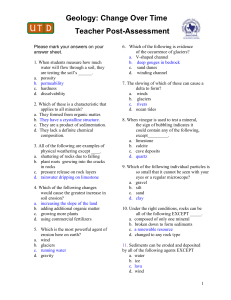
Molten rock that comes to the surface of the earth is called:
... a. the cementation of rock fragments b. the carrying away of sediment c. the development of mineral crystals d. the decomposition of organisms 24. Fossils are generally found in what type of rocks? a. rocks from volcanoes b. sedimentary rocks c. metamorphic rocks d. rocks containing quartz 25. Which ...
... a. the cementation of rock fragments b. the carrying away of sediment c. the development of mineral crystals d. the decomposition of organisms 24. Fossils are generally found in what type of rocks? a. rocks from volcanoes b. sedimentary rocks c. metamorphic rocks d. rocks containing quartz 25. Which ...
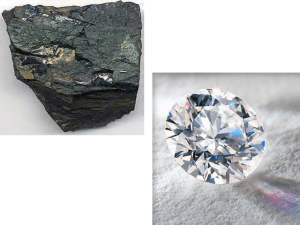
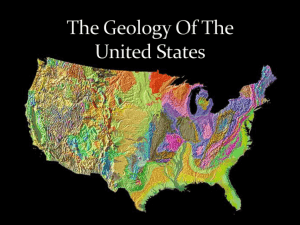
GeologyOfTheUS
... Modern Rocky Mountains created by the Laramide Orogeny. Current topography result of erosion after Neogene uplift and ...
... Modern Rocky Mountains created by the Laramide Orogeny. Current topography result of erosion after Neogene uplift and ...

Chapter 3 – Rocks
... Erosion - transportation of material. Deposition - When an agent of erosion (water, wind, ice, or gravity) lose energy and sediments drop back to the ground ...
... Erosion - transportation of material. Deposition - When an agent of erosion (water, wind, ice, or gravity) lose energy and sediments drop back to the ground ...
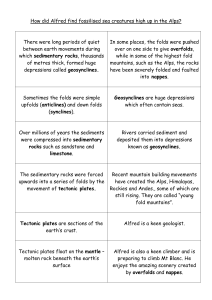
How did Alfred find fossilised sea animals high up in the Alps
... highest peak is Mt Blanc in France at 4810 m ...
... highest peak is Mt Blanc in France at 4810 m ...

Unit 3 Geochemical Cycles in the Earth`s System
... • ______ – remains of plants in swamps • Formed by ____________ (release of gases due to bacteria) • ________ – partial decomp • _________ – more dense • ______________ coal – further compressed, most abundant • ____________ – hardest form of coal due to pressure ...
... • ______ – remains of plants in swamps • Formed by ____________ (release of gases due to bacteria) • ________ – partial decomp • _________ – more dense • ______________ coal – further compressed, most abundant • ____________ – hardest form of coal due to pressure ...
SCI Ch4 Study Guide KEY
... What theory does this support? Continental drift 5. What is glossopteris? A fossil plant that helps support the theory of continental drift 6. Why does sea floor spreading occur? Molten material beneath Earth’s crust rises to the surface 7. What type of currents inside Earth might be a cause of sea ...
... What theory does this support? Continental drift 5. What is glossopteris? A fossil plant that helps support the theory of continental drift 6. Why does sea floor spreading occur? Molten material beneath Earth’s crust rises to the surface 7. What type of currents inside Earth might be a cause of sea ...

Science Chapter 4 Study Guide Vocabulary
... minerals--the basic building block of rocks (example-sulfur, salt) conservation—to use resources wisely (example—turn off lights) Sedimentary Rocks—rocks made of sand or sediment and is pressed into layers. This would be a good place to find a fossil. (ex. Sandstone, shale) Igneous Rocks—made from m ...
... minerals--the basic building block of rocks (example-sulfur, salt) conservation—to use resources wisely (example—turn off lights) Sedimentary Rocks—rocks made of sand or sediment and is pressed into layers. This would be a good place to find a fossil. (ex. Sandstone, shale) Igneous Rocks—made from m ...

1 Billion Years Ago 450 Million Years Ago 400 Million Years Ago
... standing near a soaring mountain range on a giant continent called Pangea. The rocks you see today were formed on the floor of an ancient ocean that divided that continent as plates in the Earth’s crust moved apart. Today’s Green Mountains formed as these plates eventually collided again, closing th ...
... standing near a soaring mountain range on a giant continent called Pangea. The rocks you see today were formed on the floor of an ancient ocean that divided that continent as plates in the Earth’s crust moved apart. Today’s Green Mountains formed as these plates eventually collided again, closing th ...

geology
... standing near a soaring mountain range on a giant continent called Pangea. The rocks you see today were formed on the floor of an ancient ocean that divided that continent as plates in the Earth’s crust moved apart. Today’s Green Mountains formed as these plates eventually collided again, closing th ...
... standing near a soaring mountain range on a giant continent called Pangea. The rocks you see today were formed on the floor of an ancient ocean that divided that continent as plates in the Earth’s crust moved apart. Today’s Green Mountains formed as these plates eventually collided again, closing th ...
Earth Processes Part 1: Lithosphere
... Chemical weathering (composition changed) Erosion -the process by which Earth materials are moved from one place to another. •Wind (rain, waves), water, gravity, ice, organisms ...
... Chemical weathering (composition changed) Erosion -the process by which Earth materials are moved from one place to another. •Wind (rain, waves), water, gravity, ice, organisms ...

George Cuvier (1769 – 1832) Introduced the concept of
... George Cuvier (1769 – 1832) Introduced the concept of catastrophism Six major catastrophes from the bible o Most recent was the great flood (Noah’s Ark) Abraham Werner (1749 -1817) Challenged catastrophism Neptunism: rocks form from crystallization in the early earth’s oceans James Hutton (1726 – 17 ...
... George Cuvier (1769 – 1832) Introduced the concept of catastrophism Six major catastrophes from the bible o Most recent was the great flood (Noah’s Ark) Abraham Werner (1749 -1817) Challenged catastrophism Neptunism: rocks form from crystallization in the early earth’s oceans James Hutton (1726 – 17 ...

1 billion years ago
... continental mass earth scientists call “Avalonia” collided with eastern North America. ...
... continental mass earth scientists call “Avalonia” collided with eastern North America. ...
Geology of Great Britain

The geology of Great Britain is renowned for its diversity. As a result of its eventful geological history, Great Britain shows a rich variety of landscapes across the constituent countries of England, Wales and Scotland. Rocks of almost all geological ages are represented at outcrop, from the Archaean onwards.