
rocks - Mrs. DiLorenzo Earth Science
... How do Sedimentary Rocks form? 1. Cementation: occurs when clasts are cemented together. – Calcite, quartz, & hematite are common cements. – Clastic Sedimentary Rocks: mainly composed of solid sediments ...
... How do Sedimentary Rocks form? 1. Cementation: occurs when clasts are cemented together. – Calcite, quartz, & hematite are common cements. – Clastic Sedimentary Rocks: mainly composed of solid sediments ...

Rocks - I Teach Bio
... Wind and water break down the earth Bits of earth settle in lakes and rivers Layers are formed and build up Pressure and time turn the layers to rock ...
... Wind and water break down the earth Bits of earth settle in lakes and rivers Layers are formed and build up Pressure and time turn the layers to rock ...

A Brief Summary of New England (Massachusetts
... al., 1998). These rocks were further modified during Mesozoic extension associated with the opening of the modern Atlantic, involving faulting with vertical displacements as great as 8 km (i.e. Connecticut Valley Border Fault). The western part of Massachusetts consists of rocks that formed on or ne ...
... al., 1998). These rocks were further modified during Mesozoic extension associated with the opening of the modern Atlantic, involving faulting with vertical displacements as great as 8 km (i.e. Connecticut Valley Border Fault). The western part of Massachusetts consists of rocks that formed on or ne ...

Rocks and Minerals
... • Weathering breaks down rocks into sediment. • Erosion is the movement of that sediment. • Deposition is the process where the sediment is dropped off. ...
... • Weathering breaks down rocks into sediment. • Erosion is the movement of that sediment. • Deposition is the process where the sediment is dropped off. ...

Rocks and the Rock Cycle
... rocks from one kind to another over long periods of time. But what are these igneous, sedimentary, and metamorphic rocks anyway? ...
... rocks from one kind to another over long periods of time. But what are these igneous, sedimentary, and metamorphic rocks anyway? ...

plate tectonics - mfischerscience
... first real theory of continental drift in 1912. He proposed: • The idea of Pangaea, a single landmass. • That the continents began to split apart 200 million years ago (MYA). • That continents slowly moved to their present positions. ...
... first real theory of continental drift in 1912. He proposed: • The idea of Pangaea, a single landmass. • That the continents began to split apart 200 million years ago (MYA). • That continents slowly moved to their present positions. ...

Sedimentary Rocks
... - Weathering agents wind, rain, rockslides, acid rain, ice - These can break up rocks into smaller pieces called sediment ...
... - Weathering agents wind, rain, rockslides, acid rain, ice - These can break up rocks into smaller pieces called sediment ...

Chp 12.1- Evidence for Continental Drift
... • Continental drift occurs because of areas like these ridges that PUSH along tectonic plates floating on Earth’s surface. • Geologic HOT SPOTS are anywhere magma rises to Earth’s ...
... • Continental drift occurs because of areas like these ridges that PUSH along tectonic plates floating on Earth’s surface. • Geologic HOT SPOTS are anywhere magma rises to Earth’s ...

GeomorphReview1 - University of Colorado Denver
... evidence toward unveiling the state of our planet in earlier times, and that the truth of the matter can only be reached by combing all this evidence...It is only by combing the information furnished by all the earth sciences that we can hope to determine ‘truth’ here, that is to say, to find the pi ...
... evidence toward unveiling the state of our planet in earlier times, and that the truth of the matter can only be reached by combing all this evidence...It is only by combing the information furnished by all the earth sciences that we can hope to determine ‘truth’ here, that is to say, to find the pi ...

sedmentary rocks 1
... Sedimentary structures: tell about depositional environment. Fossils: tell about depositional environment and age of deposit. ...
... Sedimentary structures: tell about depositional environment. Fossils: tell about depositional environment and age of deposit. ...

Petroleum - Research at UVU
... • Reservoir Rock - Sedimentary rock in which oil accumulates; must contain abundant pore spaces and have relatively high permeability; typically sandstone or limestone • Seal Rock - Impermeable sedimentary rock that blocks upward flow of oil and prevents it from escaping the reservoir rock layer; ty ...
... • Reservoir Rock - Sedimentary rock in which oil accumulates; must contain abundant pore spaces and have relatively high permeability; typically sandstone or limestone • Seal Rock - Impermeable sedimentary rock that blocks upward flow of oil and prevents it from escaping the reservoir rock layer; ty ...

How The Earth Works
... 35 minutes to birth of Christ 1 hour+ to pyramids 3 hours to retreat of glaciers from Wisconsin 12 days = 1 million years 2 years to extinction of dinosaurs 14 years to age of Niagara Escarpment 31 years = 1 billion years ...
... 35 minutes to birth of Christ 1 hour+ to pyramids 3 hours to retreat of glaciers from Wisconsin 12 days = 1 million years 2 years to extinction of dinosaurs 14 years to age of Niagara Escarpment 31 years = 1 billion years ...

The Esk Valley - Edinburgh Geological Society
... began melting around 19,000 years ago. The ice was concentrated between the Pentland and Moorfoot Hills, where the River Esk is situated, and left evidence such as boulder clay, meltwater channels and striations. As the climate warmed, the ice melted. Initially most of the water flowed within the ic ...
... began melting around 19,000 years ago. The ice was concentrated between the Pentland and Moorfoot Hills, where the River Esk is situated, and left evidence such as boulder clay, meltwater channels and striations. As the climate warmed, the ice melted. Initially most of the water flowed within the ic ...
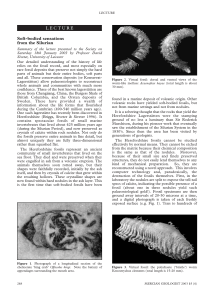
Mercian 2003 v15 p248 Soft-bodied Silurian fossils, Siveter
... Basin) it is possible to reconstruct a stratigraphy that can explain this lost thickness. As the Cheshire Basin was a major Triassic depositional centre, it is likely that, in the context of British regional geology, it also once had a thick Jurassic cover. The Prees outlier, in the southern part of ...
... Basin) it is possible to reconstruct a stratigraphy that can explain this lost thickness. As the Cheshire Basin was a major Triassic depositional centre, it is likely that, in the context of British regional geology, it also once had a thick Jurassic cover. The Prees outlier, in the southern part of ...

Plate Tectonics 1. Continental Drift
... -Ex. Appalachians and mountains in Scotland and Northern Europe 5) Climactic changes seen in geologic record -Pangea once positioned over South Pole forming glaciers in South Africa and South America -Coal deposits in North America (once covered by tropical or subtropical swamps) -Wegner didn’t know ...
... -Ex. Appalachians and mountains in Scotland and Northern Europe 5) Climactic changes seen in geologic record -Pangea once positioned over South Pole forming glaciers in South Africa and South America -Coal deposits in North America (once covered by tropical or subtropical swamps) -Wegner didn’t know ...

Geology of the Santa Cruz Mountains
... junction with San Francisquito Creek. Contemporaneous with this ancient sea was a volcano near Stanford which sent lava flows out over a distance of several square miles. The quarry on Old Page Mill Road exposes this lava flow of Miocene basalt, a dark rock overlain by light colored sandstone. Durin ...
... junction with San Francisquito Creek. Contemporaneous with this ancient sea was a volcano near Stanford which sent lava flows out over a distance of several square miles. The quarry on Old Page Mill Road exposes this lava flow of Miocene basalt, a dark rock overlain by light colored sandstone. Durin ...

STAGE I – Formation of Multiple Ore Deposits
... Tectonic processes are dynamic and, over time, compressive conditions often reverse to extensional conditions where plates are drawn apart by opposing forces. This is typically accommodated by development of normal faults and grabens which allow the plate to “stretch out”. The deformational history ...
... Tectonic processes are dynamic and, over time, compressive conditions often reverse to extensional conditions where plates are drawn apart by opposing forces. This is typically accommodated by development of normal faults and grabens which allow the plate to “stretch out”. The deformational history ...

Geology and Hydrology of Khwisero District, Kenya
... Shivakala Fm and its deposition by braided streams that are carrying coarse material from basin flanks to the basin The Kavirondian Basin is then below sea level during deposition of Igukhu and Mudaa Fm The Igukhu and Mudaa Fm were both deposited by turbidity currents and the Igukhu is more proximal ...
... Shivakala Fm and its deposition by braided streams that are carrying coarse material from basin flanks to the basin The Kavirondian Basin is then below sea level during deposition of Igukhu and Mudaa Fm The Igukhu and Mudaa Fm were both deposited by turbidity currents and the Igukhu is more proximal ...

Earth Science Introduction
... • 35 minutes to birth of Christ • 1 hour+ to pyramids • 3 hours to retreat of glaciers from Wisconsin • 12 days = 1 million years • 2 years to extinction of dinosaurs • 14 years to age of Niagara Escarpment • 31 years = 1 billion years ...
... • 35 minutes to birth of Christ • 1 hour+ to pyramids • 3 hours to retreat of glaciers from Wisconsin • 12 days = 1 million years • 2 years to extinction of dinosaurs • 14 years to age of Niagara Escarpment • 31 years = 1 billion years ...

Rock Types - Volcanoes Alive!
... the surrounding rock. These rocks are coarse grained. An example is granite. Extrusive igneous rocks, on the other hand, are formed when magma reaches the surface of Earth and cools quickly. Mineral crystals cannot grow very large during this rapid cooling, so the rocks are fine grained. Texture can ...
... the surrounding rock. These rocks are coarse grained. An example is granite. Extrusive igneous rocks, on the other hand, are formed when magma reaches the surface of Earth and cools quickly. Mineral crystals cannot grow very large during this rapid cooling, so the rocks are fine grained. Texture can ...

Yr 7 Rocks and Fossils Unit Overview
... contain minerals and are formed by processes that occur within Earth over a variety of timescales. In this unit students will Understand that the earth is made of layers Explain how volcanoes are formed, lava flows and types of rocks formed by the cooling of lava. Understand that different typ ...
... contain minerals and are formed by processes that occur within Earth over a variety of timescales. In this unit students will Understand that the earth is made of layers Explain how volcanoes are formed, lava flows and types of rocks formed by the cooling of lava. Understand that different typ ...

EarthScience_Quiz_Ch3
... d) It was formed through the deposition of sediment in a low-energy environment, such as a lagoon. _____4. What does the presence of limestone in the central United States suggest about the past environment of this region? a) The region once had an arid climate. b) The region was once covered by fas ...
... d) It was formed through the deposition of sediment in a low-energy environment, such as a lagoon. _____4. What does the presence of limestone in the central United States suggest about the past environment of this region? a) The region once had an arid climate. b) The region was once covered by fas ...

introduction to encinitas geology - SDSU geology
... You might have a question at this point. If these sedimentary rocks were formed near the ocean and were buried over 50 million years ago, how come they are at the surface today and high above the level of the sea? Good question! The Earth’s upper surface is made up of many large pieces called tecto ...
... You might have a question at this point. If these sedimentary rocks were formed near the ocean and were buried over 50 million years ago, how come they are at the surface today and high above the level of the sea? Good question! The Earth’s upper surface is made up of many large pieces called tecto ...

3. Caledonian Orogenesis
... 1. Name the orogenic belt that formed in Britain during the Lower Palaeozoic. 2. When was this orogenesis completed by? 3. What two continents collided during this orogenesis? 4. What was the ocean that was destroyed? 5. What areas in Britain were affected? 6. What is the general trend of the struct ...
... 1. Name the orogenic belt that formed in Britain during the Lower Palaeozoic. 2. When was this orogenesis completed by? 3. What two continents collided during this orogenesis? 4. What was the ocean that was destroyed? 5. What areas in Britain were affected? 6. What is the general trend of the struct ...
Geology of Great Britain

The geology of Great Britain is renowned for its diversity. As a result of its eventful geological history, Great Britain shows a rich variety of landscapes across the constituent countries of England, Wales and Scotland. Rocks of almost all geological ages are represented at outcrop, from the Archaean onwards.