
Slide 1
... • There were many American Indians • American Indians have lived in Glacier National Park for more then 10,000 years. • The Blackfeet, the Kalispell, the Kootenai, the Salish, and the flathead were all early residents of the area. • The Blackfeet controlled most of the land ...
... • There were many American Indians • American Indians have lived in Glacier National Park for more then 10,000 years. • The Blackfeet, the Kalispell, the Kootenai, the Salish, and the flathead were all early residents of the area. • The Blackfeet controlled most of the land ...

Earth Science 2007-2008 Final Study Guide
... A wave generated by an earthquake in the ocean is called a tsunami. The probability of an earthquake is based on history and the places on a fault that have not experienced a quake for a while is called a seismic gap. ...
... A wave generated by an earthquake in the ocean is called a tsunami. The probability of an earthquake is based on history and the places on a fault that have not experienced a quake for a while is called a seismic gap. ...

The district is situated in a complex zone of intrusions on the
... Weldedlapilli- to block-bearingcrystaltuff, tuff brecciaandtuffite of the LantauFonnation(RepulseBay Volcanic Group) is exposedin the extremesouthwestern part of the district. Theserocks are thoughtto occupy an ancientcaldera fonning the centralpart of LantauIsland. They are assignedto the Repulse B ...
... Weldedlapilli- to block-bearingcrystaltuff, tuff brecciaandtuffite of the LantauFonnation(RepulseBay Volcanic Group) is exposedin the extremesouthwestern part of the district. Theserocks are thoughtto occupy an ancientcaldera fonning the centralpart of LantauIsland. They are assignedto the Repulse B ...

Time - Research School of Earth Sciences
... books on similar subject, the research and lectures of my colleagues from various universities around the world, my own research, and finally, numerous web sites. I am grateful for some figures I used in this lecture to E. Garnero and L. Breger. I am thankful to many others who make their research a ...
... books on similar subject, the research and lectures of my colleagues from various universities around the world, my own research, and finally, numerous web sites. I am grateful for some figures I used in this lecture to E. Garnero and L. Breger. I am thankful to many others who make their research a ...

Topic 10: GEOLOGY of SYDNEY REGION
... ridgetops. When deeply buried, crystallisation and recrystallization of the constituent quartz has produced sandstone with a range of hardness. Part is now solid hard quartzite. In some bands with residual porosity the quartz sand grains developed overgrowths extending into cavities between the grai ...
... ridgetops. When deeply buried, crystallisation and recrystallization of the constituent quartz has produced sandstone with a range of hardness. Part is now solid hard quartzite. In some bands with residual porosity the quartz sand grains developed overgrowths extending into cavities between the grai ...
Continental Drift - sciencewithskinner
... 2. Geological - Age and type of rocks match - Mountain ranges fit together ...
... 2. Geological - Age and type of rocks match - Mountain ranges fit together ...

III. SEDIMENTARY ROCK
... BIG Idea Most rocks are formed from pre-existing rocks through external and internal geologic processes. ...
... BIG Idea Most rocks are formed from pre-existing rocks through external and internal geologic processes. ...

GEOS1901 SKOU
... Wind, glaciers, shoreline currents: activity is restricted to special climate zones Dissolved minerals carried in solution and are ultimately precipitated as limestone or salt Human interactions Cross-bedding: layers in a strata which are inclined at an angle – sand grains are moved by wind/water, f ...
... Wind, glaciers, shoreline currents: activity is restricted to special climate zones Dissolved minerals carried in solution and are ultimately precipitated as limestone or salt Human interactions Cross-bedding: layers in a strata which are inclined at an angle – sand grains are moved by wind/water, f ...


7th Grade Science Unit 3 Vocabulary Uniformitarianism
... Radiometric Dating- A method of determining the absolute age of an object by comparing the relative percentages of a radioactive parent isotope and a stable daughter isotope. ...
... Radiometric Dating- A method of determining the absolute age of an object by comparing the relative percentages of a radioactive parent isotope and a stable daughter isotope. ...
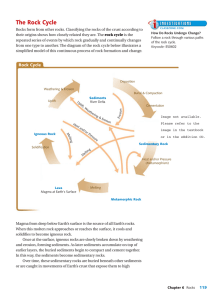

Oceanography Worksheet #1
... Base your answers to questions 4- 7 on the diagram below. The diagram shows ocean waves approaching a shoreline. A groin (a short wall of rocks perpendicular to the shoreline) and a breakwater (an offshore structure) have been constructed along the beach. Letters A, B, C, D, and E represent locatio ...
... Base your answers to questions 4- 7 on the diagram below. The diagram shows ocean waves approaching a shoreline. A groin (a short wall of rocks perpendicular to the shoreline) and a breakwater (an offshore structure) have been constructed along the beach. Letters A, B, C, D, and E represent locatio ...

Early Paleozoic - This Old Earth
... Abrupt end with onset of subduction and ocean closure during Middle Ordovician ...
... Abrupt end with onset of subduction and ocean closure during Middle Ordovician ...

Physical Geography - Brogranoni-GEO1
... As far back as 1620, Francis Bacon spotted that the west coast of Africa and the east coast of South America looked as if they would fit together, like pieces of a jigsaw. Between then and 1912 other people identified further similarities between other continental coastlines, but it was only in 1912 ...
... As far back as 1620, Francis Bacon spotted that the west coast of Africa and the east coast of South America looked as if they would fit together, like pieces of a jigsaw. Between then and 1912 other people identified further similarities between other continental coastlines, but it was only in 1912 ...


Outstanding geologic feature of Pennsylvania—Governor Dick
... and limestones underlie the Great Valley. Beyond that, one can see Blue Mountain, which is capped by Silurian-age Tuscarora sandstone (approximately 440 million years old). Even further north are higher ridges of Pennsylvanian-age rocks (323 to 299 million years old). These rocks are part of the Ant ...
... and limestones underlie the Great Valley. Beyond that, one can see Blue Mountain, which is capped by Silurian-age Tuscarora sandstone (approximately 440 million years old). Even further north are higher ridges of Pennsylvanian-age rocks (323 to 299 million years old). These rocks are part of the Ant ...

Igneous Rocks
... magma cools very slowly forming large crystals in rocks such as granite. • Volcanic rocks are igneous rocks that form above the earth's surface. They cool quickly and form small crystals. Example are basalt (made from lava) and pumicestone (formed when lava is forcefully ejected from a volcano and a ...
... magma cools very slowly forming large crystals in rocks such as granite. • Volcanic rocks are igneous rocks that form above the earth's surface. They cool quickly and form small crystals. Example are basalt (made from lava) and pumicestone (formed when lava is forcefully ejected from a volcano and a ...

TAYSIDE – A LAND MOULDED FROM ROCK AND ICE
... World Famous Fish, Insects and Plants - Devonian and Carboniferous Between 410 – 290 Ma Scotland was located 10 – 20° south of the Equator. Rainforest covered much of the Midland Valley to the south and coral reefs flourished in the surrounding tropical seas. The sedimentary and igneous rocks of thi ...
... World Famous Fish, Insects and Plants - Devonian and Carboniferous Between 410 – 290 Ma Scotland was located 10 – 20° south of the Equator. Rainforest covered much of the Midland Valley to the south and coral reefs flourished in the surrounding tropical seas. The sedimentary and igneous rocks of thi ...

A Brief Geologic History of the Hudson Valley
... The Ordovician saw the approach of a chain of volcanic islands. These islands, called a volcanic island arc, were formed by the subduction of oceanic crust off the coast of Laurentia. A modern analogue are the Aleutian Islands off Alaska where the Pacific seafloor is subducting beneath the Bering Se ...
... The Ordovician saw the approach of a chain of volcanic islands. These islands, called a volcanic island arc, were formed by the subduction of oceanic crust off the coast of Laurentia. A modern analogue are the Aleutian Islands off Alaska where the Pacific seafloor is subducting beneath the Bering Se ...

Understanding Our Environment
... Slide slowly across earth’s surface. - Ocean basins form where continents crack and pull apart. - Magma forced up through cracks in oceanic crust form mid-oceanic ridges. ...
... Slide slowly across earth’s surface. - Ocean basins form where continents crack and pull apart. - Magma forced up through cracks in oceanic crust form mid-oceanic ridges. ...
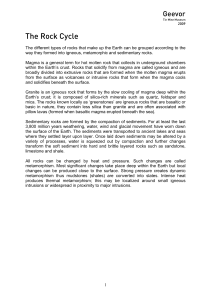
The Rock Cycle - Geevor Tin Mine
... Earth’s crust; it is composed of silica-rich minerals such as quartz, feldspar and mica. The rocks known locally as ‘greenstones’ are igneous rocks that are basaltic or basic in nature, they contain less silica than granite and are often associated with pillow lavas (formed when basaltic magma erupt ...
... Earth’s crust; it is composed of silica-rich minerals such as quartz, feldspar and mica. The rocks known locally as ‘greenstones’ are igneous rocks that are basaltic or basic in nature, they contain less silica than granite and are often associated with pillow lavas (formed when basaltic magma erupt ...


Rock Cycle Questions and Short Story
... Determine which type of rock was created by the following event: 1. Magma rose from the mantle and slowly cooled in a crack deep below the earth’s surface. 2. An earthquake shook a mountain causing an avalanche. The rocks fell down the side of a mountain and landed in a shallow ocean where they were ...
... Determine which type of rock was created by the following event: 1. Magma rose from the mantle and slowly cooled in a crack deep below the earth’s surface. 2. An earthquake shook a mountain causing an avalanche. The rocks fell down the side of a mountain and landed in a shallow ocean where they were ...

Sedimentary rocks
... The oldest meteorites and moon rocks found on earth are 4.6 billion years old. The oldest earth rocks found are zircon grains from a sandstone in western Australia, dated 4.1 - 4.2 billion years old. ...
... The oldest meteorites and moon rocks found on earth are 4.6 billion years old. The oldest earth rocks found are zircon grains from a sandstone in western Australia, dated 4.1 - 4.2 billion years old. ...

Fundamental Principles of Historical Geology
... Formation - a body of rock with distinctive lithology that is bounded by contacts. Must be thick enough to map (>20 feet thick). Outcrop or Exposure - where rocks are exposed at the earth’s surface. ...
... Formation - a body of rock with distinctive lithology that is bounded by contacts. Must be thick enough to map (>20 feet thick). Outcrop or Exposure - where rocks are exposed at the earth’s surface. ...
Geology of Great Britain

The geology of Great Britain is renowned for its diversity. As a result of its eventful geological history, Great Britain shows a rich variety of landscapes across the constituent countries of England, Wales and Scotland. Rocks of almost all geological ages are represented at outcrop, from the Archaean onwards.