
Unconformity
... sedimentary rock strata are parallel and the contact plane is an erosional surface= Disconformity ...
... sedimentary rock strata are parallel and the contact plane is an erosional surface= Disconformity ...

Geologic History of Chapel Hill
... FIGURE FOUR By Ordovician time (500 m.y.) the spreading of the Iapetus ocean ceased, and it began to close as the marginal continents drifted back toward each other. (Present-day analogy: Africa moving toward the Mediterranean Sea compressing rocks over southern edge of Europe – causing folded and ...
... FIGURE FOUR By Ordovician time (500 m.y.) the spreading of the Iapetus ocean ceased, and it began to close as the marginal continents drifted back toward each other. (Present-day analogy: Africa moving toward the Mediterranean Sea compressing rocks over southern edge of Europe – causing folded and ...


geology - South Dakota Space Grant Consortium
... years old (during the Tertiary Period) Minnelusa Formation o Yellow sandstone, tan limestone, and red shale o 500 feet thick o Approximately 320 – 270 million years old (during the Pennsylvanian Period) Pahasapa Limestone (regionally known as the Madison Limestone) ...
... years old (during the Tertiary Period) Minnelusa Formation o Yellow sandstone, tan limestone, and red shale o 500 feet thick o Approximately 320 – 270 million years old (during the Pennsylvanian Period) Pahasapa Limestone (regionally known as the Madison Limestone) ...
Paleozoic Plate Tectonics Quiz
... 5) Eastern North America has a sequence of metamorphic rock, metamorphosed sedimentary rock and a volcanic arc. This is due to a) Convergence during the Taconic Orogeny. b) Convergence due to the Appalachian Orogeny. c) Divergence due to the opening of the Atlantic Ocean. d) Divergence during the L ...
... 5) Eastern North America has a sequence of metamorphic rock, metamorphosed sedimentary rock and a volcanic arc. This is due to a) Convergence during the Taconic Orogeny. b) Convergence due to the Appalachian Orogeny. c) Divergence due to the opening of the Atlantic Ocean. d) Divergence during the L ...

Rocks - Images
... – It has been found that the magnetic field of the Earth has changed through time – Pattern of alternating normal and reversed polarity in rocks ...
... – It has been found that the magnetic field of the Earth has changed through time – Pattern of alternating normal and reversed polarity in rocks ...

Click Here For PDF
... 3. less altered and easier to study and interpret than rocks of the Archean 4. not as abundantly fossiliferous as many Phanerozoic strata II. The Archean cratonic elements welded together to form a large supercontinent during the early Proterozoic. A. Laurentia - North American cratron 1. welding oc ...
... 3. less altered and easier to study and interpret than rocks of the Archean 4. not as abundantly fossiliferous as many Phanerozoic strata II. The Archean cratonic elements welded together to form a large supercontinent during the early Proterozoic. A. Laurentia - North American cratron 1. welding oc ...

Researchers find oldest rocks on Earth
... Canadian bedrock more than four billion years old but also for their chemical composition, which resembles that of volcanic rocks in geologic may be the oldest known section of the Earth's settings where tectonic plates are crashing early crust. Scientists at the Carnegie Institution together. "This ...
... Canadian bedrock more than four billion years old but also for their chemical composition, which resembles that of volcanic rocks in geologic may be the oldest known section of the Earth's settings where tectonic plates are crashing early crust. Scientists at the Carnegie Institution together. "This ...

III. SEDIMENTARY ROCK
... FORMATION OF SEDIMENTARY ROCKS SEDIMENTARY ROCKS ARE EITHER CLASTIC, CHEMICAL or ...
... FORMATION OF SEDIMENTARY ROCKS SEDIMENTARY ROCKS ARE EITHER CLASTIC, CHEMICAL or ...


Non-Clastic Sedimentary Rocks
... Coal is another non-clastic rock. It formed from the dead remains of plants. Millions of years ago, plants fell into swamps. They were covered with layers of sediment and did not rot. Over millions of years, as the remains were buried deeper under more and more layers of sediment, they were changed ...
... Coal is another non-clastic rock. It formed from the dead remains of plants. Millions of years ago, plants fell into swamps. They were covered with layers of sediment and did not rot. Over millions of years, as the remains were buried deeper under more and more layers of sediment, they were changed ...
The Earth An Intimate History R.Fortey August 18
... passage of time, exactly how much, was not clear. Concomitant with the dating of rocks came the identification of fossils. Nowadays, fossils are used as fingerprints to date rocks, while fossils originally were dated by the rocks in which they were embedded. The immutability of species was for a lon ...
... passage of time, exactly how much, was not clear. Concomitant with the dating of rocks came the identification of fossils. Nowadays, fossils are used as fingerprints to date rocks, while fossils originally were dated by the rocks in which they were embedded. The immutability of species was for a lon ...

Document
... Granite). They have large mineral grains Extrusive- Magma that reaches the earth’s surface and cools relatively quickly. (Examples- Basalt, obsidian, pumice). The mineral grains are small. Note: MAGMA- inside the Earth, LAVA- outside of the Earth ...
... Granite). They have large mineral grains Extrusive- Magma that reaches the earth’s surface and cools relatively quickly. (Examples- Basalt, obsidian, pumice). The mineral grains are small. Note: MAGMA- inside the Earth, LAVA- outside of the Earth ...

Making of North America Part 2 1. After Rodinia broke apart, North
... 3. Professor Johnson next visits southern ___________ where he looks into Zion Canyon. The 2,000 foot sandstone cliffs are the remnants of a lost world. These were formed in the _______________ Period. At this time much of the western part of the continent was a sea of sand dunes. This desert existe ...
... 3. Professor Johnson next visits southern ___________ where he looks into Zion Canyon. The 2,000 foot sandstone cliffs are the remnants of a lost world. These were formed in the _______________ Period. At this time much of the western part of the continent was a sea of sand dunes. This desert existe ...

ocks in the lithosphere
... The lithosphere of the Earth, is not homogeneous. Crust under the oceans is only about 5 km thick while continental crust can be up to 65 km thick. Also, ocean crust is made of denser minerals than continental crust. The tectonic plates are made up of Earth’s crust and the upper part of the mantle ...
... The lithosphere of the Earth, is not homogeneous. Crust under the oceans is only about 5 km thick while continental crust can be up to 65 km thick. Also, ocean crust is made of denser minerals than continental crust. The tectonic plates are made up of Earth’s crust and the upper part of the mantle ...
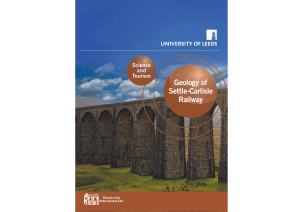
Settle-Carlisle booklet
... As the train pulls out of Settle, Sugar Loaf hill is to the east. It is formed of Carboniferous Limestone and along the bottom of the hill lies the South Craven fault. This fault is part of the system of faults (including the North Craven Fault) which form the boundary between the Pennine basin to t ...
... As the train pulls out of Settle, Sugar Loaf hill is to the east. It is formed of Carboniferous Limestone and along the bottom of the hill lies the South Craven fault. This fault is part of the system of faults (including the North Craven Fault) which form the boundary between the Pennine basin to t ...

3 Paleozoic Geology Homework c
... 28) All of the following landforms are associated with the Ancestral Rockies EXCEPT: a) the Front Range. b) the Catskill Mountains. c) the Uncompahgre Plateau. 29) Sediments in the stratigraphic record of North America primarily record: a) sedimentary sequences of regression away from the cratonic i ...
... 28) All of the following landforms are associated with the Ancestral Rockies EXCEPT: a) the Front Range. b) the Catskill Mountains. c) the Uncompahgre Plateau. 29) Sediments in the stratigraphic record of North America primarily record: a) sedimentary sequences of regression away from the cratonic i ...
Geology Unit Review - Bennatti
... The test will cover the entire geology unit including plate tectonics, earthquakes, the structure of the Earth, rocks and minerals, the influence of the last ice age on the Maine landscape and other topics covered in this unit. Go over each of your handouts (paying careful attention to questions tha ...
... The test will cover the entire geology unit including plate tectonics, earthquakes, the structure of the Earth, rocks and minerals, the influence of the last ice age on the Maine landscape and other topics covered in this unit. Go over each of your handouts (paying careful attention to questions tha ...

Pretty Rock Cycle
... Title: Pretty Rock Cycle This right here is my rocks All the rocks are falling around me including metamorphic, igneous, and sedimentary Metamorphic is banded together formed by heat pressure Get out the way magma coming through you better move before it gets on you Then it’s going to form the igneo ...
... Title: Pretty Rock Cycle This right here is my rocks All the rocks are falling around me including metamorphic, igneous, and sedimentary Metamorphic is banded together formed by heat pressure Get out the way magma coming through you better move before it gets on you Then it’s going to form the igneo ...
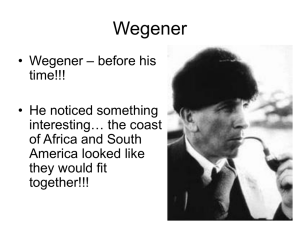
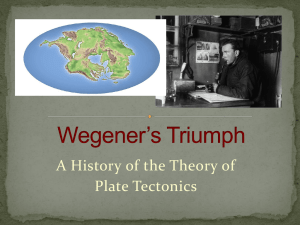
107-Wegner-Plates
... • Then he noticed that there were fossils that were found on opposite sides of the ocean! BUT – these animals could not swim long distances!!! • Plant fossils, Animal Fossils, Coal Beds, and some mountain ranges that looked very much alike. • This lead to the idea of Continental Drift ...
... • Then he noticed that there were fossils that were found on opposite sides of the ocean! BUT – these animals could not swim long distances!!! • Plant fossils, Animal Fossils, Coal Beds, and some mountain ranges that looked very much alike. • This lead to the idea of Continental Drift ...

Igneous and Metamorphic Rock Notes
... Intrusive rocks are igneous rocks that solidify (become solid rock) beneath the Earth’s surface. Extrusive rocks are igneous rocks that solidify when it comes to the surface and spills out onto the land. Metamorphic means “changed”. These rocks change from one kind of rock to another. This change is ...
... Intrusive rocks are igneous rocks that solidify (become solid rock) beneath the Earth’s surface. Extrusive rocks are igneous rocks that solidify when it comes to the surface and spills out onto the land. Metamorphic means “changed”. These rocks change from one kind of rock to another. This change is ...
PHYSICAL GEOLOGY
... know on sight several minerals and rocks that commonly occur on the earth’s surface distinguish the major classes of rocks and explain their origin understand the various processes of physical and chemical weathering and be able to recognize them in the field explain the different agents of erosion ...
... know on sight several minerals and rocks that commonly occur on the earth’s surface distinguish the major classes of rocks and explain their origin understand the various processes of physical and chemical weathering and be able to recognize them in the field explain the different agents of erosion ...

Landscape Development - Gouverneur Central School District
... Gradient (slope) – a way to describe the land because it is a measurable characteristic and useful because it shows the development of soils The three major types of landscapes are distinguished by gradient, elevation, and rock structure. ESRT page 2. They are: 1. Mountains: high elevation, non-sedi ...
... Gradient (slope) – a way to describe the land because it is a measurable characteristic and useful because it shows the development of soils The three major types of landscapes are distinguished by gradient, elevation, and rock structure. ESRT page 2. They are: 1. Mountains: high elevation, non-sedi ...
Geology of Great Britain

The geology of Great Britain is renowned for its diversity. As a result of its eventful geological history, Great Britain shows a rich variety of landscapes across the constituent countries of England, Wales and Scotland. Rocks of almost all geological ages are represented at outcrop, from the Archaean onwards.