
Rockin` Geology Vocabulary
... The wearing away of soil and/or rock by wind, water, temperature change, or gravity ...
... The wearing away of soil and/or rock by wind, water, temperature change, or gravity ...
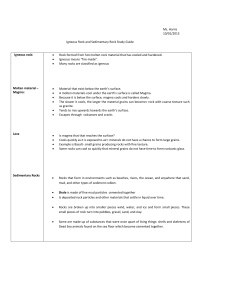
Ms. Harris 10/01/2013 Igneous Rock and
... The slower it cools, the larger the material grains can become= rock with coarse texture such as granite. Tends to rise upwards towards the earth’s surface. Escapes through volcanoes and cracks ...
... The slower it cools, the larger the material grains can become= rock with coarse texture such as granite. Tends to rise upwards towards the earth’s surface. Escapes through volcanoes and cracks ...
A Brief Geologic History of the Kansas City Area C.G. Spencer The
... The oldest rocks found around Kansas City are “only” about 296 to 300 million years old. That is less than 10% of the total age of the earth, so most of geologic time is not recorded in the rocks we find here. However, we can use information generated from studies of rock layers exposed in other pla ...
... The oldest rocks found around Kansas City are “only” about 296 to 300 million years old. That is less than 10% of the total age of the earth, so most of geologic time is not recorded in the rocks we find here. However, we can use information generated from studies of rock layers exposed in other pla ...
Word Doc.
... The oldest rocks found around Kansas City are “only” about 296 to 300 million years old. That is less than 10% of the total age of the earth, so most of geologic time is not recorded in the rocks we find here. However, we can use information generated from studies of rock layers exposed in other pla ...
... The oldest rocks found around Kansas City are “only” about 296 to 300 million years old. That is less than 10% of the total age of the earth, so most of geologic time is not recorded in the rocks we find here. However, we can use information generated from studies of rock layers exposed in other pla ...
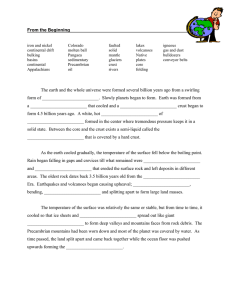
From the Beginning The earth and the whole universe were formed
... we know today were once grouped together as one large land mass known as _________________________. Approximately 180 million years ago it began to split up. Continents are part of large plates of rock that move like _________________________ over the mantle. This movement is known as plate tectonic ...
... we know today were once grouped together as one large land mass known as _________________________. Approximately 180 million years ago it began to split up. Continents are part of large plates of rock that move like _________________________ over the mantle. This movement is known as plate tectonic ...

Sedimentary Rocks There are a lot of processes that cause rocks to
... New sediment acts like a blanket for old sediment-sediments get buried by other sediments Sediment can include minerals, small pieces of plants and other organic matter. The sediment is compressed over a long period of time before consolidating into solid layers of rock. Sedimentary rocks forms laye ...
... New sediment acts like a blanket for old sediment-sediments get buried by other sediments Sediment can include minerals, small pieces of plants and other organic matter. The sediment is compressed over a long period of time before consolidating into solid layers of rock. Sedimentary rocks forms laye ...

Correlation and Time`s Arrow
... • Von Humboldt used Jurassic to name a limestone formation exposed in the Jura Mountains. • This dips under sequences of chalky limestones to the west, named Cretaceous (= Chalk). • The Cretaceous formations are overlain in and around Paris by sands, clays, marls, limestones and gypsums. Arduino’s t ...
... • Von Humboldt used Jurassic to name a limestone formation exposed in the Jura Mountains. • This dips under sequences of chalky limestones to the west, named Cretaceous (= Chalk). • The Cretaceous formations are overlain in and around Paris by sands, clays, marls, limestones and gypsums. Arduino’s t ...
File
... 2) ____________ mountains: When plates collide, rocks can fold if they are hot enough to act like bendable plastic. 3) ______________________ mountains: Sometimes the rocks in Earth’s crust are too brittle to fold, and they instead break, forming a fault. Fault blocks can tilt or slide down. 4) Moun ...
... 2) ____________ mountains: When plates collide, rocks can fold if they are hot enough to act like bendable plastic. 3) ______________________ mountains: Sometimes the rocks in Earth’s crust are too brittle to fold, and they instead break, forming a fault. Fault blocks can tilt or slide down. 4) Moun ...

here
... gabbros forming the rugged slopes of Slieve Foye and Barnavave. The granite occurs (but without much outcrop) on the col between the two mountains, and over on the SW slopes of Slieve Foye – there is a noticeable change in the appearance of the mountain at the change in geology. Both of these rocks ...
... gabbros forming the rugged slopes of Slieve Foye and Barnavave. The granite occurs (but without much outcrop) on the col between the two mountains, and over on the SW slopes of Slieve Foye – there is a noticeable change in the appearance of the mountain at the change in geology. Both of these rocks ...
Introduction to Geography
... Introduction to Geography By Arthur Getis Judith Getis Jerome D. Fellmann ...
... Introduction to Geography By Arthur Getis Judith Getis Jerome D. Fellmann ...

Sedimentary Rocks
... (or larger = >2mm) • Require a lot of energy to transport, for example: fast rivers, glaciers, land slides – a. rounded = Conglomerate - transported a long distance by fast-flowing water (= fast fluvial) – b. angular = Breccia - transported a short distance by: • Glaciers - deposited when ice melts ...
... (or larger = >2mm) • Require a lot of energy to transport, for example: fast rivers, glaciers, land slides – a. rounded = Conglomerate - transported a long distance by fast-flowing water (= fast fluvial) – b. angular = Breccia - transported a short distance by: • Glaciers - deposited when ice melts ...

The Earth`s Drifting Continents - Earth
... that the continents were once together and have since drifted apart. Was not accepted until 30 years later. ...
... that the continents were once together and have since drifted apart. Was not accepted until 30 years later. ...

Kevin Page 400 million years of history within
... 400 million years of history within the view. Well the view from Haytor is superb, you can see about 400 million years of the history of south west England from here, starting down in the south with the Devonian rocks, named after the county of Devon, the only comparable area in the world with a who ...
... 400 million years of history within the view. Well the view from Haytor is superb, you can see about 400 million years of the history of south west England from here, starting down in the south with the Devonian rocks, named after the county of Devon, the only comparable area in the world with a who ...

Late Paleozoic Mountain Building
... “Thin-skinned” tectonics (no basement involvment) Continuation to the south and west of the Appalachians in OK/AR/TX. Fold and thrust belt of Paleozoic deep water rocks thrust northward onto the N.American Craton. Flysch deposits show amazing sedimentary structures (graded beds-turbidites, and sole ...
... “Thin-skinned” tectonics (no basement involvment) Continuation to the south and west of the Appalachians in OK/AR/TX. Fold and thrust belt of Paleozoic deep water rocks thrust northward onto the N.American Craton. Flysch deposits show amazing sedimentary structures (graded beds-turbidites, and sole ...

Down: COUNTY GEOLOGY OF IRELAND 1
... this continent from the rest of Ireland, England, Wales and Europe. Over millions of years, this ocean closed and the two ancient continents collided, heating and deforming the rocks to form slates. The same rock types occur from Longford, through County Down and into the Southern Uplands of Scotlan ...
... this continent from the rest of Ireland, England, Wales and Europe. Over millions of years, this ocean closed and the two ancient continents collided, heating and deforming the rocks to form slates. The same rock types occur from Longford, through County Down and into the Southern Uplands of Scotlan ...
Heat From the outer core causes convection currents in the semi
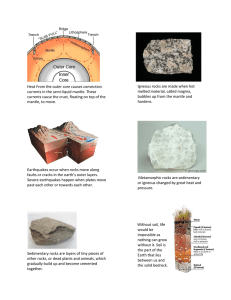
... other rocks, or dead plants and animals, which gradually build up and become cemented together. ...
... other rocks, or dead plants and animals, which gradually build up and become cemented together. ...

History of Lake District Geology
... but across NW Europe and NE America. The southern part of Avalonia became the East coast of America and there is a fault in Newfoundland which is a continuation of the Great Glen fault in Scotland. The muds, silts and sands of the Skiddaw Group became compressed, extensively folded and in some cases ...
... but across NW Europe and NE America. The southern part of Avalonia became the East coast of America and there is a fault in Newfoundland which is a continuation of the Great Glen fault in Scotland. The muds, silts and sands of the Skiddaw Group became compressed, extensively folded and in some cases ...

Unit 7 Study Guide
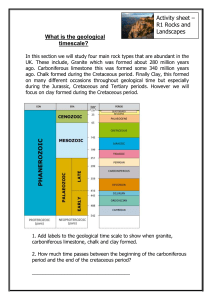
... GEOLOGIC CHANGE OVER TIME Due to continental drift, tectonic plates move causes Earth’s surface to change. Some ef fects of this change: Mountains are created and eroded, The sea floor spreads as new rock pushes up to create ocean ridges. Layers of rock are disturbed causing them to be tilted, ...
... GEOLOGIC CHANGE OVER TIME Due to continental drift, tectonic plates move causes Earth’s surface to change. Some ef fects of this change: Mountains are created and eroded, The sea floor spreads as new rock pushes up to create ocean ridges. Layers of rock are disturbed causing them to be tilted, ...
Timeline for Core Geology
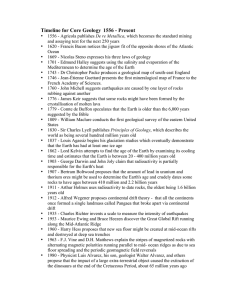
... 1862 - Lord Kelvin attempts to find the age of the Earth by examining its cooling time and estimates that the Earth is between 20 - 400 million years old 1903 - George Darwin and John Joly claim that radioactivity is partially responsible for the Earth's heat 1907 - Bertram Boltwood proposes that th ...
... 1862 - Lord Kelvin attempts to find the age of the Earth by examining its cooling time and estimates that the Earth is between 20 - 400 million years old 1903 - George Darwin and John Joly claim that radioactivity is partially responsible for the Earth's heat 1907 - Bertram Boltwood proposes that th ...

Settle-Carlisle leaflet (pdf file)
... Today’s landscape has been strongly influenced by the last ice age. The last glaciers to cover the region were during the late Devensian ice age (26,000-13,500 years ago). These deposited boulder clay (a mix of boulders, rock fragments and gravel held together by sandy clay) which includes rocks car ...
... Today’s landscape has been strongly influenced by the last ice age. The last glaciers to cover the region were during the late Devensian ice age (26,000-13,500 years ago). These deposited boulder clay (a mix of boulders, rock fragments and gravel held together by sandy clay) which includes rocks car ...

Middle Paleozoic Mountain Building
... Similar sequence of Limestones (Heldeberg Grp.), sands, silts, and shales deeper water flysch (Hamilton Group) and Redbed Molasse Deposits (braided streams and alluvial fans) Siccar Point-famous angular unconformity from James Hutton. Old Red Sandstone sitting on top of Silurain Rocks. Formed from t ...
... Similar sequence of Limestones (Heldeberg Grp.), sands, silts, and shales deeper water flysch (Hamilton Group) and Redbed Molasse Deposits (braided streams and alluvial fans) Siccar Point-famous angular unconformity from James Hutton. Old Red Sandstone sitting on top of Silurain Rocks. Formed from t ...

Derry - Geoschol
... older rocks have been buried beneath vast spreads of sand and gravel deposited during the last ice age when ice and glacially-dammed lakes dominated the landscape. Derry fossils Fossils are usually found only in sedimentary rocks less than about 550 million years old. Hence, many of the rocks in Co ...
... older rocks have been buried beneath vast spreads of sand and gravel deposited during the last ice age when ice and glacially-dammed lakes dominated the landscape. Derry fossils Fossils are usually found only in sedimentary rocks less than about 550 million years old. Hence, many of the rocks in Co ...

Geology of Great Britain

The geology of Great Britain is renowned for its diversity. As a result of its eventful geological history, Great Britain shows a rich variety of landscapes across the constituent countries of England, Wales and Scotland. Rocks of almost all geological ages are represented at outcrop, from the Archaean onwards.