

Dunbar Geology Walk - Edinburgh Geological Society
... the Earth’s crust was close to the equator, between 420 and 300 million years ago (the Devonian and Carboniferous Periods). Away back in the mists of time ... The geological foundations of this area date back to a period of mountain building and tectonic plate convergence, known as the Caledonian Or ...
... the Earth’s crust was close to the equator, between 420 and 300 million years ago (the Devonian and Carboniferous Periods). Away back in the mists of time ... The geological foundations of this area date back to a period of mountain building and tectonic plate convergence, known as the Caledonian Or ...

Petrology and geochemistry of the metamorphic rocks in the SW
... Chlorite has ripidolite compositions and muscovite is rich in the muscovite end-member. Based on calculations, chlorite mineral in regional metamorphic rocks in the study area have formed at temperature of 387-416 ºC and low-to medium pressure. According to the microscopic studies, field observation ...
... Chlorite has ripidolite compositions and muscovite is rich in the muscovite end-member. Based on calculations, chlorite mineral in regional metamorphic rocks in the study area have formed at temperature of 387-416 ºC and low-to medium pressure. According to the microscopic studies, field observation ...
Chapter 3: Mountains, Coast and Shelf
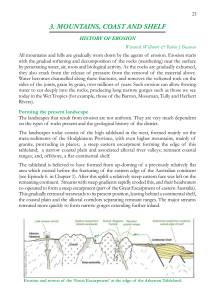
... In the Hodgkinson Province the layering and close fracturing in the rocks assists entry of percolating water, and in the wet tropical climate near the coast, this has led to considerable depths of softened rock material. On steep ground, bouldery soil and clay has moved downhill by processes such as ...
... In the Hodgkinson Province the layering and close fracturing in the rocks assists entry of percolating water, and in the wet tropical climate near the coast, this has led to considerable depths of softened rock material. On steep ground, bouldery soil and clay has moved downhill by processes such as ...

weathering_and_erosion
... tectonic plates" coming together. By contrast, volcanoes are usually not created where two tectonic plates slide past one another. Volcanoes can also form where there is stretching and thinning of the Earth's crust (called "non-hotspot intraplate volcanism"), such as in the African Rift Valley, the ...
... tectonic plates" coming together. By contrast, volcanoes are usually not created where two tectonic plates slide past one another. Volcanoes can also form where there is stretching and thinning of the Earth's crust (called "non-hotspot intraplate volcanism"), such as in the African Rift Valley, the ...

Pre-lithification tectonic foliation development in a clastic
... sedimentary sequence from the Dingle Peninsula of south west Ireland. Fabrics in these rocks reflect significant levels of tectonic shortening are a product of grain translation, rigid body rotation and repacking of intra- and extra-formational clasts during deformation of an unconsolidated clastic ...
... sedimentary sequence from the Dingle Peninsula of south west Ireland. Fabrics in these rocks reflect significant levels of tectonic shortening are a product of grain translation, rigid body rotation and repacking of intra- and extra-formational clasts during deformation of an unconsolidated clastic ...

Ch 12 and 13 ppt 2010
... other rocks and crystallizes, the fault or intrusion is younger than the rock affected ...
... other rocks and crystallizes, the fault or intrusion is younger than the rock affected ...

topic13pptpart1
... the rock column with trilobites, they had to come from the same time period. 3.) If an older index fossil is on TOP of a younger one: Then the Law of Superposition has been disturbed ...
... the rock column with trilobites, they had to come from the same time period. 3.) If an older index fossil is on TOP of a younger one: Then the Law of Superposition has been disturbed ...

SXR339 Ancient Mountains ISBN0749258470
... 1.1 Setting the scene Some of Britain’s most dramatic scenery is to be found in the Scottish Highlands. The sight of mighty Ben Nevis, the desolate plateau of the Cairngorms, or the imposing landscapes of Glen Coe (pictured on the front cover) can unleash the call of the wild in all of us. Although ...
... 1.1 Setting the scene Some of Britain’s most dramatic scenery is to be found in the Scottish Highlands. The sight of mighty Ben Nevis, the desolate plateau of the Cairngorms, or the imposing landscapes of Glen Coe (pictured on the front cover) can unleash the call of the wild in all of us. Although ...
The Lake Highway
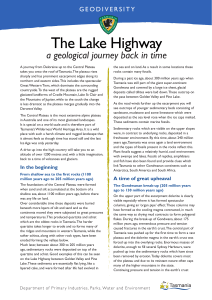
... The foundations of the Central Plateau were formed when sand and silt accumulated at the bottom of a shallow sea, about 1100 million years ago, before there was any life on land. Over considerable time these deposits were buried beneath more layers of silt and sand and as the continents moved t ...
... The foundations of the Central Plateau were formed when sand and silt accumulated at the bottom of a shallow sea, about 1100 million years ago, before there was any life on land. Over considerable time these deposits were buried beneath more layers of silt and sand and as the continents moved t ...
cenozoic1
... Peidmont Usually heavily weathered igneous and metamorphic rock similar to the Blue Ridge as well as rocks that formed during the rifting of Pangaea (rift basin sediments and igneous dikes). ...
... Peidmont Usually heavily weathered igneous and metamorphic rock similar to the Blue Ridge as well as rocks that formed during the rifting of Pangaea (rift basin sediments and igneous dikes). ...

Sedimentary rock
... Sedimentary Rocks • Igneous rocks are the most common rocks on Earth, but because most of them exist below the surface you might not have seen too many of them. • 75 percent of the rocks exposed at the surface are sedimentary rocks. ...
... Sedimentary Rocks • Igneous rocks are the most common rocks on Earth, but because most of them exist below the surface you might not have seen too many of them. • 75 percent of the rocks exposed at the surface are sedimentary rocks. ...

Introduction to Structural Geology
... - Advection of heat in magmas - Upwelling of asthenosphere at oceanic spreading centers 1.4 The Earth’s crust and plate tectonics: Introduction Continental Crust - granodioritic composition Oceanic Crust-basaltic composition Surface elevation - Bimodal -continents-w/in 100’s of meters of sea level - ...
... - Advection of heat in magmas - Upwelling of asthenosphere at oceanic spreading centers 1.4 The Earth’s crust and plate tectonics: Introduction Continental Crust - granodioritic composition Oceanic Crust-basaltic composition Surface elevation - Bimodal -continents-w/in 100’s of meters of sea level - ...

Layers of the Earth - University of Dayton
... The sandstone layer was formed by a river Over time the river erodes the bedrock and forms small pieces of sand The sand sticks together and forms sandstone at the bottom of the river ...
... The sandstone layer was formed by a river Over time the river erodes the bedrock and forms small pieces of sand The sand sticks together and forms sandstone at the bottom of the river ...

Wave Erosion - energy is concentrated on headlands due to
... Wave Erosion - energy is concentrated on headlands due to refraction (bending of waves) & the energy is reduced in bays Wave-cut Cliff - produced by wave action cutting away its base. The cliff develops as the upper portions collapse after being undermined - may be evident in sea caves; Continued er ...
... Wave Erosion - energy is concentrated on headlands due to refraction (bending of waves) & the energy is reduced in bays Wave-cut Cliff - produced by wave action cutting away its base. The cliff develops as the upper portions collapse after being undermined - may be evident in sea caves; Continued er ...

Study Guide - ab032.k12.sd.us
... -Surface Waves-surface heaves up and down like an ocean wave, or swaying from side to side Seismograph-machine used to study waves and patterns of waves as they arrive Tsunamis-huge ocean waves that reach a shoreline and can rise more than 15 meters and destroy everything in their path -can move at ...
... -Surface Waves-surface heaves up and down like an ocean wave, or swaying from side to side Seismograph-machine used to study waves and patterns of waves as they arrive Tsunamis-huge ocean waves that reach a shoreline and can rise more than 15 meters and destroy everything in their path -can move at ...

Metamorphic Rock Metamorphic rocks have been changed over
... and friction of tectonic plates. Uplift and erosion help bring metamorphic rock to the Earth's surface. Examples of metamorphic rocks include anthracite, quartzite, marble, slate, gneiss and schist. Marble is a metamorphic rock that is formed from the sedimentary rock limestone. Sometimes sedimentar ...
... and friction of tectonic plates. Uplift and erosion help bring metamorphic rock to the Earth's surface. Examples of metamorphic rocks include anthracite, quartzite, marble, slate, gneiss and schist. Marble is a metamorphic rock that is formed from the sedimentary rock limestone. Sometimes sedimentar ...

Exploration Booklet as a - Friends of the Lakeshore Nature Preserve
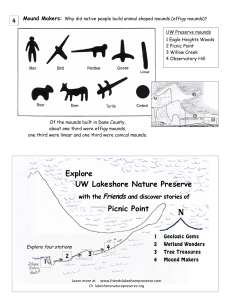
... amphibole, and mica, which can be seen with the naked eye. 2500-3000 million years old. Carried here by glaciers from what is now Canada. ...
... amphibole, and mica, which can be seen with the naked eye. 2500-3000 million years old. Carried here by glaciers from what is now Canada. ...

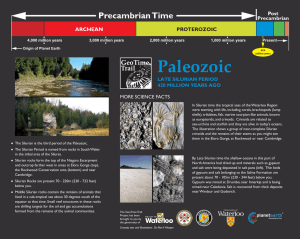
Paleozoic, Late Silurian Period, 420 Million Years Ago
... The illustration shows a group of near-complete Silurian crinoids and the remains of their stems as you might see them in the Elora Gorge, at Rockwood or near Cambridge. The Silurian is the third period of the Paleozoic. The Silurian Period is named from rocks in South Wales in the tribal area of th ...
... The illustration shows a group of near-complete Silurian crinoids and the remains of their stems as you might see them in the Elora Gorge, at Rockwood or near Cambridge. The Silurian is the third period of the Paleozoic. The Silurian Period is named from rocks in South Wales in the tribal area of th ...

Outstanding geologic feature of Pennsylvania—Sentinel
... Sentinel Rock is a prominent pinnacle of bedrock on the hillside just east of the spillway for the Lake Nockamixon dam in Nockamixon State Park. The pinnacle has been separated along a vertical, northeast-oriented joint from a blocky outcrop of Brunswick Formation, which is composed of brownish-red ...
... Sentinel Rock is a prominent pinnacle of bedrock on the hillside just east of the spillway for the Lake Nockamixon dam in Nockamixon State Park. The pinnacle has been separated along a vertical, northeast-oriented joint from a blocky outcrop of Brunswick Formation, which is composed of brownish-red ...

Slide 1
... “Doesn't the east coast of South America fit exactly against the west coast of Africa, as if they had once been joined?” (1910, letter to his fiancee) ...
... “Doesn't the east coast of South America fit exactly against the west coast of Africa, as if they had once been joined?” (1910, letter to his fiancee) ...
Geology of Great Britain

The geology of Great Britain is renowned for its diversity. As a result of its eventful geological history, Great Britain shows a rich variety of landscapes across the constituent countries of England, Wales and Scotland. Rocks of almost all geological ages are represented at outcrop, from the Archaean onwards.