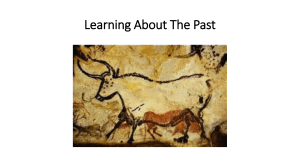
Learning About The Past
... Timelines record major events and display when the events happened. You need to remember the following things when using timelines. Timelines present a chronological record that displays events from left to right. Events on the left of a timeline happened before the events on the right on a timeline ...
... Timelines record major events and display when the events happened. You need to remember the following things when using timelines. Timelines present a chronological record that displays events from left to right. Events on the left of a timeline happened before the events on the right on a timeline ...

Final Exam Study Guide
... the quotation in connection with the general themes discussed in this course. Allow no more than 20 minutes for each essay. A. “At the very first the deathless ones who have Olympian homes made a golden race of mortal people, who existed at the time of Cronus, when he was basileus in heaven. They li ...
... the quotation in connection with the general themes discussed in this course. Allow no more than 20 minutes for each essay. A. “At the very first the deathless ones who have Olympian homes made a golden race of mortal people, who existed at the time of Cronus, when he was basileus in heaven. They li ...
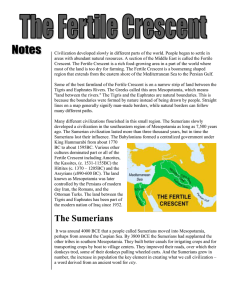
The Civilizations of Mesopotamia
... order to make sure that everyone was treated fairly, he had his scribes draw up a code of laws that are known as the Code of Hammurabi. The laws in the code were not completely original. They were taken, for the most part, from the written laws developed by the Sumerians. Hammurabi’s code was a litt ...
... order to make sure that everyone was treated fairly, he had his scribes draw up a code of laws that are known as the Code of Hammurabi. The laws in the code were not completely original. They were taken, for the most part, from the written laws developed by the Sumerians. Hammurabi’s code was a litt ...

Ancient Greece and the Birth of Modern Civilization
... 2200 BCE Minoan Civilization begins on Crete 1600 BCE Mycenaean Civilization begins on the Peloponnesus 1300 BCE Mycenaean expansion—Magna Grecia and Hellenic Age Persian Wars (499-479 BCE) Peloponnesian Wars (431-404 BCE) Philip II of Macedon conquers Athens and Thebes in 338 BCE Alexander the Grea ...
... 2200 BCE Minoan Civilization begins on Crete 1600 BCE Mycenaean Civilization begins on the Peloponnesus 1300 BCE Mycenaean expansion—Magna Grecia and Hellenic Age Persian Wars (499-479 BCE) Peloponnesian Wars (431-404 BCE) Philip II of Macedon conquers Athens and Thebes in 338 BCE Alexander the Grea ...

18-Pollitt Ch 5
... Mainland Greece engaged in changing alliances and continued strife. In the meantime, Macedon, a kingdom in the north of Greece, was building its military power under king Philip (359-339), and in 338 BCE Philip defeated the united Greeks at the Battle of Chaeonea to establish Macedonian power over m ...
... Mainland Greece engaged in changing alliances and continued strife. In the meantime, Macedon, a kingdom in the north of Greece, was building its military power under king Philip (359-339), and in 338 BCE Philip defeated the united Greeks at the Battle of Chaeonea to establish Macedonian power over m ...

18-PollittCh5.pptx [Read-Only]
... Mainland Greece engaged in changing alliances and continued strife. In the meantime, Macedon, a kingdom in the north of Greece, was building its military power under king Philip (359-339), and in 338 BCE Philip defeated the united Greeks at the Battle of Chaeonea to establish Macedonian power over m ...
... Mainland Greece engaged in changing alliances and continued strife. In the meantime, Macedon, a kingdom in the north of Greece, was building its military power under king Philip (359-339), and in 338 BCE Philip defeated the united Greeks at the Battle of Chaeonea to establish Macedonian power over m ...

HERE
... “come back with your shield… or on it” Not segregated from life: married men of their own age (about 18 yrs old)/ could divorce Needed women to play active role in order to help keep helots in place Aristotle: “the male rulers of Sparta are ruled by women” ...
... “come back with your shield… or on it” Not segregated from life: married men of their own age (about 18 yrs old)/ could divorce Needed women to play active role in order to help keep helots in place Aristotle: “the male rulers of Sparta are ruled by women” ...

Persia and Pan
... “It was the beginning of spring that the King dismissed his other strategoi and Mardonios the son of Gobryes came down to the sea, bringing with him a large force….Mardonios arrived in Ionia and there something remarkable happened, at least I think so….for Mardonios put down all the tyrants of the I ...
... “It was the beginning of spring that the King dismissed his other strategoi and Mardonios the son of Gobryes came down to the sea, bringing with him a large force….Mardonios arrived in Ionia and there something remarkable happened, at least I think so….for Mardonios put down all the tyrants of the I ...

here to see the summary report
... The highest level of agreement was expressed for the statement “Any tourist development should take the environment into account”. ...
... The highest level of agreement was expressed for the statement “Any tourist development should take the environment into account”. ...

Chapter 3 - Early African Societies and the Bantu Migrations
... The Pyramids • Symbols of the pharaoh’s authority and ...
... The Pyramids • Symbols of the pharaoh’s authority and ...

投影片 1
... The Hellenistic Age: A GreekSpeaking World The immigration of the Greeks to the newly conquered territories The great Hellenistic cities grew out of the earlier city-state model and continued many of its civic and political institutions. At Alexandria, in Egypt, a Greek library was formed. ...
... The Hellenistic Age: A GreekSpeaking World The immigration of the Greeks to the newly conquered territories The great Hellenistic cities grew out of the earlier city-state model and continued many of its civic and political institutions. At Alexandria, in Egypt, a Greek library was formed. ...

AP World Chapter 10: Mediterranean Society: The Greek Phase
... feasting, Alexander took ill and died at age 33 -Alexander never really had time to develop a ruling system or implement his intriguing plan to marry his officers to Persian women and create a new ruling class of Greek, Macedonian, and Persian ancestry -Named 70 cities after himself ...
... feasting, Alexander took ill and died at age 33 -Alexander never really had time to develop a ruling system or implement his intriguing plan to marry his officers to Persian women and create a new ruling class of Greek, Macedonian, and Persian ancestry -Named 70 cities after himself ...

Foundations of Civilization
... Strengthened the army, rebuilt and fortified cities and constructed a temple, constructed ships and traded with the Phoenicians ...
... Strengthened the army, rebuilt and fortified cities and constructed a temple, constructed ships and traded with the Phoenicians ...


Welcome to World History and day one of Block Scheduling. Please
... - They stayed in the military until they were 60. ...
... - They stayed in the military until they were 60. ...

Sparta
... “come back with your shield… or on it” Not segregated from life: married men of their own age (about 18 yrs old)/ could divorce Needed women to play active role in order to help keep helots in place Aristotle: “the male rulers of Sparta are ruled by women” ...
... “come back with your shield… or on it” Not segregated from life: married men of their own age (about 18 yrs old)/ could divorce Needed women to play active role in order to help keep helots in place Aristotle: “the male rulers of Sparta are ruled by women” ...
3000 BCE - Bridgepoint Education
... Persia attempted to conquer Greece beginning in 500 BCE. The Athenians defeated the Persian army of King Darius in 490 BCE at the plain of Marathon. After Darius’s death, his son Xerxes attacked again in 480 BCE. Skirmishes between Greece and Persia continued for decades, until a peace treaty was si ...
... Persia attempted to conquer Greece beginning in 500 BCE. The Athenians defeated the Persian army of King Darius in 490 BCE at the plain of Marathon. After Darius’s death, his son Xerxes attacked again in 480 BCE. Skirmishes between Greece and Persia continued for decades, until a peace treaty was si ...

ROMAN MONARCHY about 753 BCE Village of Rome
... the naval battle of Actium (near Greece) First Roman governor of Egypt Octavian became Caesar Augustus, the first emperor THE ROMAN EMPIRE Tiberius, stepson of Caesar Augustus, became emperor Romans invade Britain under the direction of Emperor Claudius Druid revolts in Britain Fire destroyed much o ...
... the naval battle of Actium (near Greece) First Roman governor of Egypt Octavian became Caesar Augustus, the first emperor THE ROMAN EMPIRE Tiberius, stepson of Caesar Augustus, became emperor Romans invade Britain under the direction of Emperor Claudius Druid revolts in Britain Fire destroyed much o ...

Greek Theater - Bengal English
... At the end of his life he was dragged before the jury by his son Iofon, charged for dementia. In the court he recited a part of his latest work, "Oedipus at Colonus". The judges admired his spirit and found him innocent Died in Athens in 405 BC at the age of 92 ...
... At the end of his life he was dragged before the jury by his son Iofon, charged for dementia. In the court he recited a part of his latest work, "Oedipus at Colonus". The judges admired his spirit and found him innocent Died in Athens in 405 BC at the age of 92 ...
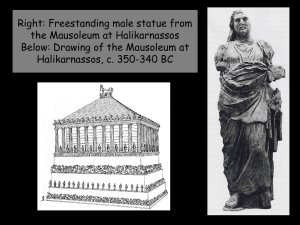
Drawing of the Mausoleum at Halikarnassos, c. 350-340 BC
... Alexandros of Antioch-onthe-Meander. Venus de Milo (Melos, Greece), c. 150-125 BCE, marble teasing the spectator ...
... Alexandros of Antioch-onthe-Meander. Venus de Milo (Melos, Greece), c. 150-125 BCE, marble teasing the spectator ...

Key Terms
... Week 9.1: Augustus and the Transformation of the Roman World Understand in general terms… The situation after Caesar’s assassination: how the tyrannicides lost control of Rome, how Octavian displaced Antony as leader of the Caesarians but then joined forces with Lepidus as a member of the “Second” T ...
... Week 9.1: Augustus and the Transformation of the Roman World Understand in general terms… The situation after Caesar’s assassination: how the tyrannicides lost control of Rome, how Octavian displaced Antony as leader of the Caesarians but then joined forces with Lepidus as a member of the “Second” T ...
The Ancient Near East
... Class system in Ancient Egypt Huge gap between the rich and the poor Treatment of Women Economic system built on agriculture Trade flourished after 2000 BCE Early Egyptian factories Egyptian Business Innovations --invented deeds, contracts and wills --oldest known currency in history ...
... Class system in Ancient Egypt Huge gap between the rich and the poor Treatment of Women Economic system built on agriculture Trade flourished after 2000 BCE Early Egyptian factories Egyptian Business Innovations --invented deeds, contracts and wills --oldest known currency in history ...

The Classical Age
... Greek and Persian alliances? 481 BCE = Persians are coming . . . Fall 480 BCE = Battle of Thermopylae King Leonidas of Sparta (490-480 BCE) Greeks retreat ...
... Greek and Persian alliances? 481 BCE = Persians are coming . . . Fall 480 BCE = Battle of Thermopylae King Leonidas of Sparta (490-480 BCE) Greeks retreat ...

Foundation legend – 753 BCE
... Votes – class; role of consuls Roman Senate – made policy/governed, served for life, nominated sons Patricians/Plebeians 450 BCE – Twelve Tables tribunes 400s BCE – Rome took most of Italy – Italians granted Roman citizenship 264 – 202 BCE – Two wars against Carthaginians (gained control of western ...
... Votes – class; role of consuls Roman Senate – made policy/governed, served for life, nominated sons Patricians/Plebeians 450 BCE – Twelve Tables tribunes 400s BCE – Rome took most of Italy – Italians granted Roman citizenship 264 – 202 BCE – Two wars against Carthaginians (gained control of western ...