621 BCE and the Origin of Deuteronomy
... material found in Deuteronomy, and the major instrument of religious reforms carried out by King Josiah (652 – 608 BCE, II Kings 22 and 23). Josiah became King of Judea at age 12 when HIS Father was assassinated after being King for only two years. Josiah continued the reforms started by his Great G ...
... material found in Deuteronomy, and the major instrument of religious reforms carried out by King Josiah (652 – 608 BCE, II Kings 22 and 23). Josiah became King of Judea at age 12 when HIS Father was assassinated after being King for only two years. Josiah continued the reforms started by his Great G ...
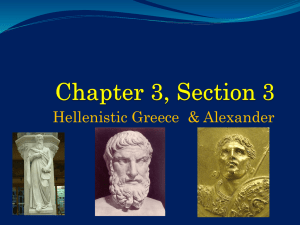
DOCA Ch 3.3 Hellenistic Alexander
... Philip II (382 – 336 BCE, ruled from 359) combined good diplomacy with military innovation to expand his northern Macedonian kingdom southward and eastward. His biggest military innovation involved a phalanx using longer spears, combined with a devastating cavalry attack. He defeated the Greeks at ...
... Philip II (382 – 336 BCE, ruled from 359) combined good diplomacy with military innovation to expand his northern Macedonian kingdom southward and eastward. His biggest military innovation involved a phalanx using longer spears, combined with a devastating cavalry attack. He defeated the Greeks at ...
Iulius Caesar: First Invasion of Britain
... • Secondly: • Storm damaged cavalry and already docked ships. ...
... • Secondly: • Storm damaged cavalry and already docked ships. ...
The Aftermath of the Persian Wars
... Marathon; the Boeotians of Plataea and the attic contingent are coming to blows with the barbarians. In this place neither side has the advantage, but the center of the fighting shows the barbarians in flight and pushing one another into the morass, while at the end of the painting are the Phoenicia ...
... Marathon; the Boeotians of Plataea and the attic contingent are coming to blows with the barbarians. In this place neither side has the advantage, but the center of the fighting shows the barbarians in flight and pushing one another into the morass, while at the end of the painting are the Phoenicia ...
ancient_egypt AP World
... (people from western Asia) Hyksos swept through with new tools for war --> bronze weapons & horse-drawn chariots Easily conquered the Egyptians & set up a new dynasty (for about 110 years) ...
... (people from western Asia) Hyksos swept through with new tools for war --> bronze weapons & horse-drawn chariots Easily conquered the Egyptians & set up a new dynasty (for about 110 years) ...
Ancient Egypt
... (people from western Asia) Hyksos swept through with new tools for war --> bronze weapons & horse-drawn chariots Easily conquered the Egyptians & set up a new dynasty (for about 110 years) ...
... (people from western Asia) Hyksos swept through with new tools for war --> bronze weapons & horse-drawn chariots Easily conquered the Egyptians & set up a new dynasty (for about 110 years) ...
Egypt PPT - Spring Branch ISD
... (people from western Asia) Hyksos swept through with new tools for war --> bronze weapons & horse-drawn chariots Easily conquered the Egyptians & set up a new dynasty (for about 110 years) ...
... (people from western Asia) Hyksos swept through with new tools for war --> bronze weapons & horse-drawn chariots Easily conquered the Egyptians & set up a new dynasty (for about 110 years) ...
ancient_egypt AP World
... (people from western Asia) Hyksos swept through with new tools for war --> bronze weapons & horse-drawn chariots Easily conquered the Egyptians & set up a new dynasty (for about 110 years) ...
... (people from western Asia) Hyksos swept through with new tools for war --> bronze weapons & horse-drawn chariots Easily conquered the Egyptians & set up a new dynasty (for about 110 years) ...
File
... (people from western Asia) Hyksos swept through with new tools for war --> bronze weapons & horse-drawn chariots Easily conquered the Egyptians & set up a new dynasty (for about 110 years) ...
... (people from western Asia) Hyksos swept through with new tools for war --> bronze weapons & horse-drawn chariots Easily conquered the Egyptians & set up a new dynasty (for about 110 years) ...
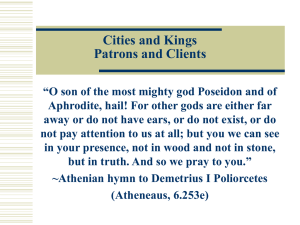
The Abnormal States: Sparta and Athens
... to enrol [in] separate formations with their own commanders, while to those who chose to leave he provided clothes and supplies/ from his own resources and sent them each to their chosen destination, more than 300 men altogether, and he also appealed for the release of all the Athenian citizens who ...
... to enrol [in] separate formations with their own commanders, while to those who chose to leave he provided clothes and supplies/ from his own resources and sent them each to their chosen destination, more than 300 men altogether, and he also appealed for the release of all the Athenian citizens who ...
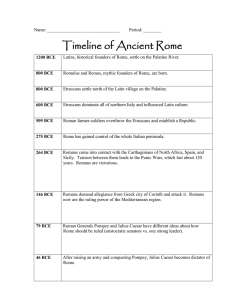
1200 BCE – Latins, historical founders of Rome, settle on the
... Rome has gained control of the whole Italian peninsula. ...
... Rome has gained control of the whole Italian peninsula. ...
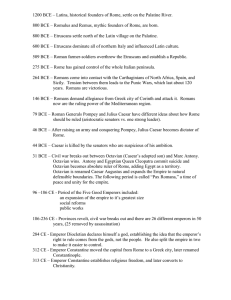
Roman timeline
... 275 BCE – Rome has gained control of the whole Italian peninsula. 264 BCE – Romans come into contact with the Carthaginians of North Africa, Spain, and Sicily. Tension between them leads to the Punic Wars, which last about 120 years. Romans are victorious. 146 BCE – Romans demand allegiance from Gre ...
... 275 BCE – Rome has gained control of the whole Italian peninsula. 264 BCE – Romans come into contact with the Carthaginians of North Africa, Spain, and Sicily. Tension between them leads to the Punic Wars, which last about 120 years. Romans are victorious. 146 BCE – Romans demand allegiance from Gre ...
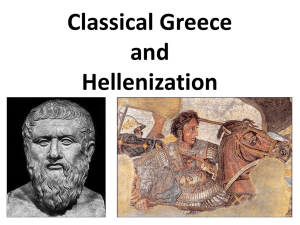
Classical Greece and Hellenization PPT
... Peloponnesian War (431-404 BCE) • Sparta fought against growing Athenian empire • Sparta and its allies defeated Athens – All of Greece was weakened ...
... Peloponnesian War (431-404 BCE) • Sparta fought against growing Athenian empire • Sparta and its allies defeated Athens – All of Greece was weakened ...
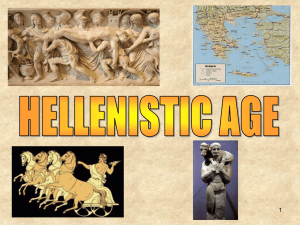
Hellenism was not always tolerated by the local people. In 167 BCE
... Seleucus I Nicator who founded the Seleucid Empire, was one of Alexander the Great’s generals in Babylonia. He expanded his empire west to Syria, north to Thrace, and east to the Indus River valley. ...
... Seleucus I Nicator who founded the Seleucid Empire, was one of Alexander the Great’s generals in Babylonia. He expanded his empire west to Syria, north to Thrace, and east to the Indus River valley. ...
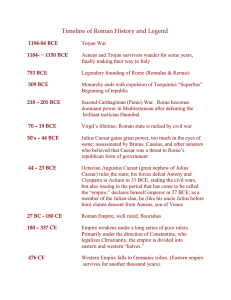
Timeline of Roman Legend and History
... Caesar) rules the state; his forces defeat Antony and Cleopatra at Actium in 31 BCE, ending the civil wars, but also issuing in the period that has come to be called the “empire;” declares himself emperor in 27 BCE; as a member of the Julian clan, he (like his uncle Julius before him) claims descent ...
... Caesar) rules the state; his forces defeat Antony and Cleopatra at Actium in 31 BCE, ending the civil wars, but also issuing in the period that has come to be called the “empire;” declares himself emperor in 27 BCE; as a member of the Julian clan, he (like his uncle Julius before him) claims descent ...
The Decline of the City
... officers with Persian noblewomen; >punished soldiers who did not respect Persian culture; • Adopted Persian dress for himself • Encouraged the ritual of proskynesis ...
... officers with Persian noblewomen; >punished soldiers who did not respect Persian culture; • Adopted Persian dress for himself • Encouraged the ritual of proskynesis ...
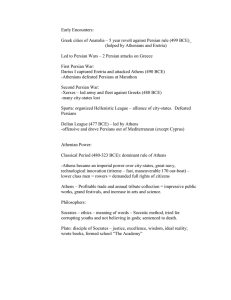
Greek cities of Anatolia – 5 year revolt against Persian rule (499 BCE)
... Athens – other city-states resented them. Peloponnesian War (431 BCE) Athens vs. Sparta: war of alliances Sparta: navy paid by Persians. Defeated Athens in 404 BCE Sparta (arrogance) – led to other city-states hating Sparta Internal conflict – Persia took advantage: Regained land in Anatolia and we ...
... Athens – other city-states resented them. Peloponnesian War (431 BCE) Athens vs. Sparta: war of alliances Sparta: navy paid by Persians. Defeated Athens in 404 BCE Sparta (arrogance) – led to other city-states hating Sparta Internal conflict – Persia took advantage: Regained land in Anatolia and we ...

File
... known under the name of Alasia. After 1400 BC Mycenaean's from Greece reach the island as merchants. During the l2th and 11th centuries. Mass waves of Achaean Greeks come to settle on the island spreading the Greek language, religion and customs. They gradually take control over Cyprus and establish ...
... known under the name of Alasia. After 1400 BC Mycenaean's from Greece reach the island as merchants. During the l2th and 11th centuries. Mass waves of Achaean Greeks come to settle on the island spreading the Greek language, religion and customs. They gradually take control over Cyprus and establish ...

Finding Love In Cyprus
... BC, Phoenician was widely spoken and written in the island. Dr Ulbrich finds it remarkable that alphabetic Greek, which had been known in mainland Greece since the eighth century BC, was not used in Cyprus until the end of the fourth century BC, after Alexander the Great’s conquest of the Persian em ...
... BC, Phoenician was widely spoken and written in the island. Dr Ulbrich finds it remarkable that alphabetic Greek, which had been known in mainland Greece since the eighth century BC, was not used in Cyprus until the end of the fourth century BC, after Alexander the Great’s conquest of the Persian em ...
Impact of Alexander
... government, Athens never returned to its former power… • Constant warfare among other states continued… In 371, Sparta lost its first war to Thebes • The loss of manpower on both sides weakened all of Greece ...
... government, Athens never returned to its former power… • Constant warfare among other states continued… In 371, Sparta lost its first war to Thebes • The loss of manpower on both sides weakened all of Greece ...
The Decline of the City
... government, Athens never returned to its former power… • Constant warfare among other states continued… In 371, Sparta lost its first war to Thebes • The loss of manpower on both sides weakened all of Greece ...
... government, Athens never returned to its former power… • Constant warfare among other states continued… In 371, Sparta lost its first war to Thebes • The loss of manpower on both sides weakened all of Greece ...
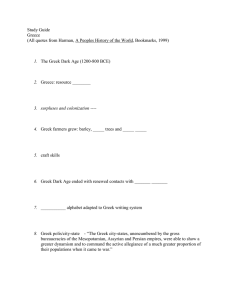
Study Guide Greece (All quotes from Harman, A Peoples History of
... 11. Greek slavery --- “The relative unproductiveness of the land had one other very important side effect. The surplus output that could be obtained after feeding a peasant family and its children was quite small. But it could be increased considerably by working the land -- and later the mines and ...
... 11. Greek slavery --- “The relative unproductiveness of the land had one other very important side effect. The surplus output that could be obtained after feeding a peasant family and its children was quite small. But it could be increased considerably by working the land -- and later the mines and ...
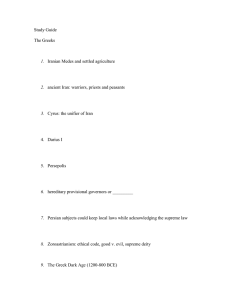
Study Guide
... 19. Greek slavery --- “The relative unproductiveness of the land had one other very important side effect. The surplus output that could be obtained after feeding a peasant family and its children was quite small. But it could be increased considerably by working the land --- and later the mines an ...
... 19. Greek slavery --- “The relative unproductiveness of the land had one other very important side effect. The surplus output that could be obtained after feeding a peasant family and its children was quite small. But it could be increased considerably by working the land --- and later the mines an ...
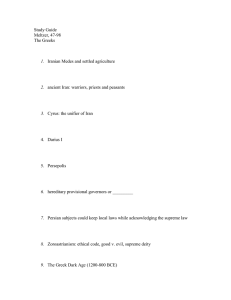
Study Guide 2
... 19. Greek slavery --- “The relative unproductiveness of the land had one other very important side effect. The surplus output that could be obtained after feeding a peasant family and its children was quite small. But it could be increased considerably by working the land --- and later the mines an ...
... 19. Greek slavery --- “The relative unproductiveness of the land had one other very important side effect. The surplus output that could be obtained after feeding a peasant family and its children was quite small. But it could be increased considerably by working the land --- and later the mines an ...