
Compared to the desolate surface of the Moon, Earth must
... B. Aphanitic: crystals are so small they cannot be seen by the naked eye—or barely seen. Magma cools more quickly Extrusive Rocks (Volcanic Rocks): crystallized from lava that flowed out, or extruded, onto Earth’s surface ...
... B. Aphanitic: crystals are so small they cannot be seen by the naked eye—or barely seen. Magma cools more quickly Extrusive Rocks (Volcanic Rocks): crystallized from lava that flowed out, or extruded, onto Earth’s surface ...

A Geological Tour Information Guide
... sediments they deposit are called turbidites. Heat, pressure, and folding in the earth’s crust changed the horizontal, soft sediment layers into sedimentary rocks that are presently tilted into an almost vertical position. The Quoddy Formation probably represents deep water deposits of a gradually s ...
... sediments they deposit are called turbidites. Heat, pressure, and folding in the earth’s crust changed the horizontal, soft sediment layers into sedimentary rocks that are presently tilted into an almost vertical position. The Quoddy Formation probably represents deep water deposits of a gradually s ...


Geologic Time
... change an~ well-preserved in many different kinds of rocks. Geologists evaluate the age of rocks and geologic events using two different approaches. Relative age dating is the technique of determining a sequence of geological events, based upon the structural relations of rocks. Absolute age dating ...
... change an~ well-preserved in many different kinds of rocks. Geologists evaluate the age of rocks and geologic events using two different approaches. Relative age dating is the technique of determining a sequence of geological events, based upon the structural relations of rocks. Absolute age dating ...

The Rock Cycle - Valhalla High School
... • What are 3 great “truths” about the Rock Cycle? Think about everything we talked about today and see if you can list them below: ...
... • What are 3 great “truths” about the Rock Cycle? Think about everything we talked about today and see if you can list them below: ...

Geology Across America
... Pennsylvania resulted in Pennsylvanian and Mississippian Paleozoic coal beds to undergo metamorphism. This is the source of the rich anthracite coal reserves of Pennsylvania. As we examine the mountains and the regions to the left and right, we note that there are few Mesozoic and little Permian (Pa ...
... Pennsylvania resulted in Pennsylvanian and Mississippian Paleozoic coal beds to undergo metamorphism. This is the source of the rich anthracite coal reserves of Pennsylvania. As we examine the mountains and the regions to the left and right, we note that there are few Mesozoic and little Permian (Pa ...
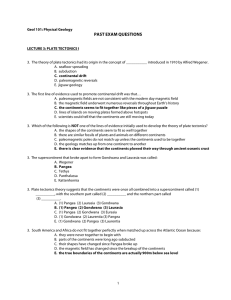
PAST EXAM QUESTIONS
... D. paleomagnetic reversals E. jigsaw geology 3. The first line of evidence used to promote continental drift was that… A. paleomagnetic fields are not consistent with the modern day magnetic field B. the magnetic field underwent numerous reversals throughout Earth’s history C. the continents seems t ...
... D. paleomagnetic reversals E. jigsaw geology 3. The first line of evidence used to promote continental drift was that… A. paleomagnetic fields are not consistent with the modern day magnetic field B. the magnetic field underwent numerous reversals throughout Earth’s history C. the continents seems t ...
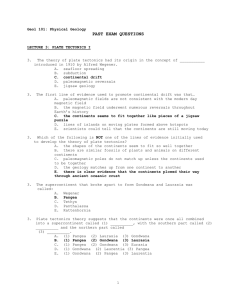
Word
... D. lines of islands on moving plates formed above hotspots E. scientists could tell that the continents are still moving today Which of the following is NOT one of the lines of evidence initially used to develop the theory of plate tectonics? A. the shapes of the continents seem to fit so well toget ...
... D. lines of islands on moving plates formed above hotspots E. scientists could tell that the continents are still moving today Which of the following is NOT one of the lines of evidence initially used to develop the theory of plate tectonics? A. the shapes of the continents seem to fit so well toget ...

Terms you should be able to define and concepts you should
... geologic history of an area. Use Figure 4 to complete the questions below. 12. Which of the structures or layers are obviously igneous rocks? 13. Which structure is a fault? 14. Identify the unconformities in the figure. 15. Is rock layer I older or younger than layer J? What principle did you apply ...
... geologic history of an area. Use Figure 4 to complete the questions below. 12. Which of the structures or layers are obviously igneous rocks? 13. Which structure is a fault? 14. Identify the unconformities in the figure. 15. Is rock layer I older or younger than layer J? What principle did you apply ...
Name
... curves. Scientists determine which reflectance curves show plants, water, soil, and other materials on earth. Together, satellite images and spectral analysis allow scientists to gather information on the Earth from a distance. Ground truthing is when scientists directly observe the areas they are a ...
... curves. Scientists determine which reflectance curves show plants, water, soil, and other materials on earth. Together, satellite images and spectral analysis allow scientists to gather information on the Earth from a distance. Ground truthing is when scientists directly observe the areas they are a ...

Terms you should be able to define and concepts you should
... geologic history of an area. Use Figure 4 to complete the questions below. 12. Which of the structures or layers are obviously igneous rocks? 13. Which structure is a fault? 14. Identify the unconformities in the figure. 15. Is rock layer I older or younger than layer J? What principle did you apply ...
... geologic history of an area. Use Figure 4 to complete the questions below. 12. Which of the structures or layers are obviously igneous rocks? 13. Which structure is a fault? 14. Identify the unconformities in the figure. 15. Is rock layer I older or younger than layer J? What principle did you apply ...

3. igneous and metamorphic petrology
... 3.12 Solid-state crystal growth. Stress and deformation. Ductile flow. Role of fluids in deformation. Origin of anisotropic fabric in metamorphic tectonites. 3.13 Description, occurrence and origin of metamorphic rock associations. Types of metamorphism: cataclastic metamorphism, contact metamorphis ...
... 3.12 Solid-state crystal growth. Stress and deformation. Ductile flow. Role of fluids in deformation. Origin of anisotropic fabric in metamorphic tectonites. 3.13 Description, occurrence and origin of metamorphic rock associations. Types of metamorphism: cataclastic metamorphism, contact metamorphis ...
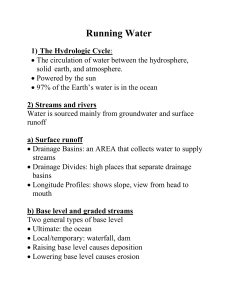
Running Water
... Form when more water is frozen than melts each year Water is stored in glaciers for long periods of time 2% of the earth’s water is in glaciers If all glaciers melted, sea level would dramatically rise Glaciers are a strong erosional force, like a bulldozer 1) Types of Glaciers a) Valley ( ...
... Form when more water is frozen than melts each year Water is stored in glaciers for long periods of time 2% of the earth’s water is in glaciers If all glaciers melted, sea level would dramatically rise Glaciers are a strong erosional force, like a bulldozer 1) Types of Glaciers a) Valley ( ...
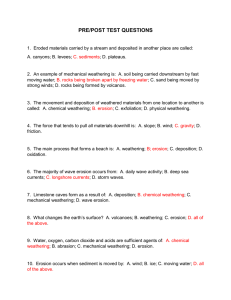

Sea Floor Spreading LAB 2017
... continually been forming over millions of years at the mid-ocean ridges. Hess found that on each side of the ridge, sea floor got older as a person moved away from the ridge towards the continents. The older, denser oceanic crust eventually descends into deep trenches along the continents and is rec ...
... continually been forming over millions of years at the mid-ocean ridges. Hess found that on each side of the ridge, sea floor got older as a person moved away from the ridge towards the continents. The older, denser oceanic crust eventually descends into deep trenches along the continents and is rec ...

Rock Identification and stories lab
... cemented together. If you look at the particles with a handlens, or even with the naked eye, you can see individual grains often somewhat rounded because sharp edges were knocked off during transport down stream, along beaches, etc. Sand-sized particles range from just big enough to see to about 2mm ...
... cemented together. If you look at the particles with a handlens, or even with the naked eye, you can see individual grains often somewhat rounded because sharp edges were knocked off during transport down stream, along beaches, etc. Sand-sized particles range from just big enough to see to about 2mm ...

Field Mapping of the Redrock Area, Burro Mountains, southwest
... Paleoproterozoic sedimentary rocks in the Burro Mountains, southern Mazatzal province, have an unknown depositional age, depositional setting, and source region, and they were subsequently metamorphosed by one or all of the magmatic events that occurred at 1.63 Ga, 1.46 Ga, and 1.25 Ga. The main goa ...
... Paleoproterozoic sedimentary rocks in the Burro Mountains, southern Mazatzal province, have an unknown depositional age, depositional setting, and source region, and they were subsequently metamorphosed by one or all of the magmatic events that occurred at 1.63 Ga, 1.46 Ga, and 1.25 Ga. The main goa ...

Boulder Walk brochure
... Group IV – This group shows examples of metamorphic rocks; those that have been transformed by heat and pressure. Metamorphic rocks occur throughout earth’s crust and are formed when rocks of any type are exposed to high heat and pressure either deep under the earth’s surface, at the junction of con ...
... Group IV – This group shows examples of metamorphic rocks; those that have been transformed by heat and pressure. Metamorphic rocks occur throughout earth’s crust and are formed when rocks of any type are exposed to high heat and pressure either deep under the earth’s surface, at the junction of con ...


Mineralogy, geochemistry, and chronology of REE
... rutile, synchysite, priorite, xenotime, thorite, and uranophane. Synchysite is the major host of LREEs, up to 63 wt.% LREO, while HREEs are concentrated dominantly in xenotime, up to 16 wt.% HREO, and priorite, up to 9 wt.% HREO. The geochemical and textural characteristics of these rocks are consis ...
... rutile, synchysite, priorite, xenotime, thorite, and uranophane. Synchysite is the major host of LREEs, up to 63 wt.% LREO, while HREEs are concentrated dominantly in xenotime, up to 16 wt.% HREO, and priorite, up to 9 wt.% HREO. The geochemical and textural characteristics of these rocks are consis ...

Document
... changes that take place when magma is injected into the surrounding solid rock (country rock). The changes that occur are greatest wherever the magma comes into contact with the rock because the temperatures are highest at this boundary and decrease with distance from it. • Regional metamorphism: ...
... changes that take place when magma is injected into the surrounding solid rock (country rock). The changes that occur are greatest wherever the magma comes into contact with the rock because the temperatures are highest at this boundary and decrease with distance from it. • Regional metamorphism: ...

Rocks and Minerals
... The Nature of Sedimentary Rocks • Layers are easily identified – Majors layers (formations) easily recognized over large distances – Smaller layers within a formation are separated by bedding planes – Gradation in grain size, composition or physical features may vary ...
... The Nature of Sedimentary Rocks • Layers are easily identified – Majors layers (formations) easily recognized over large distances – Smaller layers within a formation are separated by bedding planes – Gradation in grain size, composition or physical features may vary ...

The Pembrokeshire Coast – processes and landforms
... • Mass movement, or mass-wasting process, such as rockfalls, slumps and slides involve the downhill movement of surface materials, including solid rock, under the force of gravity. These movements can potentially have the greatest and most sudden impacts on the coast, although soil creep on more ge ...
... • Mass movement, or mass-wasting process, such as rockfalls, slumps and slides involve the downhill movement of surface materials, including solid rock, under the force of gravity. These movements can potentially have the greatest and most sudden impacts on the coast, although soil creep on more ge ...

7 THE GEOLOGICAL ENVIRONMENT FOR REPOSITORY SITING
... 7.2 Characteristics of the geological environment in Japan In general, rock types that have been identified internationally for radioactive waste disposal are classed into crystalline rocks, argillaceous rocks and evaporites. The first category includes granites, high-grade metamorphic rocks and wel ...
... 7.2 Characteristics of the geological environment in Japan In general, rock types that have been identified internationally for radioactive waste disposal are classed into crystalline rocks, argillaceous rocks and evaporites. The first category includes granites, high-grade metamorphic rocks and wel ...
Geology of Great Britain

The geology of Great Britain is renowned for its diversity. As a result of its eventful geological history, Great Britain shows a rich variety of landscapes across the constituent countries of England, Wales and Scotland. Rocks of almost all geological ages are represented at outcrop, from the Archaean onwards.