
On the recognition of volcanic material in sedimentary rocks by
... tertiary tuffoid rocks from West-Java. East-Borneo and Poeloe-Lam>t and of some recent volcanic ashes from different localities. The problem has also been considered from a theoretical point of view. while it appeared to be possible to foresay some of the mineralogical features of these volcanic sed ...
... tertiary tuffoid rocks from West-Java. East-Borneo and Poeloe-Lam>t and of some recent volcanic ashes from different localities. The problem has also been considered from a theoretical point of view. while it appeared to be possible to foresay some of the mineralogical features of these volcanic sed ...

Lecture 10 Stratigraphy and Geologic Time
... development of three main types of unconformity in cross-section, and explains how an incomplete succession of strata provides a record of Earth history. View 1 shows a disconformity, View 2 shows a nonconformity and View 3 shows an angular unconformity. [by Stephen Marshak] ...
... development of three main types of unconformity in cross-section, and explains how an incomplete succession of strata provides a record of Earth history. View 1 shows a disconformity, View 2 shows a nonconformity and View 3 shows an angular unconformity. [by Stephen Marshak] ...

PDF file
... Such gills are seen on Walk 3 (following Piers Gill on Scafell Pike) and Walk 6 (following Hell Gill on Bowfell, Walk 5, descending Aaron Slack between Great Gable and Green Gable on the line of the Rosset Gill fault). The folding, tilting and faulting during the mountain-building episode have had a ...
... Such gills are seen on Walk 3 (following Piers Gill on Scafell Pike) and Walk 6 (following Hell Gill on Bowfell, Walk 5, descending Aaron Slack between Great Gable and Green Gable on the line of the Rosset Gill fault). The folding, tilting and faulting during the mountain-building episode have had a ...

Science 8—Chapter 13 Vocab PP Less 2 Quiz
... • the natural process that moves sediments from place to place ...
... • the natural process that moves sediments from place to place ...
Igneous Rock - East Hanover Township School District
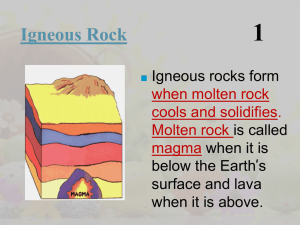
... B) They form from magma that is rich in iron and magnesium and poor in silica, which is the compound SiO2. C) The presence of iron and magnesium in minerals in basalt gives basalt its dark color. D) Basaltic lava is fluid and flows freely from volcanoes in Hawaii, such as Kilauea. E) Basalt is the m ...
... B) They form from magma that is rich in iron and magnesium and poor in silica, which is the compound SiO2. C) The presence of iron and magnesium in minerals in basalt gives basalt its dark color. D) Basaltic lava is fluid and flows freely from volcanoes in Hawaii, such as Kilauea. E) Basalt is the m ...

Unit 3 Test - Problem
... Dora wrote down some observations of four rock samples she was studying. Based on her observations, which of the following rock samples is most likely a sedimentary rock? A. ...
... Dora wrote down some observations of four rock samples she was studying. Based on her observations, which of the following rock samples is most likely a sedimentary rock? A. ...

Sedimentary Rocks
... sedimentary rock sandstone. This sandstone is very porous and is easily penetrated by rainwater. Water damage was common in the early days of construction for the building. To stop the water damage, workers covered the sandstone in a mixture of salt, rice, and glue, which help to give the White Hous ...
... sedimentary rock sandstone. This sandstone is very porous and is easily penetrated by rainwater. Water damage was common in the early days of construction for the building. To stop the water damage, workers covered the sandstone in a mixture of salt, rice, and glue, which help to give the White Hous ...

CHAPTER 10_Deep Time..
... baked contacts—If a rock is in places metamorphosed as a result of contact with a hot body of magma or lava (which later crystallized to form igneous rock), the metamorphosed rock must have existed (as unaltered rock) prior to the metamorphic event. uniformitarianism—“The present is the key to the p ...
... baked contacts—If a rock is in places metamorphosed as a result of contact with a hot body of magma or lava (which later crystallized to form igneous rock), the metamorphosed rock must have existed (as unaltered rock) prior to the metamorphic event. uniformitarianism—“The present is the key to the p ...

EARTH SCIENCE SOL REVIEW
... Ocean crust is younger than continental crust. Youngest area of ocean floor is at midocean ridges Ocean crust is thinner than continental crust ...
... Ocean crust is younger than continental crust. Youngest area of ocean floor is at midocean ridges Ocean crust is thinner than continental crust ...

Earth Science Dept SOL Review Powerpoint
... Ocean crust is younger than continental crust. Youngest area of ocean floor is at midocean ridges Ocean crust is thinner than continental crust ...
... Ocean crust is younger than continental crust. Youngest area of ocean floor is at midocean ridges Ocean crust is thinner than continental crust ...

File
... Northwest. Scientists believe that sedimentary rocks like these represent evidence of crustal change because these rocks were 1. formed by igneous intrusion 2. faulted during deposition 3. originally deposited in horizontal layers 4. changed from metamorphic rocks ...
... Northwest. Scientists believe that sedimentary rocks like these represent evidence of crustal change because these rocks were 1. formed by igneous intrusion 2. faulted during deposition 3. originally deposited in horizontal layers 4. changed from metamorphic rocks ...

Classifying Rocks
... results in the formation of sedimentary rock. Exposure to extreme heat or pressure or both will cause some rocks to change from one type to another. This change results in the formation of metamorphic rock. These formation processes result in characteristic appearances and properties that enable cla ...
... results in the formation of sedimentary rock. Exposure to extreme heat or pressure or both will cause some rocks to change from one type to another. This change results in the formation of metamorphic rock. These formation processes result in characteristic appearances and properties that enable cla ...

Detrital Remanent Magnetization (DRM)
... • formed during or soon after deposition of sediments • locked in by compaction and lithification to sedimentary rock • relatively weak ...
... • formed during or soon after deposition of sediments • locked in by compaction and lithification to sedimentary rock • relatively weak ...

INFORME GEOBRASIL (www.geobrasil.net)
... From an empirical standpoint the mass extinction at the close of the Palaeozoic, 251 Ma ago, links closely with eruption of the largest known flood basalt pile in Siberia, and there is no known extraterrestrial impact that tallies. So it seems likely that the P-T event was generated by the influence ...
... From an empirical standpoint the mass extinction at the close of the Palaeozoic, 251 Ma ago, links closely with eruption of the largest known flood basalt pile in Siberia, and there is no known extraterrestrial impact that tallies. So it seems likely that the P-T event was generated by the influence ...

Field Trip No. 1
... Note: These notes are to be handed in at the end of the excursion This excursion is designed to show you some different sedimentary rock types that deposited under a variety of environmental conditions. You will also be introduced to the geomorphologic features and note the influence of rock type on ...
... Note: These notes are to be handed in at the end of the excursion This excursion is designed to show you some different sedimentary rock types that deposited under a variety of environmental conditions. You will also be introduced to the geomorphologic features and note the influence of rock type on ...

EARTH SCIENCE SOL REVIEW
... pressure on existing rocks. Contact metamorphism—small area in contact with an igneous intrusion “bakes” the rock and changes it. Regional metamorphism—large area changed due to heat and pressure. Usually with mountains. ...
... pressure on existing rocks. Contact metamorphism—small area in contact with an igneous intrusion “bakes” the rock and changes it. Regional metamorphism—large area changed due to heat and pressure. Usually with mountains. ...

Lecture 10 Stratigraphy and Geologic Time
... development of three main types of unconformity in cross-section, and explains how an incomplete succession of strata provides a record of Earth history. View 1 shows a disconformity, View 2 shows a nonconformity and View 3 shows an angular unconformity. [by Stephen Marshak] ...
... development of three main types of unconformity in cross-section, and explains how an incomplete succession of strata provides a record of Earth history. View 1 shows a disconformity, View 2 shows a nonconformity and View 3 shows an angular unconformity. [by Stephen Marshak] ...
Rocks and Minerals Midterm Rev
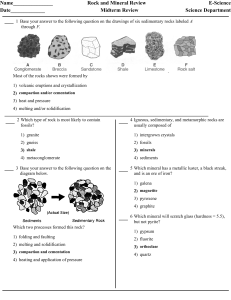
... As compaction and cementation of these sediments eventually occur, which area will become siltstone? 1) A 2) B 3) C 4) D 8 Base your answer to the following question on the photograph below. The photograph shows several broken samples of the same colorless mineral. ...
... As compaction and cementation of these sediments eventually occur, which area will become siltstone? 1) A 2) B 3) C 4) D 8 Base your answer to the following question on the photograph below. The photograph shows several broken samples of the same colorless mineral. ...

Chapter 02 Earth Structure and Plate Tectonics
... 5. The refraction and shadow patterns of seismic P-waves and S-waves indicate the dimensions and properties of Earth's layers. 6. Shear waves do not pass through a solid liquid boundary between Earth's layers. Compressional waves can pass this type of boundary. 7. Oceanic-type crust is more dense th ...
... 5. The refraction and shadow patterns of seismic P-waves and S-waves indicate the dimensions and properties of Earth's layers. 6. Shear waves do not pass through a solid liquid boundary between Earth's layers. Compressional waves can pass this type of boundary. 7. Oceanic-type crust is more dense th ...
Igneous Rock - East Hanover Township School District
... B) They form from magma that is rich in iron and magnesium and poor in silica, which is the compound SiO2. C) The presence of iron and magnesium in minerals in basalt gives basalt its dark color. D) Basaltic lava is fluid and flows freely from volcanoes in Hawaii, such as Kilauea. E) Basalt is the m ...
... B) They form from magma that is rich in iron and magnesium and poor in silica, which is the compound SiO2. C) The presence of iron and magnesium in minerals in basalt gives basalt its dark color. D) Basaltic lava is fluid and flows freely from volcanoes in Hawaii, such as Kilauea. E) Basalt is the m ...
Origins Of The Himalayan Treasure Chest
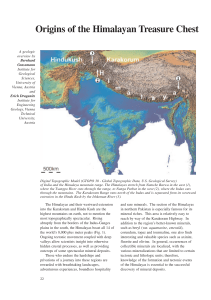
... Eurasia. There the Tethys oceanic crust partially melted. By about 60 million years ago, the oceanic crust of the Tethys had been pushed entirely beneath Eurasia. No longer separated by an ocean, India and Eurasia began to collide along what is known as the Indus-Tsangpo suture zone. This colliding ...
... Eurasia. There the Tethys oceanic crust partially melted. By about 60 million years ago, the oceanic crust of the Tethys had been pushed entirely beneath Eurasia. No longer separated by an ocean, India and Eurasia began to collide along what is known as the Indus-Tsangpo suture zone. This colliding ...

Ruhr sandstone - Geowissenschaftlicher Dienst Dr. Olaf Otto Dillmann
... over this plane meanders its way north, where they flow into the sea. In addition to rivers, the landscape is dominated by swamps. This swamps, in which, under hot and humid climate grows lush vegetation, are the birthplaces of the layers of hard coal. Often the streams overflow their banks, it come ...
... over this plane meanders its way north, where they flow into the sea. In addition to rivers, the landscape is dominated by swamps. This swamps, in which, under hot and humid climate grows lush vegetation, are the birthplaces of the layers of hard coal. Often the streams overflow their banks, it come ...

Question: Equal volumes of the four samples (iron
... Intensely metamorphosed; includes portions of the Taconic Sequence and Cortlandt Complex. TACONIC SEQUENCE sandstones, shales, and slates Slightly to intensely metamorphosed rocks of CAMBRIAN through MIDDLE ORDOVICIAN ages. MIDDLE PROTEROZOIC gneisses, quartzites, and marbles Lines are generalized s ...
... Intensely metamorphosed; includes portions of the Taconic Sequence and Cortlandt Complex. TACONIC SEQUENCE sandstones, shales, and slates Slightly to intensely metamorphosed rocks of CAMBRIAN through MIDDLE ORDOVICIAN ages. MIDDLE PROTEROZOIC gneisses, quartzites, and marbles Lines are generalized s ...

PowerPoint Presentation - Sediments and Sedimentary Rocks
... Phosphatic sediment (e.g., fish bones) Diagenetic ...
... Phosphatic sediment (e.g., fish bones) Diagenetic ...

General Session G01 Structural geology and Neotectonics
... ophiolites are traced as strongly deformed allochtonous tectonic sheets and slices. They are underlain by Upper Devonian-Lower Carboniferous volcanogenic-sedimentary island-arc type deposits and overlain by Middle-Upper Carboniferous molasse. According to rare finds of fossil fauna (corals) age of v ...
... ophiolites are traced as strongly deformed allochtonous tectonic sheets and slices. They are underlain by Upper Devonian-Lower Carboniferous volcanogenic-sedimentary island-arc type deposits and overlain by Middle-Upper Carboniferous molasse. According to rare finds of fossil fauna (corals) age of v ...
Geology of Great Britain

The geology of Great Britain is renowned for its diversity. As a result of its eventful geological history, Great Britain shows a rich variety of landscapes across the constituent countries of England, Wales and Scotland. Rocks of almost all geological ages are represented at outcrop, from the Archaean onwards.