Chapter 11
... magnetic field? Is this field constant, or does it change? The fluid outer core generates at least 90% of Earth's magnetic field and the magnetosphere that surrounds and protects Earth from the solar wind (A flow of gas and energetic charged particles, mostly protons and electrons [plasma] which str ...
... magnetic field? Is this field constant, or does it change? The fluid outer core generates at least 90% of Earth's magnetic field and the magnetosphere that surrounds and protects Earth from the solar wind (A flow of gas and energetic charged particles, mostly protons and electrons [plasma] which str ...

Make Your Own Fossils!
... break apart and change the earth’s surface. Chemical changes can be caused when minerals in rocks react with oxygen, called oxidation, or through minerals in rocks reacting with acid, which often occurs because of acid rain. When earth materials are weathered and broken into smaller pieces, these sm ...
... break apart and change the earth’s surface. Chemical changes can be caused when minerals in rocks react with oxygen, called oxidation, or through minerals in rocks reacting with acid, which often occurs because of acid rain. When earth materials are weathered and broken into smaller pieces, these sm ...

Bedrock Geologic Map of Saratoga National Historical Park and
... The onslaught of the Taconic Orogeny closed up the western portion of the Iapetus Ocean, eventually resulting in the collision of the Taconia volcanic island arc with the edge of the Laurentian shelf. This slow process was accompanied by the depression of the shallow shelf as Taconia approached. The ...
... The onslaught of the Taconic Orogeny closed up the western portion of the Iapetus Ocean, eventually resulting in the collision of the Taconia volcanic island arc with the edge of the Laurentian shelf. This slow process was accompanied by the depression of the shallow shelf as Taconia approached. The ...

400 600 800 1000 200 400 600 800 1000 200 400 600 800 1000
... Rocks $600 Granite has a texture of large crystals so it is classified as an ____________________ igneous rock. ...
... Rocks $600 Granite has a texture of large crystals so it is classified as an ____________________ igneous rock. ...

Geology Unit Jeopardy Part 2
... Rocks $600 Granite has a texture of large crystals so it is classified as an ____________________ igneous rock. ...
... Rocks $600 Granite has a texture of large crystals so it is classified as an ____________________ igneous rock. ...


Generalized Geologic History of the North American Cordillera
... The Sevier orogeny defines a more western event that took advantage of weak bedding planes in thick Paleozoic and Mesozoic sedimentary rock. Shortening in basement metamorphic and igneous rocks was transferred tens of miles eastward along the weak shale and evaporite layers, producing “thin-skinne ...
... The Sevier orogeny defines a more western event that took advantage of weak bedding planes in thick Paleozoic and Mesozoic sedimentary rock. Shortening in basement metamorphic and igneous rocks was transferred tens of miles eastward along the weak shale and evaporite layers, producing “thin-skinne ...

Some Common Sedimentary Rocks
... Minerals make up all of the solid surfaces on Earth. Cleavage, hardness, streak, color, and luster are properties that describe minerals. Remember: Cows have such colorful lives! Minerals include salts, talc, metal, ores, and gemstones. Luster is the way a mineral shines or reflects light. ...
... Minerals make up all of the solid surfaces on Earth. Cleavage, hardness, streak, color, and luster are properties that describe minerals. Remember: Cows have such colorful lives! Minerals include salts, talc, metal, ores, and gemstones. Luster is the way a mineral shines or reflects light. ...

rock - Ms. Pinkstaff
... 75% of the rocks exposed at the surface are sedimentary rocks. Sediments are loose materials such as rock fragments, mineral grains, and bits of shell that have been moved by wind, water, ice, or gravity. ...
... 75% of the rocks exposed at the surface are sedimentary rocks. Sediments are loose materials such as rock fragments, mineral grains, and bits of shell that have been moved by wind, water, ice, or gravity. ...


Lower arc crust– A review of some important
... Fertil La Huerta range; • Documents interactions between primitive, sub-arc magmas and a thick section of passive margin metasedimentary rocks; • Deepest rocks were 28-30 km below arc surface; • Not metamorphosed subsequently; • Fresh, outstanding rock outcrops; • Logistically easy to work with. ...
... Fertil La Huerta range; • Documents interactions between primitive, sub-arc magmas and a thick section of passive margin metasedimentary rocks; • Deepest rocks were 28-30 km below arc surface; • Not metamorphosed subsequently; • Fresh, outstanding rock outcrops; • Logistically easy to work with. ...

ROCKS and how to identify them
... is pyroclastic (fireformed fragments) and forms in explosive eruptions. It is a mix of large angular fragments and small ash. Often, the material is hot when it comes to rest and cools (welds) into a very hard rock. ...
... is pyroclastic (fireformed fragments) and forms in explosive eruptions. It is a mix of large angular fragments and small ash. Often, the material is hot when it comes to rest and cools (welds) into a very hard rock. ...

Slide 1
... The evidence Wegener needed was discovered almost 20 years after his death. Geologist found that the sediments nearest the ridge were thinner than those farther away. The rocks also got older as you went farther from the ridge. The ocean floor is also much younger than the continental rock. There ar ...
... The evidence Wegener needed was discovered almost 20 years after his death. Geologist found that the sediments nearest the ridge were thinner than those farther away. The rocks also got older as you went farther from the ridge. The ocean floor is also much younger than the continental rock. There ar ...

CHAPTER 13 Denudation, weathering and mass wasting
... establishing a radial pattern of rivers actively cutting through any remaining younger rocks and superimposing themselves on the Lake District terrane. Most recently, during the past 2.6 Ma, Quaternary glaciation etched the Lakes and Dales region. Although each successive glaciation in mountain area ...
... establishing a radial pattern of rivers actively cutting through any remaining younger rocks and superimposing themselves on the Lake District terrane. Most recently, during the past 2.6 Ma, Quaternary glaciation etched the Lakes and Dales region. Although each successive glaciation in mountain area ...

Answers Rocks
... 3 Geologists generally decide the age of rocks by knowing the age of the formation of rocks that the rock came from. Some rocks have radioactive isotopes such as uranium and thorium. These isotopes decay at a constant rate. By measuring the amount of isotope in a rock, it is possible to calculate t ...
... 3 Geologists generally decide the age of rocks by knowing the age of the formation of rocks that the rock came from. Some rocks have radioactive isotopes such as uranium and thorium. These isotopes decay at a constant rate. By measuring the amount of isotope in a rock, it is possible to calculate t ...

Soils Overview Part 1 - Massachusetts Envirothon
... surfaces, forming boulders, stones, cobbles, and gravel, which are called fragments. sand, silt, and clay. ...
... surfaces, forming boulders, stones, cobbles, and gravel, which are called fragments. sand, silt, and clay. ...
sequences
... – as indicated by Upper Ordovician tillites found today in the Sahara Desert – Avalonia separated from Gondwana and collided with Baltica ...
... – as indicated by Upper Ordovician tillites found today in the Sahara Desert – Avalonia separated from Gondwana and collided with Baltica ...

Metamorphic conditions of the omphacite
... re-equilibration of the mineral system used for geothermobarometry. Such re-equilibration could have happened during the decompression stage, which followed the metamorphic peak. Therefore alternative pressure-temperature estimates using e.g. phase equilibrium thermodynamic modeling or Raman band sh ...
... re-equilibration of the mineral system used for geothermobarometry. Such re-equilibration could have happened during the decompression stage, which followed the metamorphic peak. Therefore alternative pressure-temperature estimates using e.g. phase equilibrium thermodynamic modeling or Raman band sh ...

Day Six Lesson - Russell County Schools
... texture. More than 700 different types of igneous rocks are known. Sedimentary rocks form by the compaction and cementing together of sediments , broken pieces of rock-like gravel, sand, silt, or clay. Those sediments can be formed from the weathering and erosion of preexisting rocks. Sedimentary ro ...
... texture. More than 700 different types of igneous rocks are known. Sedimentary rocks form by the compaction and cementing together of sediments , broken pieces of rock-like gravel, sand, silt, or clay. Those sediments can be formed from the weathering and erosion of preexisting rocks. Sedimentary ro ...

Suggested Answers: Extension Questions
... minerals), and textures (tendency for minerals to align forming foliation). Also tendency for rocks to become harder/less porous as a result. Not Heat & Pressure – these are agents of change, not the changes themselves. ...
... minerals), and textures (tendency for minerals to align forming foliation). Also tendency for rocks to become harder/less porous as a result. Not Heat & Pressure – these are agents of change, not the changes themselves. ...

D1) Weathering and Erosion - Vancouver Island University
... buried beneath other rock cannot be weathered to any extent. Intrusive igneous rocks form where magma bodies cool at depths of several hundreds of metres to several tens of kilometres. In most cases sediments are turned into sedimentary rocks only when they are buried by other sediments to depths in ...
... buried beneath other rock cannot be weathered to any extent. Intrusive igneous rocks form where magma bodies cool at depths of several hundreds of metres to several tens of kilometres. In most cases sediments are turned into sedimentary rocks only when they are buried by other sediments to depths in ...
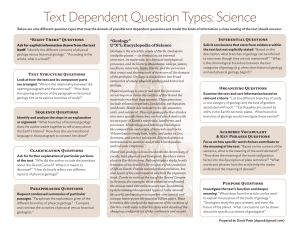
Text Dependent Question Types: Science
... into more specific branches, each of which deals with its own part of Earth’s materials, landforms, and processes. Mineralogy and petrology investigate the composition and origin of minerals and rocks. Volcanologists study lava, rocks, and gases on live, dormant, and extinct volcanoes. Seismologists ...
... into more specific branches, each of which deals with its own part of Earth’s materials, landforms, and processes. Mineralogy and petrology investigate the composition and origin of minerals and rocks. Volcanologists study lava, rocks, and gases on live, dormant, and extinct volcanoes. Seismologists ...

Science 3360 - Kennesaw State University | College of Science and
... 3. Fossils of identical plants and animals found on all continents. This had been explained at the time by postulating that land bridges, now sunken, had once connected the continents. ...
... 3. Fossils of identical plants and animals found on all continents. This had been explained at the time by postulating that land bridges, now sunken, had once connected the continents. ...

Igneous Rocks Power Point
... About 1.1 billion years ago, the continent that had been building for billions of years began to split apart across what is now Minnesota. • The “Midcontinent rift,” is where the crust began to separate to form a new ocean basin, but stopped short of actually making a new ...
... About 1.1 billion years ago, the continent that had been building for billions of years began to split apart across what is now Minnesota. • The “Midcontinent rift,” is where the crust began to separate to form a new ocean basin, but stopped short of actually making a new ...

LAB 4: TEXTURES AND IDENTIFICATION OF SEDIMENTARY
... grains, fragments of pre-existing rocks that have been packed together with spaces (pores) between grains. These pores may later be filled in with cementing materials such as silica or calcite deposited by groundwater moving through the sediment. Examples of clastic sedimentary rocks are sandstone a ...
... grains, fragments of pre-existing rocks that have been packed together with spaces (pores) between grains. These pores may later be filled in with cementing materials such as silica or calcite deposited by groundwater moving through the sediment. Examples of clastic sedimentary rocks are sandstone a ...
Geology of Great Britain

The geology of Great Britain is renowned for its diversity. As a result of its eventful geological history, Great Britain shows a rich variety of landscapes across the constituent countries of England, Wales and Scotland. Rocks of almost all geological ages are represented at outcrop, from the Archaean onwards.