
Geologic Map of the Ruidoso Downs Quadrangle, Lincoln, Otero
... Qg – Stream gravel deposits (lower to middle (?) Pleistocene) - Moderately lithified, crudely bedded pebble to boulder gravel along Rio Ruidoso valley and the margin of Pajarita Flats in the southwest corner of the quadrangle. Along Rio Ruidoso, sandy clast-supported gravel is interbedded with chann ...
... Qg – Stream gravel deposits (lower to middle (?) Pleistocene) - Moderately lithified, crudely bedded pebble to boulder gravel along Rio Ruidoso valley and the margin of Pajarita Flats in the southwest corner of the quadrangle. Along Rio Ruidoso, sandy clast-supported gravel is interbedded with chann ...

Rock Cycle Lesson 2017
... Igneous rock – forms when magma/lava from a volcano cools and hardens. Sedimentary rock – forms when sediments are buried, compacted & cemented together. Metamorphic rock – forms when existing rock is subjected to great heat & pressure over a long period of time. ...
... Igneous rock – forms when magma/lava from a volcano cools and hardens. Sedimentary rock – forms when sediments are buried, compacted & cemented together. Metamorphic rock – forms when existing rock is subjected to great heat & pressure over a long period of time. ...

Weathering
... - metamorphism restricted to zones called aureoles (halos) around the intrusion - isochemical process in which no ions are added or lost, they are just rearranged. 2b. Contact Metasomatism - ions are added and lost by exchange between the fluids and the rocks - escaping gases and magmatic solutions ...
... - metamorphism restricted to zones called aureoles (halos) around the intrusion - isochemical process in which no ions are added or lost, they are just rearranged. 2b. Contact Metasomatism - ions are added and lost by exchange between the fluids and the rocks - escaping gases and magmatic solutions ...

Test # 2 Study Guide Weathering What is Weathering? - in
... - metamorphism restricted to zones called aureoles (halos) around the intrusion - isochemical process in which no ions are added or lost, they are just rearranged. 2b. Contact Metasomatism - ions are added and lost by exchange between the fluids and the rocks - escaping gases and magmatic solutions ...
... - metamorphism restricted to zones called aureoles (halos) around the intrusion - isochemical process in which no ions are added or lost, they are just rearranged. 2b. Contact Metasomatism - ions are added and lost by exchange between the fluids and the rocks - escaping gases and magmatic solutions ...

Influence of natural organic acids on the leaching of major and trace
... Ai = λ i Ciq(irock ) , where λ i and qi are constants which values are close for various rocks (table). Parameter Ai describes mobility of elements i at the initial stage of leaching when only small amount of organic acids has react and Bi m << 1. The generality of dependence (2) for different eleme ...
... Ai = λ i Ciq(irock ) , where λ i and qi are constants which values are close for various rocks (table). Parameter Ai describes mobility of elements i at the initial stage of leaching when only small amount of organic acids has react and Bi m << 1. The generality of dependence (2) for different eleme ...
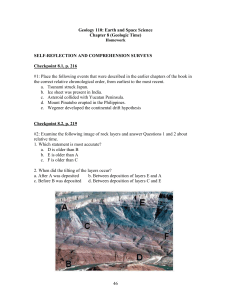
GEHomeworkCh8
... predictions. (Note that the dates of periods quoted have been modified by more recent interpretations.) Scientists investigating an abandoned quarry in Canada have found what appear to be the oldest known footprints of terrestrial creatures--foot-long critters resembling modern bugs that crawled fro ...
... predictions. (Note that the dates of periods quoted have been modified by more recent interpretations.) Scientists investigating an abandoned quarry in Canada have found what appear to be the oldest known footprints of terrestrial creatures--foot-long critters resembling modern bugs that crawled fro ...

First Hour Exam Answers
... of continental margins, that support the combined theories of continental drift and plate tectonics, and indicate how each line of evidence supports these concepts. Avoid circular reasoning (i.e., don't use plate tectonics as evidence for plate tectonics!). (10 points: 4-3-3) (1) Identical plant and ...
... of continental margins, that support the combined theories of continental drift and plate tectonics, and indicate how each line of evidence supports these concepts. Avoid circular reasoning (i.e., don't use plate tectonics as evidence for plate tectonics!). (10 points: 4-3-3) (1) Identical plant and ...
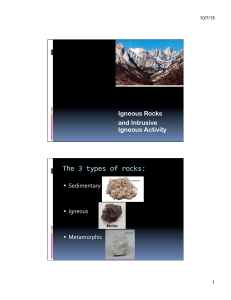
Rock cycle and Igneous rocks
... Obsidian is usually black in color though it can also be red or have a greenish tint. It is a dense volcanic glass, usually composed of rhyolite, rich in iron and magnesium. Obsidian is formed when the lava cools so quickly that crystals do not have time to grow. Obsidian fractures with very sharp e ...
... Obsidian is usually black in color though it can also be red or have a greenish tint. It is a dense volcanic glass, usually composed of rhyolite, rich in iron and magnesium. Obsidian is formed when the lava cools so quickly that crystals do not have time to grow. Obsidian fractures with very sharp e ...

Essentials of Geology Sedimentary Rocks
... of the surface of the continents even though they make up only a small part of the continental crust. Many times in the past the continents have been covered by shallow, warm seas which deposited thick sequences of sediments. ...
... of the surface of the continents even though they make up only a small part of the continental crust. Many times in the past the continents have been covered by shallow, warm seas which deposited thick sequences of sediments. ...

Geology of the Kaimai Ranges
... took millions of years to form, most movement happened about 1-2 million years ago when the Kaimai volcanos on the east of the Hauraki Fault were uplifted (in places up to 4 kilometres higher than the west). As well as creating the mountain range, the faulting also tilted the Waiteariki Ignimbrite t ...
... took millions of years to form, most movement happened about 1-2 million years ago when the Kaimai volcanos on the east of the Hauraki Fault were uplifted (in places up to 4 kilometres higher than the west). As well as creating the mountain range, the faulting also tilted the Waiteariki Ignimbrite t ...

Rock
... • Form when pre-existing rocks are changed by heat and/or pressure – Occurs during mountain building, volcanic activity, etc… ...
... • Form when pre-existing rocks are changed by heat and/or pressure – Occurs during mountain building, volcanic activity, etc… ...
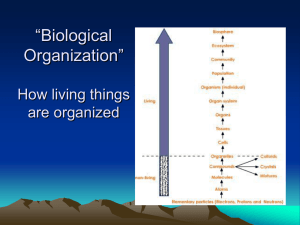

Metamorphic. evolution of high-pressure, low
... DIFILIPPO, Erica L., [email protected], and BRADY, John B., [email protected], Department of Geology, Smith College, Northampton, MA ...
... DIFILIPPO, Erica L., [email protected], and BRADY, John B., [email protected], Department of Geology, Smith College, Northampton, MA ...

Cymdeithas Daeareg Gogledd Cymru North Wales Geology
... within the Ordovician volcanic rocks of Snowdonia can be measured. Their degree of distortion makes it possible to assess the actual amount of tectonic deformation (crustal shortening) to which Snowdonia was subjected during the Caledonian mountain-building episode, around 400 million years before t ...
... within the Ordovician volcanic rocks of Snowdonia can be measured. Their degree of distortion makes it possible to assess the actual amount of tectonic deformation (crustal shortening) to which Snowdonia was subjected during the Caledonian mountain-building episode, around 400 million years before t ...

Stone Walls: Stories from Minnesota`s Geologic Past
... Quarried in the Minnesota River valley, the Morton Gneiss can be found in buildings and cemeteries across the nation. No two pieces of the rock are the same and one needs only a modest imagination upon which to base a description. For me, descriptions of rock always seem to center on something edib ...
... Quarried in the Minnesota River valley, the Morton Gneiss can be found in buildings and cemeteries across the nation. No two pieces of the rock are the same and one needs only a modest imagination upon which to base a description. For me, descriptions of rock always seem to center on something edib ...

Field Report - Indus Experiences
... underlying geology are also significant. Where did all these plants come from? 200 million years ago (Ma), when the ancestors of flowering plants first appeared, India was still part of Pangaea. When Pangaea started to break apart (165 Ma), early angiosperms were already widespread and diverse and b ...
... underlying geology are also significant. Where did all these plants come from? 200 million years ago (Ma), when the ancestors of flowering plants first appeared, India was still part of Pangaea. When Pangaea started to break apart (165 Ma), early angiosperms were already widespread and diverse and b ...

LAURENTIA j20 Geosynclinal theory < Hall, Dana - e
... as a unit is destined to be, is being, or was folded orogenically, is called a geosyncline (Figure j20.1). Hans Stille in 1940 called the continentward part of a geosyncline with shallow-water quartzcarbonate facies sediments, a miogeosyncline (less of a geosyncline), and the oceanward part of a geo ...
... as a unit is destined to be, is being, or was folded orogenically, is called a geosyncline (Figure j20.1). Hans Stille in 1940 called the continentward part of a geosyncline with shallow-water quartzcarbonate facies sediments, a miogeosyncline (less of a geosyncline), and the oceanward part of a geo ...

rocks!!
... in layers because they tend to sort by density when they are heated. • Quartzite forms from the metamorphism of its parent rock, quartz sandstone. When heat and/or pressure is applied, it causes the parent rock to become more dense and resistant to weathering. ...
... in layers because they tend to sort by density when they are heated. • Quartzite forms from the metamorphism of its parent rock, quartz sandstone. When heat and/or pressure is applied, it causes the parent rock to become more dense and resistant to weathering. ...

00258 Guide to CH Building Stone
... through the garden shrubs and can also be found lining the pavements and roads down Matford Lane. Similar walls are easily sighted around Exeter Cathedral. The wall seems to have been built out of reclaimed blocks from the local area along with locally quarried material. The characteristically red-b ...
... through the garden shrubs and can also be found lining the pavements and roads down Matford Lane. Similar walls are easily sighted around Exeter Cathedral. The wall seems to have been built out of reclaimed blocks from the local area along with locally quarried material. The characteristically red-b ...

South Africa`s Newest Mineral Oasis: Geology of the Salt River
... 1.72 wt.% Zn; 0.63 wt.% Cu; 0.44 wt.% Pb; 23.5 g/t Ag and 1.0g/t Au with a highgrade shoot along the eastern edge of the deposit. However, it should be noted that the deposit remains open at depth and to the west where a further four prospects have been identified. Regional Geology: The Salt River d ...
... 1.72 wt.% Zn; 0.63 wt.% Cu; 0.44 wt.% Pb; 23.5 g/t Ag and 1.0g/t Au with a highgrade shoot along the eastern edge of the deposit. However, it should be noted that the deposit remains open at depth and to the west where a further four prospects have been identified. Regional Geology: The Salt River d ...

13. Earth Structure, Rocks, Minerals and the Rock Cycle
... All rock types physically and chemically decomposed by a variety of surface processes collectively known as weathering The debris thus created often transported by erosional processes via streams, glaciers, wind, and gravity When this debris is deposited as permanent sediment, the processes of ...
... All rock types physically and chemically decomposed by a variety of surface processes collectively known as weathering The debris thus created often transported by erosional processes via streams, glaciers, wind, and gravity When this debris is deposited as permanent sediment, the processes of ...

Geologic Time Part I: Relative Dating
... 1. Deposition of sediment comprising Unit A (Sedimentation rates in the deep ocean range from .0005 - .001 mm per year). How long would it take to accumulate 200 meters of sediment?) 2. burial compaction & lithification of Unit A, 3. deformation (folding) of Unit A, 4. uplift and erosion of Unit A, ...
... 1. Deposition of sediment comprising Unit A (Sedimentation rates in the deep ocean range from .0005 - .001 mm per year). How long would it take to accumulate 200 meters of sediment?) 2. burial compaction & lithification of Unit A, 3. deformation (folding) of Unit A, 4. uplift and erosion of Unit A, ...

C:\Users\Jim\Documents\school stuff\ses4u\Earth Materials Review
... Some event in earth history. 5) What is the likelihood that any particular layer of sediment on a river bottom actually gets preserved in a rock? Very low. Most sediment layers are reworked many times as sediment is deposited, on average, at very slow rates: fractions of millimetres per year. 6) How ...
... Some event in earth history. 5) What is the likelihood that any particular layer of sediment on a river bottom actually gets preserved in a rock? Very low. Most sediment layers are reworked many times as sediment is deposited, on average, at very slow rates: fractions of millimetres per year. 6) How ...

COWLEY COLLEGE
... Contrast the beneficial and catastrophic effects of volcanism on humans. Compare the three major types of volcanoes in terms of their size, shape, and composition and give examples of each. Recognize the characteristics of volcanic domes. Explain how the texture of an igneous rock gives clues about ...
... Contrast the beneficial and catastrophic effects of volcanism on humans. Compare the three major types of volcanoes in terms of their size, shape, and composition and give examples of each. Recognize the characteristics of volcanic domes. Explain how the texture of an igneous rock gives clues about ...
Geology of Great Britain

The geology of Great Britain is renowned for its diversity. As a result of its eventful geological history, Great Britain shows a rich variety of landscapes across the constituent countries of England, Wales and Scotland. Rocks of almost all geological ages are represented at outcrop, from the Archaean onwards.