Geology of Peoria and Tazewell Counties
... During the Paleozoic Era, sediments accumulated in the seas that covered Illinois and adjacent states. The shallow seas connected with the open ocean to the south during much of the Paleozoic, and the area of southern Illinois was an embayment. The southern part of Illinois and adjacent parts of Ind ...
... During the Paleozoic Era, sediments accumulated in the seas that covered Illinois and adjacent states. The shallow seas connected with the open ocean to the south during much of the Paleozoic, and the area of southern Illinois was an embayment. The southern part of Illinois and adjacent parts of Ind ...

Rocks - rozyckiphsscience
... • Physical and chemical processes that transform sediments into sedimentary rock • Includes compaction and cementation • Compaction---the weight of the overlying sediments forces the sediment grains closer together (physical change) • Cementation---mineral growth cements sediment grains together int ...
... • Physical and chemical processes that transform sediments into sedimentary rock • Includes compaction and cementation • Compaction---the weight of the overlying sediments forces the sediment grains closer together (physical change) • Cementation---mineral growth cements sediment grains together int ...

unconformity - Shaileshchaure
... that can represent a break in the geologic record of hundreds of mi llions of years or more. For example, the contact between a 400-million-year-old sandstone that was deposited by a rising sea on a weathered bedrock surface that is 600 million years old is an unconformity that represents a time hia ...
... that can represent a break in the geologic record of hundreds of mi llions of years or more. For example, the contact between a 400-million-year-old sandstone that was deposited by a rising sea on a weathered bedrock surface that is 600 million years old is an unconformity that represents a time hia ...

Rocks
... limestone or sandstone. Why? 17. A piece of rock contains layers. What type of rock would it probably ...
... limestone or sandstone. Why? 17. A piece of rock contains layers. What type of rock would it probably ...

M211-Adirondack-New England Mixed Forest
... mineral content. Forest vegetation was largely aspen-birch and white-red-jack pine cover types. ...
... mineral content. Forest vegetation was largely aspen-birch and white-red-jack pine cover types. ...

GY 112 Lecture Notes - University of South Alabama
... encounter basalt (a finely crystalline generally black rock; see image to the left from the Drexel University web site), you suspect a divergent plate paleotectonic setting. In contrast, a convergent place paleotectonic setting would produce granite, a coarsely crystalline, generally pink rock (pict ...
... encounter basalt (a finely crystalline generally black rock; see image to the left from the Drexel University web site), you suspect a divergent plate paleotectonic setting. In contrast, a convergent place paleotectonic setting would produce granite, a coarsely crystalline, generally pink rock (pict ...

What is a Rock?
... All rock types physically and chemically decomposed by a variety of surface processes collectively known as weathering The debris thus created often transported by erosional processes via streams, glaciers, wind, and gravity When this debris is deposited as permanent sediment, the processes of ...
... All rock types physically and chemically decomposed by a variety of surface processes collectively known as weathering The debris thus created often transported by erosional processes via streams, glaciers, wind, and gravity When this debris is deposited as permanent sediment, the processes of ...

ROCKS and how to identify them
... surface allows crystals to This group of igneous rocks is called EXTRUSIVE grow to large size. These crystals are easily visible Igneous Rocks and are typically volcanic in origin. and distinguish this group of Cooling may be so rapid igneous rocks as that crystals do not have a INTRUSIVE Igneous Ro ...
... surface allows crystals to This group of igneous rocks is called EXTRUSIVE grow to large size. These crystals are easily visible Igneous Rocks and are typically volcanic in origin. and distinguish this group of Cooling may be so rapid igneous rocks as that crystals do not have a INTRUSIVE Igneous Ro ...

wave erosion - Fort Thomas Independent Schools
... • The wind causes water particles to move up and down as a wave goes by. The water particles themselves don’t move forward. • Think of it as wind blowing tall grass in the field. The grass moves back and forth but doesn’t move from its place. ...
... • The wind causes water particles to move up and down as a wave goes by. The water particles themselves don’t move forward. • Think of it as wind blowing tall grass in the field. The grass moves back and forth but doesn’t move from its place. ...
PEN CAER
... the tuffs, while shardic fragments are seen in thin section. These tuffs are thought to be sediment-gravity flow deposits, derived from the reworking of primary silicic eruptive volcanic detritus. The basic clasts were most probably eroded from wall rocks in the volcanic edifice during eruption. Ove ...
... the tuffs, while shardic fragments are seen in thin section. These tuffs are thought to be sediment-gravity flow deposits, derived from the reworking of primary silicic eruptive volcanic detritus. The basic clasts were most probably eroded from wall rocks in the volcanic edifice during eruption. Ove ...
Bedrock - NH Division of Forests and Lands
... rocks are those that have formed from the cooling and crystallization of molten rock. Molten rock found below the Earth’s surface, within the lithosphere of the Earth, is known as magma, while molten rock that has erupted onto the ocean floor or onto the surface of a continent is known as lava. Igne ...
... rocks are those that have formed from the cooling and crystallization of molten rock. Molten rock found below the Earth’s surface, within the lithosphere of the Earth, is known as magma, while molten rock that has erupted onto the ocean floor or onto the surface of a continent is known as lava. Igne ...

Final Exam - UTEP Geology Homepage
... calculate the age of a sample given its half-life and the amount of decay Mass Extinctions & Geologic Time What they are What causes them When the major ones were. Geologic time: be familiar with major divisions and the important things that occurred during them: Precambrian, Paleozoic, Meso ...
... calculate the age of a sample given its half-life and the amount of decay Mass Extinctions & Geologic Time What they are What causes them When the major ones were. Geologic time: be familiar with major divisions and the important things that occurred during them: Precambrian, Paleozoic, Meso ...
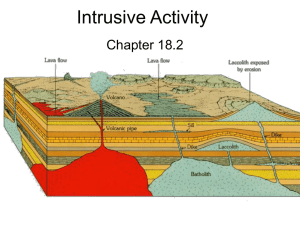
Intrusive Activity
... B. Magma can also cause blocks of rock to break off and sink into the magma, where the rocks may eventually melt. C. Magma can melt the rock into which it intrudes. ...
... B. Magma can also cause blocks of rock to break off and sink into the magma, where the rocks may eventually melt. C. Magma can melt the rock into which it intrudes. ...

Pangaea The Earth is divided into three layers
... -the crust and the mantle and the core. We live on the crust and it’s the thinnest layer -the mountains to the desert to the ocean floor. Two thirds of the Earth’s mass is the mantle in between the core and the crust The core is a mystery but through volcanoes some of the mantle reaches us. Hey, it ...
... -the crust and the mantle and the core. We live on the crust and it’s the thinnest layer -the mountains to the desert to the ocean floor. Two thirds of the Earth’s mass is the mantle in between the core and the crust The core is a mystery but through volcanoes some of the mantle reaches us. Hey, it ...

Reading Science!
... rock, have been changed by intense pressure and extreme heat from deep inside the Earth. With enough heat and pressure the a rocks appearance, structure and composition can result in the formation of a different rock. Granite, that was once an igneous rock, will become gneiss when it is placed under ...
... rock, have been changed by intense pressure and extreme heat from deep inside the Earth. With enough heat and pressure the a rocks appearance, structure and composition can result in the formation of a different rock. Granite, that was once an igneous rock, will become gneiss when it is placed under ...

Exam 2 powerpoint review
... Spring & summer high sediment input thick, coarse, light-colored layers ...
... Spring & summer high sediment input thick, coarse, light-colored layers ...

Answers to pgs. 125 - 128 wks.
... 14. The continents once formed a single landmass, broke up, and drifted to their present locations because of a. tectonic drift. b. plate tectonics. c. continental drift. d. continental tectonics. 15. As a continent moves across Earth’s surface, a. it carries oceans with it. b. it carries rocks and ...
... 14. The continents once formed a single landmass, broke up, and drifted to their present locations because of a. tectonic drift. b. plate tectonics. c. continental drift. d. continental tectonics. 15. As a continent moves across Earth’s surface, a. it carries oceans with it. b. it carries rocks and ...
Deformation - Bakersfield College
... – Large strike-slip fault that cuts through the lithosphere – Accommodates motion between two large crustal plates ...
... – Large strike-slip fault that cuts through the lithosphere – Accommodates motion between two large crustal plates ...

Fourth Grade Science Vocabulary
... slowly=larger mineral grains-course texture Molten rock above ground=lava cools more quickly=small grains =fine texture or no grains = volcanic glass C10 Form from smaller bits of rock that become Some are made of substances that were once Sedimentary pressed or cemented together in layers. living; ...
... slowly=larger mineral grains-course texture Molten rock above ground=lava cools more quickly=small grains =fine texture or no grains = volcanic glass C10 Form from smaller bits of rock that become Some are made of substances that were once Sedimentary pressed or cemented together in layers. living; ...

Limestone is a sedimentary rock!
... Intrusive rock cools under the surface. It has more time to cool and forms larger crystals. Quartz ...
... Intrusive rock cools under the surface. It has more time to cool and forms larger crystals. Quartz ...

Porosity is a measure of volume of the free space in a rock. Most
... Left: This sandstone is both porous and permeable. The inset shows a sandstone outcrop. ...
... Left: This sandstone is both porous and permeable. The inset shows a sandstone outcrop. ...

Field Guide Local Geology Review
... Melanges are common in the Northern California coast ranges: recognized by large random boulders sitting on rolling hillsides. Boulders are hard and stand out from the soft greenish-gray or bluish-gray clay matrix, which is seldom seen. The clay matrix does not have layering. Melanges form because i ...
... Melanges are common in the Northern California coast ranges: recognized by large random boulders sitting on rolling hillsides. Boulders are hard and stand out from the soft greenish-gray or bluish-gray clay matrix, which is seldom seen. The clay matrix does not have layering. Melanges form because i ...
Chapter 3
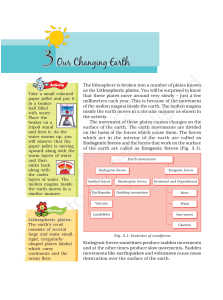
... all round the earth. These vibrations are called earthquakes (Fig. 3.3). The place in the crust where the movement starts is called the focus. The place on the surface above the focus is called the epicentre. Vibrations travel outwards from the epicentre as waves. Greatest damage is usually closest ...
... all round the earth. These vibrations are called earthquakes (Fig. 3.3). The place in the crust where the movement starts is called the focus. The place on the surface above the focus is called the epicentre. Vibrations travel outwards from the epicentre as waves. Greatest damage is usually closest ...

Unit 9 Presentation
... amphitheaters. Similar falls from fins help make arches. GEOSC 10 - Geology of the National Parks ...
... amphitheaters. Similar falls from fins help make arches. GEOSC 10 - Geology of the National Parks ...

Chapter 5 Rocks
... Rock that forms from the cooling of magma below the surface or lava at the surface is called ...
... Rock that forms from the cooling of magma below the surface or lava at the surface is called ...
Geology of Great Britain

The geology of Great Britain is renowned for its diversity. As a result of its eventful geological history, Great Britain shows a rich variety of landscapes across the constituent countries of England, Wales and Scotland. Rocks of almost all geological ages are represented at outcrop, from the Archaean onwards.