
Sedimentary Rocks
... C. “Bioclastic sediments” are formed by living organisms. Many aquatic marine organisms produce shells or other protective coverings by secreting calcium carbonate (limestone) or calcium magnesium carbonate (dolomite). When these organisms die, their shells accumulate along the sea floor forming la ...
... C. “Bioclastic sediments” are formed by living organisms. Many aquatic marine organisms produce shells or other protective coverings by secreting calcium carbonate (limestone) or calcium magnesium carbonate (dolomite). When these organisms die, their shells accumulate along the sea floor forming la ...

Chapter 13 Rocks and Minerals
... together. Conglomerate, sandstone, siltstone, and shale are forms of detrital rock. From coarse pebbles to fine clays. Classified based on sediment size that forms the rock. Chemical sedimentary rocks – formed when dissolved mineral come out of solution. Calcium carbonate is carried in solution in o ...
... together. Conglomerate, sandstone, siltstone, and shale are forms of detrital rock. From coarse pebbles to fine clays. Classified based on sediment size that forms the rock. Chemical sedimentary rocks – formed when dissolved mineral come out of solution. Calcium carbonate is carried in solution in o ...
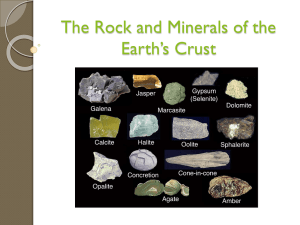
The Rock and Minerals of the Earth*s Crust
... On the other hand, the term sima is used for denser basaltic rocks of the ocean floor, as they are primarily comprised of silicon and magnesium. ◦ Iron is present in greater amounts in these rocks. ◦ Usually darker in color than the granitic continental rocks ...
... On the other hand, the term sima is used for denser basaltic rocks of the ocean floor, as they are primarily comprised of silicon and magnesium. ◦ Iron is present in greater amounts in these rocks. ◦ Usually darker in color than the granitic continental rocks ...

3.4 Notes: Metamorphic Rocks Think About… Heat and Pressure
... The deeper below the surface the rocks are, the greater the metamorphic changes that occur in them. • Example: Shale near the surface becomes _______________, while shale deep in Earth becomes Gneiss. ...
... The deeper below the surface the rocks are, the greater the metamorphic changes that occur in them. • Example: Shale near the surface becomes _______________, while shale deep in Earth becomes Gneiss. ...

Document
... a second into the movie. •The Christian era (BC-AD boundary) would be 3/4 of a second into the movie. •The most recent Ice Age would be 7 seconds into it. •The movie would run about 6 hours before we got to the end of the Mesozoic era (extinction of the dinosaurs). •We'd have to watch the movie for ...
... a second into the movie. •The Christian era (BC-AD boundary) would be 3/4 of a second into the movie. •The most recent Ice Age would be 7 seconds into it. •The movie would run about 6 hours before we got to the end of the Mesozoic era (extinction of the dinosaurs). •We'd have to watch the movie for ...

Rocks - Warnick
... solution by precipitation or evaporation -fine-grained unless they are crystallized ...
... solution by precipitation or evaporation -fine-grained unless they are crystallized ...

Name_________________________ Date_______ Period
... Fill in the blank 14. The __________________ is a never ending process that all rocks are always in. 15. The three types of rock in the rock cycle are; _____________________________ _____________________________ _____________________________ 16. When rock is in a liquefied state, and below the eart ...
... Fill in the blank 14. The __________________ is a never ending process that all rocks are always in. 15. The three types of rock in the rock cycle are; _____________________________ _____________________________ _____________________________ 16. When rock is in a liquefied state, and below the eart ...

Castle Hill Field Guide (Teacher version)
... Stop 1. Torlesse rocks – the basement of the Southern Alps. The Porters Pass Fault. Torlesse rocks (sandstone and mudstones, greywacke (often with fine layers – laminations) Fig. 2) form the Southern Alps and were deposited at continental shelf and greater water depths during the time that a large ...
... Stop 1. Torlesse rocks – the basement of the Southern Alps. The Porters Pass Fault. Torlesse rocks (sandstone and mudstones, greywacke (often with fine layers – laminations) Fig. 2) form the Southern Alps and were deposited at continental shelf and greater water depths during the time that a large ...

Advertising - Science Outreach
... Stop 1. Torlesse rocks – the basement of the Southern Alps. The Porters Pass Fault. Torlesse rocks (sandstone and mudstones, greywacke (often with fine layers – laminations) Fig. 2) form the Southern Alps and were deposited at continental shelf and greater water depths during the time that a large ...
... Stop 1. Torlesse rocks – the basement of the Southern Alps. The Porters Pass Fault. Torlesse rocks (sandstone and mudstones, greywacke (often with fine layers – laminations) Fig. 2) form the Southern Alps and were deposited at continental shelf and greater water depths during the time that a large ...
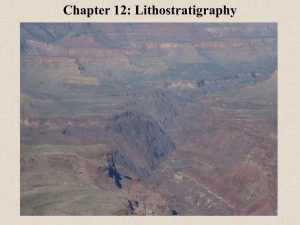
Chapter 12 - Faculty Server Contact
... Unconformable contact types Angular unconformity: younger sediments rest upon the eroded surface of tilted or folded rocks. Disconformity: contact between younger and older beds is marked by a visible, irregular or uneven erosional surface. ...
... Unconformable contact types Angular unconformity: younger sediments rest upon the eroded surface of tilted or folded rocks. Disconformity: contact between younger and older beds is marked by a visible, irregular or uneven erosional surface. ...

Geology
... Figure4 A- Is show rocks under the stress by tectonic forces in the earth. B- Is show rocks have a bending or deformation shape (Strain). C-Is show rocks are break with discharge of energy is released as Seismic Waves which causes the earthquake. The break of earth Rocks is called Fault with move pa ...
... Figure4 A- Is show rocks under the stress by tectonic forces in the earth. B- Is show rocks have a bending or deformation shape (Strain). C-Is show rocks are break with discharge of energy is released as Seismic Waves which causes the earthquake. The break of earth Rocks is called Fault with move pa ...
Continental Drift Theory
... off the coast of Newfoundland match mountains in the British Isles and Scandinavia which are comparable in age and structure. ...
... off the coast of Newfoundland match mountains in the British Isles and Scandinavia which are comparable in age and structure. ...

Classifying Rocks
... rock. Extreme heat or pressure will cause some rocks to change into metamorphic rock. These different formation processes give each type a characteristic appearance. This lets us classify rocks into one of the three categories. 3 Deep under Earth's crust the temperature is hot enough to melt rocks. ...
... rock. Extreme heat or pressure will cause some rocks to change into metamorphic rock. These different formation processes give each type a characteristic appearance. This lets us classify rocks into one of the three categories. 3 Deep under Earth's crust the temperature is hot enough to melt rocks. ...

chap11earthsciencete..
... 6: (a) Cementation is the process by which sediments are joined together to form rock. 7: The (k) structure determines the arrangement of minerals in a rock. 8: (b) Clastic rock is a type of sedimentary rock consisting of broken fragments of rock and minerals. 9: (j) Sediments are small bits of matt ...
... 6: (a) Cementation is the process by which sediments are joined together to form rock. 7: The (k) structure determines the arrangement of minerals in a rock. 8: (b) Clastic rock is a type of sedimentary rock consisting of broken fragments of rock and minerals. 9: (j) Sediments are small bits of matt ...

Plate Tectonics - River Mill Academy
... •These mountains are formed as new sea floor is created from magma that wells up from the mantle below. ...
... •These mountains are formed as new sea floor is created from magma that wells up from the mantle below. ...

Adakites and the Origin of Cu, Au and Mineralisation
... The Andean Austral Volcanic Zone (AAVZ), southern Chile, lies above a subducted spreading centre between the Nazca and Antarctic Plates. Adakitic magmatism in the AAVZ has been attributed to melting of the hot crustal rocks associated with the subducted spreading centre (Stern and Killian 1996). If ...
... The Andean Austral Volcanic Zone (AAVZ), southern Chile, lies above a subducted spreading centre between the Nazca and Antarctic Plates. Adakitic magmatism in the AAVZ has been attributed to melting of the hot crustal rocks associated with the subducted spreading centre (Stern and Killian 1996). If ...

Weathering and Erosion Study Guide
... 14. Which statement best explains how water mechanically breaks down rocks? A. Water expands when it freezes (Ice Wedging) B. Water does not break down rocks C. Acids in water react with chemicals in the rock D. All of the above 15. Which of the following things will most likely experience oxidation ...
... 14. Which statement best explains how water mechanically breaks down rocks? A. Water expands when it freezes (Ice Wedging) B. Water does not break down rocks C. Acids in water react with chemicals in the rock D. All of the above 15. Which of the following things will most likely experience oxidation ...

Minnesota Rocks box - University of Minnesota Duluth
... sediments—made up of individual particles—the grains, which may be large (coarse) or small (fine), were originally part of ...
... sediments—made up of individual particles—the grains, which may be large (coarse) or small (fine), were originally part of ...

Rocks
... lava that cover large areas. This magma makes up much of the ocean floor. Temperatures of basaltic magma range from 900 to 12000 at the surface. IT contains a high percentage of iron and magnesium. The presence of these elements produces igneous rocks that are generally quite dense and dark in color ...
... lava that cover large areas. This magma makes up much of the ocean floor. Temperatures of basaltic magma range from 900 to 12000 at the surface. IT contains a high percentage of iron and magnesium. The presence of these elements produces igneous rocks that are generally quite dense and dark in color ...
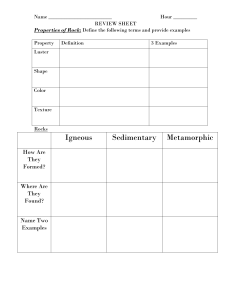

Planet Earth Study Guide
... B. Identify evidence for the rock cycle, and use the rock cycle concept to interpret and explain the characteristics of particular rocks 1. distinguish between rocks and minerals 2. describe characteristics of the three main classes of rocks—igneous, sedimentary and metamorphic—and describe evidence ...
... B. Identify evidence for the rock cycle, and use the rock cycle concept to interpret and explain the characteristics of particular rocks 1. distinguish between rocks and minerals 2. describe characteristics of the three main classes of rocks—igneous, sedimentary and metamorphic—and describe evidence ...

Zircon geochronology of intrusive rocks from Cap de Creus, Eastern
... results of this study suggest that subduction-related calc-alkaline magmatic activity in the Cap de Creus was coeval and coupled with D2 dextral transpression involving NNW–SSE crustal shortening during Late Carboniferous – Early Permian time (c. 299–291 Ma). Since these age determinations are withi ...
... results of this study suggest that subduction-related calc-alkaline magmatic activity in the Cap de Creus was coeval and coupled with D2 dextral transpression involving NNW–SSE crustal shortening during Late Carboniferous – Early Permian time (c. 299–291 Ma). Since these age determinations are withi ...

Geochemical characteristics of granitic rocks underlying ion
... (HREE)-rich deposits, because they are more critical than light REE (LREE). The REE grades of the ion-adsorption type deposits range widely from 140 to 6500 ppm in southern China and other countries. The HREE-rich ores are typically low-grades and underlain by fractionated granites characterized by ...
... (HREE)-rich deposits, because they are more critical than light REE (LREE). The REE grades of the ion-adsorption type deposits range widely from 140 to 6500 ppm in southern China and other countries. The HREE-rich ores are typically low-grades and underlain by fractionated granites characterized by ...

ENVI 21 Life in the Ocean
... Underlie ~8% of ocean surface Richest, most productive parts of ocean Some parts exposed during times of low sea level and eroded by rivers and glaciers now are submarine canyons Varies in width from 1 km (Pacific coast of S Am) to 750+ km (Arctic coast of Siberia) Ends at shelf break, usually at 12 ...
... Underlie ~8% of ocean surface Richest, most productive parts of ocean Some parts exposed during times of low sea level and eroded by rivers and glaciers now are submarine canyons Varies in width from 1 km (Pacific coast of S Am) to 750+ km (Arctic coast of Siberia) Ends at shelf break, usually at 12 ...

Rocks in - Earth Science
... to the atmosphere and hydrosphere they start to break down Weathering is the general term for all actions that break down or wear away rock Erosion is the moving/transport of the sediment ...
... to the atmosphere and hydrosphere they start to break down Weathering is the general term for all actions that break down or wear away rock Erosion is the moving/transport of the sediment ...
Geology of Great Britain

The geology of Great Britain is renowned for its diversity. As a result of its eventful geological history, Great Britain shows a rich variety of landscapes across the constituent countries of England, Wales and Scotland. Rocks of almost all geological ages are represented at outcrop, from the Archaean onwards.