
Precambrian - E. R. Greenman
... sediment grains (calcium carbonate) are trapped on sticky mats of photosynthesizing cyanobacteria. The oldest known undisputed stromatolites are found in rocks in South Africa that are 3.0 billion years old but probable ones are also known from the Warrawoona Group in Australia which is 3.3 ...
... sediment grains (calcium carbonate) are trapped on sticky mats of photosynthesizing cyanobacteria. The oldest known undisputed stromatolites are found in rocks in South Africa that are 3.0 billion years old but probable ones are also known from the Warrawoona Group in Australia which is 3.3 ...

relative dating absolute dating principle of superposition principle of
... fragments in a rock unit are older than the rock unit itself; for example, granite inclusions in sandstone are older than the sandstone. ...
... fragments in a rock unit are older than the rock unit itself; for example, granite inclusions in sandstone are older than the sandstone. ...

Rocks chapter 3
... Rock forms from the once living remains Most common is fossil-rich limestone Formed from once living ocean organisms instead of just calcite deposits Shells of marine organism are made of CaCO3 that eventually becomes calcite where they are cemented together Coquina : rock made of shell f ...
... Rock forms from the once living remains Most common is fossil-rich limestone Formed from once living ocean organisms instead of just calcite deposits Shells of marine organism are made of CaCO3 that eventually becomes calcite where they are cemented together Coquina : rock made of shell f ...

Why does Earth`s crust move? The mystery of the moving crust has
... The evidence suggested that India was once a separate piece of land. Many millions of years ago, India drifted into Eurasia. The collision pushed rocks containing fossils from the bottom of the sea up to the top of the Himalayan mountains. ...
... The evidence suggested that India was once a separate piece of land. Many millions of years ago, India drifted into Eurasia. The collision pushed rocks containing fossils from the bottom of the sea up to the top of the Himalayan mountains. ...

Geology of the Batemans Bay region Geological evolution
... late Mesozoic era (about 145 Ma million years ago, Ma) up to the present day after the breakup of the Gondwana supercontinent. During this time the Australian lithospheric plate separated from Antarctica and drifted northward to its present location where it now collides with the SE Asian plate, the ...
... late Mesozoic era (about 145 Ma million years ago, Ma) up to the present day after the breakup of the Gondwana supercontinent. During this time the Australian lithospheric plate separated from Antarctica and drifted northward to its present location where it now collides with the SE Asian plate, the ...

GE 121 Physical and Historical Geology I Earth’s Dynamic Systems 10
... 1. An atom is the smallest unit of an element that possesses the properties of the element. It consists of a nucleus of protons and neutrons and a surrounding cloud of electrons. 2. An atom of a given element is distinguished by the number of protons in its nucleus. Isotopes are varieties of an elem ...
... 1. An atom is the smallest unit of an element that possesses the properties of the element. It consists of a nucleus of protons and neutrons and a surrounding cloud of electrons. 2. An atom of a given element is distinguished by the number of protons in its nucleus. Isotopes are varieties of an elem ...

Caledonia and Pine Grove Furnace State Park
... was altered to dolomite. We call this presentday rock unit the Tomstown Dolomite. Later, more limestone and calcareous shale, thousands of feet thick, were deposited on top of the Tomstown Dolomite. However, only a few remnants of these rock units can be seen today because they have been worn away b ...
... was altered to dolomite. We call this presentday rock unit the Tomstown Dolomite. Later, more limestone and calcareous shale, thousands of feet thick, were deposited on top of the Tomstown Dolomite. However, only a few remnants of these rock units can be seen today because they have been worn away b ...


Carter`s piece - Texas Master Naturalist
... 70° south paleolatitude. On the modern globe this is roughly between the MontanaWyoming border and the Southern tip of South America. ...
... 70° south paleolatitude. On the modern globe this is roughly between the MontanaWyoming border and the Southern tip of South America. ...

Chemistry: Atoms First, McMurry and Fay, 1st Edition
... • Era- Time periods between 100 million and 500 million years. These occur within ...
... • Era- Time periods between 100 million and 500 million years. These occur within ...

The Origin of the Ocean
... (hydrochloric acid and hydrogen sulfide) released from the Earth's interior and by volcanoes. • Probably, the ocean was salty as soon as it formed. More salts have accumulated gradually, as more of the rocks of the crust were broken down by water (weathered). • The composition of the sea salt has be ...
... (hydrochloric acid and hydrogen sulfide) released from the Earth's interior and by volcanoes. • Probably, the ocean was salty as soon as it formed. More salts have accumulated gradually, as more of the rocks of the crust were broken down by water (weathered). • The composition of the sea salt has be ...

08 minerals
... also on the timely evolution of good reservoir rocks, and traps. Sandstones and carbonates are good reservoir rocks while shale horizons generate good traps. From the limited data available in Kenya, analysis of hydrocarbon potential is difficult. However, if there was to be any potential, the most ...
... also on the timely evolution of good reservoir rocks, and traps. Sandstones and carbonates are good reservoir rocks while shale horizons generate good traps. From the limited data available in Kenya, analysis of hydrocarbon potential is difficult. However, if there was to be any potential, the most ...

VIDEO WEB HIT HOMEWORK – part 2
... - Band Iron Formations (BIF): alternating layers of iron oxides and chert deposited in the sea (chert is a type of quartz) - The BIF are the principle source of iron ore around the world today. - After 2.0 BY there would be so much free oxygen (about 1%) that very minor dissolved iron would reach th ...
... - Band Iron Formations (BIF): alternating layers of iron oxides and chert deposited in the sea (chert is a type of quartz) - The BIF are the principle source of iron ore around the world today. - After 2.0 BY there would be so much free oxygen (about 1%) that very minor dissolved iron would reach th ...

powerpoint
... sand that will become sandstone. The kaolinite clay becomes the clay mineral that makes shale. Shale is the most abundant sedimentary rock. ...
... sand that will become sandstone. The kaolinite clay becomes the clay mineral that makes shale. Shale is the most abundant sedimentary rock. ...

Earth Science SOLs: Essential Understandings, Knowledge and Skills
... The Valley and Ridge province is an area with long parallel ridges and valleys underlain by ancient folded and faulted sedimentary rocks. The folding and faulting of the sedimentary rocks occurred during a collision between Africa and North America. The collision, which occurred in the late Paleozoi ...
... The Valley and Ridge province is an area with long parallel ridges and valleys underlain by ancient folded and faulted sedimentary rocks. The folding and faulting of the sedimentary rocks occurred during a collision between Africa and North America. The collision, which occurred in the late Paleozoi ...

Introduction - Government of Nova Scotia
... Cretaceous clay and silica sand, although not included in this report, are an important type of occurrence. Classified as estuarine, the interbedded clay and silica sand were laid down in a shallow area of the sea during the latter part of the Mesozoic. CLAY PRODUCTION IN NOVA SCOTIA The clay and sh ...
... Cretaceous clay and silica sand, although not included in this report, are an important type of occurrence. Classified as estuarine, the interbedded clay and silica sand were laid down in a shallow area of the sea during the latter part of the Mesozoic. CLAY PRODUCTION IN NOVA SCOTIA The clay and sh ...

Chapter 4 Exercises 1. Observations and experiments show that rate
... km, where the country rock was very hot, would likely have larger crystals (be more coarsegrained) that the other sill, which was formed at a depth of 0.5 km and where the country rock was moderately warm. In the latter sill, the rock would have cooled more rapidly and thus finer crystals would have ...
... km, where the country rock was very hot, would likely have larger crystals (be more coarsegrained) that the other sill, which was formed at a depth of 0.5 km and where the country rock was moderately warm. In the latter sill, the rock would have cooled more rapidly and thus finer crystals would have ...

The aquifers of the UK - The UK Groundwater Forum
... the cave systems of the limestone country of the Peak District, South Wales and the Mendip Hills. There the drainage is entirely underground and the landform is known as karst. It is characterised by swallow holes that feed sub-surface streams and caverns. But this is not the typical style of ground ...
... the cave systems of the limestone country of the Peak District, South Wales and the Mendip Hills. There the drainage is entirely underground and the landform is known as karst. It is characterised by swallow holes that feed sub-surface streams and caverns. But this is not the typical style of ground ...

magnetostratigraphy
... magnetite molecules with retain this orientation unless subsequently heated past Curie point. This semipermanent alignment is referred to as thermal remanent magnetism. Detrital remanent magnetism: When the preferred orientation of magnetic minerals in sedimentary rocks imparts bulk magnetic propert ...
... magnetite molecules with retain this orientation unless subsequently heated past Curie point. This semipermanent alignment is referred to as thermal remanent magnetism. Detrital remanent magnetism: When the preferred orientation of magnetic minerals in sedimentary rocks imparts bulk magnetic propert ...
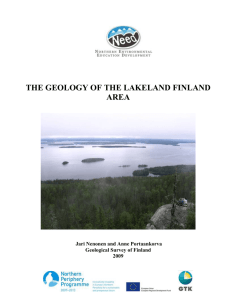
the geology of the lakeland finland area
... These gave rise in time to the quartzites, conglomerates, mica schists, mica gneisses and granulites of the Karelidic belt (Fig. 4, 5). During this period the earth’s crust was broken up by numerous rift valleys bounded by fault zones. The faults were filled with molten rock, or magma, some of which ...
... These gave rise in time to the quartzites, conglomerates, mica schists, mica gneisses and granulites of the Karelidic belt (Fig. 4, 5). During this period the earth’s crust was broken up by numerous rift valleys bounded by fault zones. The faults were filled with molten rock, or magma, some of which ...
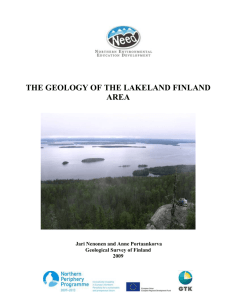
The Lakeland Finland
... These gave rise in time to the quartzites, conglomerates, mica schists, mica gneisses and granulites of the Karelidic belt (Fig. 4, 5). During this period the earth’s crust was broken up by numerous rift valleys bounded by fault zones. The faults were filled with molten rock, or magma, some of which ...
... These gave rise in time to the quartzites, conglomerates, mica schists, mica gneisses and granulites of the Karelidic belt (Fig. 4, 5). During this period the earth’s crust was broken up by numerous rift valleys bounded by fault zones. The faults were filled with molten rock, or magma, some of which ...

Field Guide Seattle to CRB
... A. Raging River Formation: The oldest rocks exposed in the Issaquah Alps are a series of siltstones, sandstones and some coarser sedimentary rocks (conglomerates), which were deposited as marine sediments in early Eocene time (prior to 53 Ma) Particles in these sediments were mostly of volcanic orig ...
... A. Raging River Formation: The oldest rocks exposed in the Issaquah Alps are a series of siltstones, sandstones and some coarser sedimentary rocks (conglomerates), which were deposited as marine sediments in early Eocene time (prior to 53 Ma) Particles in these sediments were mostly of volcanic orig ...

Geology of Galaringi and the Dundas Quarry
... and erosion. That erosion exposed the volcanic neck and apparently created a prominent outcrop on the slopes below Carlingford. There are, however, no known illustrations of what the outcrop looked like in 1830, but by about that time quarrying of the rock had commenced for use in building Sydney’s ...
... and erosion. That erosion exposed the volcanic neck and apparently created a prominent outcrop on the slopes below Carlingford. There are, however, no known illustrations of what the outcrop looked like in 1830, but by about that time quarrying of the rock had commenced for use in building Sydney’s ...

GEOLOGIC MAP OF THE RED LODGE AREA, CARBON COUNTY
... 20 ft (3-6 m) above altitude of Qal (present altitude of rivers). Mostly cobbles and pebbles with minor amounts of sand and silt. Clasts are mainly granitic igneous rocks, granitic gneiss, schist, and quartzite, with much less limestone and sandstone. Ten to 40 ft (3-12 m) thick. Qat2 Alluvial grave ...
... 20 ft (3-6 m) above altitude of Qal (present altitude of rivers). Mostly cobbles and pebbles with minor amounts of sand and silt. Clasts are mainly granitic igneous rocks, granitic gneiss, schist, and quartzite, with much less limestone and sandstone. Ten to 40 ft (3-12 m) thick. Qat2 Alluvial grave ...
CHAPTER 2 - earthjay science
... 1. (a) Mountains of the Basin and Range were formed during Miocene when the crust under that region was stretched and such tension caused up-thrown blocks (horsts) to become mountains and down-dropped blocks (grabens) to become valleys. (b) The Great Plains was formed during Miocene when uplift of t ...
... 1. (a) Mountains of the Basin and Range were formed during Miocene when the crust under that region was stretched and such tension caused up-thrown blocks (horsts) to become mountains and down-dropped blocks (grabens) to become valleys. (b) The Great Plains was formed during Miocene when uplift of t ...
Geology of Great Britain

The geology of Great Britain is renowned for its diversity. As a result of its eventful geological history, Great Britain shows a rich variety of landscapes across the constituent countries of England, Wales and Scotland. Rocks of almost all geological ages are represented at outcrop, from the Archaean onwards.