
File - Hepler Science
... - Most develop in Zone of Saturation - Cracks become larger, water table drops ...
... - Most develop in Zone of Saturation - Cracks become larger, water table drops ...
Weathering Erosion Deposition Landscapes Stuff to Know
... water flowing in the low points between ridges (can be from folded rock) ...
... water flowing in the low points between ridges (can be from folded rock) ...


Env. Geol Entrance Exam Part 1 – Multiple Choice / True
... a. protons and neutrons. b. protons and electrons. c. neutrons and electrons. d. protons, neutrons, and electrons. 2. The most common rock-forming minerals in the crust are a. carbonates. b. silicates. c. sulfates. d. sulfides. 3. With increasing distance from an oceanic ridge, a. the rocks become o ...
... a. protons and neutrons. b. protons and electrons. c. neutrons and electrons. d. protons, neutrons, and electrons. 2. The most common rock-forming minerals in the crust are a. carbonates. b. silicates. c. sulfates. d. sulfides. 3. With increasing distance from an oceanic ridge, a. the rocks become o ...

Lab 8
... 3. Two rocks have the same iron content, yet their remanent magnetization differ in strength. Give at least 3 reasons why the strength of the remanence of a rock does not depend just on its iran content. 4. An American geologist, finding on arrival to New Zealand that his compass does not rotate fre ...
... 3. Two rocks have the same iron content, yet their remanent magnetization differ in strength. Give at least 3 reasons why the strength of the remanence of a rock does not depend just on its iran content. 4. An American geologist, finding on arrival to New Zealand that his compass does not rotate fre ...

Rocks and Their Origins
... • Igneous rocks are classified based on their texture. • Coarse texture- igneous rocks with large crystals. • Fine Grain texture- rocks that have small crystals. • Glassy- rocks that cool so fast they have no specific ...
... • Igneous rocks are classified based on their texture. • Coarse texture- igneous rocks with large crystals. • Fine Grain texture- rocks that have small crystals. • Glassy- rocks that cool so fast they have no specific ...

Practice Quiz 2 ANSWERS
... B Chemical sediment is formed by processes such as evaporation and precipitation, whereas biochemical sediment is formed by processes driven by water-dwelling living organisms C Chemical sediment is formed by the reworking of animal shells, whereas biochemical sediment is formed in caves by water dr ...
... B Chemical sediment is formed by processes such as evaporation and precipitation, whereas biochemical sediment is formed by processes driven by water-dwelling living organisms C Chemical sediment is formed by the reworking of animal shells, whereas biochemical sediment is formed in caves by water dr ...

Perth Rocks - Heritage Perth
... The use of granite footings under a brick structure is clearly visible. In this case, it is quite a grand scale. This Church was designed by HS Trigg and built in 1893. The facia is a particularly decorative design referred to ‘American Romanesque’. Another of his designs can be seen in Barrack Stre ...
... The use of granite footings under a brick structure is clearly visible. In this case, it is quite a grand scale. This Church was designed by HS Trigg and built in 1893. The facia is a particularly decorative design referred to ‘American Romanesque’. Another of his designs can be seen in Barrack Stre ...

Practice Quiz 2 NOTE: practice quizzes are always in “rough” form
... C. beaches, tidal flats, spits, barrier islands, deltas ...
... C. beaches, tidal flats, spits, barrier islands, deltas ...

Introduction to Metamorphic Rock Forms
... Metamorphic rocks are formed from sedimentary or igneous rocks with physical or chemical alterations caused by heat, pressure, or the infiltration of other materials. Metamorphic rocks can be classified as either foliated or nonfoliated; foliation refers to the rock flaking or splitting into thin sl ...
... Metamorphic rocks are formed from sedimentary or igneous rocks with physical or chemical alterations caused by heat, pressure, or the infiltration of other materials. Metamorphic rocks can be classified as either foliated or nonfoliated; foliation refers to the rock flaking or splitting into thin sl ...


Deep within the earth, hot, molten material called magma is formed
... animals. When they die, their soft parts decay leaving the shells which eventually form limestone. Chalk is one important variety of Sedimentary rocks may also be formed from plant remains as Sedimentary rocks may be softer and easier to cut than igneous rocks but also more easily eroded and affecte ...
... animals. When they die, their soft parts decay leaving the shells which eventually form limestone. Chalk is one important variety of Sedimentary rocks may also be formed from plant remains as Sedimentary rocks may be softer and easier to cut than igneous rocks but also more easily eroded and affecte ...

Study Guide - Del Mar College
... by younger rocks and sediments. - Most of the Precambrian surfaces are composed of igneous and metamorphic rocks. - These types of rocks do not yield much evidence of geologic events of Earth’s past history. - Precambrian sedimentary rocks are generally folded, faulted and slightly to heavily metamo ...
... by younger rocks and sediments. - Most of the Precambrian surfaces are composed of igneous and metamorphic rocks. - These types of rocks do not yield much evidence of geologic events of Earth’s past history. - Precambrian sedimentary rocks are generally folded, faulted and slightly to heavily metamo ...

Annexure 1c - The geology and landforms of the islands
... last few million years. There have been at least 30 of these cold-warm cycles in the last 2 million years. Each cycle lasted 40,000-100,000 years and included a warm period similar to today and a cold or glacial period when large ice caps formed on southern and northern hemisphere continents. These ...
... last few million years. There have been at least 30 of these cold-warm cycles in the last 2 million years. Each cycle lasted 40,000-100,000 years and included a warm period similar to today and a cold or glacial period when large ice caps formed on southern and northern hemisphere continents. These ...
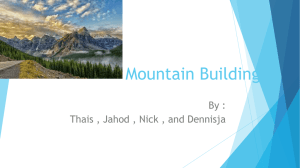
Mountain Building - Long Branch Public Schools
... Fault-Block Mountains forms when this tensions causes large blocks of the Earths crust to drop down relative to other blocks . When sedimentary rock layers are tilting up by faulting , they can produce mountains that have sharp , jagged peaks . For example , the Tentons in western Wyoming are a ...
... Fault-Block Mountains forms when this tensions causes large blocks of the Earths crust to drop down relative to other blocks . When sedimentary rock layers are tilting up by faulting , they can produce mountains that have sharp , jagged peaks . For example , the Tentons in western Wyoming are a ...

4/21/2012- Sedimentary Rocks, Metamorphic Rocks, and The Rock
... • Rock on Earth’s surface are exposed to water, wind, and other forces. ...
... • Rock on Earth’s surface are exposed to water, wind, and other forces. ...

For a PDF version of the
... Earth’s interior; magma that reaches the Earth’s surface is termed lava. 1. Cooling history of Igneous Rocks a. Intrusive igneous rocks • formed from magma that had penetrated into other rocks and solidified before reaching the surface. •pluton: very large masses • Magma - high energy sufficient to ...
... Earth’s interior; magma that reaches the Earth’s surface is termed lava. 1. Cooling history of Igneous Rocks a. Intrusive igneous rocks • formed from magma that had penetrated into other rocks and solidified before reaching the surface. •pluton: very large masses • Magma - high energy sufficient to ...
Virginia Standards of Learning
... Major features of divergent boundaries include mid-ocean ridges, rift valleys, and fissure volcanoes. Major features of transform boundaries include strike-slip faults. A fault is a break or crack in Earth’s crust along which movement has occurred. Most active faults are located at or near p ...
... Major features of divergent boundaries include mid-ocean ridges, rift valleys, and fissure volcanoes. Major features of transform boundaries include strike-slip faults. A fault is a break or crack in Earth’s crust along which movement has occurred. Most active faults are located at or near p ...

Fields of Science
... Joints are breaks in bedrock along which no movement has occurred. They can provide channels for fluids. Groundwater that flow through them and dissolves limestone can cause cavern formation. ...
... Joints are breaks in bedrock along which no movement has occurred. They can provide channels for fluids. Groundwater that flow through them and dissolves limestone can cause cavern formation. ...

GEOELECTRIC STRUCTURE AND LITHOLOGY BENEATH THE
... A study review on the geology within Olobanita area which approximately covers an area of about 400 sq.km was carried out whereby volcanic sediments of the quaternary-tertiary age were found to dominantly cover most of the areas. The study area is within the Phanerozoic basin in the Kenyan rift whic ...
... A study review on the geology within Olobanita area which approximately covers an area of about 400 sq.km was carried out whereby volcanic sediments of the quaternary-tertiary age were found to dominantly cover most of the areas. The study area is within the Phanerozoic basin in the Kenyan rift whic ...

Draft Museum Guide - Valley Geology
... Look at the metamorphic rocks display. Find the line labeled “Typical Continental Geotherm.” The geotherm (or geothermal gradient) is how increasing temperature corresponds to increasing depth within the Earth’s ...
... Look at the metamorphic rocks display. Find the line labeled “Typical Continental Geotherm.” The geotherm (or geothermal gradient) is how increasing temperature corresponds to increasing depth within the Earth’s ...

Copper - British Geological Survey
... interaction with reducing fluids from the basement causing precipitation of ores, and alteration of the ore assemblage by meteoric groundwater following basin inversion. These studies indicate the presence of other prospective areas for mineralisation of this type in the Midlands. In Scotland older ...
... interaction with reducing fluids from the basement causing precipitation of ores, and alteration of the ore assemblage by meteoric groundwater following basin inversion. These studies indicate the presence of other prospective areas for mineralisation of this type in the Midlands. In Scotland older ...
lecture notes
... movement during the Early Paleozoic resulted in the first of several continental collisions leading to the formation of Pangaea at the end of the Paleozoic. The Paleozoic history of North America can be subdivided into six cratonic sequences, which represent major transgressive-regressive cycles. ...
... movement during the Early Paleozoic resulted in the first of several continental collisions leading to the formation of Pangaea at the end of the Paleozoic. The Paleozoic history of North America can be subdivided into six cratonic sequences, which represent major transgressive-regressive cycles. ...

Rock Identification Lab
... type of metamorphism occurs during the processes associated with mountain building. Mountains are formed when two plates collide. This type of collision produces a tremendous amount of heat and pressure. This heat and pressure causes distortion and the rearrangement of minerals in a rock. As a resul ...
... type of metamorphism occurs during the processes associated with mountain building. Mountains are formed when two plates collide. This type of collision produces a tremendous amount of heat and pressure. This heat and pressure causes distortion and the rearrangement of minerals in a rock. As a resul ...

Petrology Instructor Fundamentals Magmatic Rock Bodies Study of
... Ultramafic Rock Bodies • Petrography of gabbroic and ultramafic rocks • Nature of plutons • Oceanic subalkaline basaltic to ultramafic ...
... Ultramafic Rock Bodies • Petrography of gabbroic and ultramafic rocks • Nature of plutons • Oceanic subalkaline basaltic to ultramafic ...
Geology of Great Britain

The geology of Great Britain is renowned for its diversity. As a result of its eventful geological history, Great Britain shows a rich variety of landscapes across the constituent countries of England, Wales and Scotland. Rocks of almost all geological ages are represented at outcrop, from the Archaean onwards.