
Minerals Give Clues To Their Environment Of Formation Also Rocks
... !! Bowen argued that a single magma could crystallize into both basalt and rhyolite because of fractional crystallization. Figure 4.20 ...
... !! Bowen argued that a single magma could crystallize into both basalt and rhyolite because of fractional crystallization. Figure 4.20 ...

2.9: Nomenclature of sedimentary rocks
... pressure as a result of burial under younger deposits to form lithified rocks. This restricted terminology will be used in this chapter, with the equivalent terms for sediments given between brackets where appropriate (for example, ‘sandstone’ [sand]). Five categories of sedimentary rocks are distin ...
... pressure as a result of burial under younger deposits to form lithified rocks. This restricted terminology will be used in this chapter, with the equivalent terms for sediments given between brackets where appropriate (for example, ‘sandstone’ [sand]). Five categories of sedimentary rocks are distin ...

Galera, uma leitura no texto da UDESC 2012. Tomara que não seja
... by: Oscar Wilde Like burnt-out torches by a sick man's bed Gaunt cypress-trees stand round the sun-bleached stone; Here doth the little night-owl make her throne, And the slight lizard show his jewelled head. And, where the chaliced poppies flame to red, In the still chamber of yon pyramid Surely so ...
... by: Oscar Wilde Like burnt-out torches by a sick man's bed Gaunt cypress-trees stand round the sun-bleached stone; Here doth the little night-owl make her throne, And the slight lizard show his jewelled head. And, where the chaliced poppies flame to red, In the still chamber of yon pyramid Surely so ...

Igneous Rocks
... In metamorphic rocks, the structure, texture or composition of the rock has changed. ...
... In metamorphic rocks, the structure, texture or composition of the rock has changed. ...

bowness knott
... andalusite close to the contact. Quartz veins are widely developed within these rocks, both as thin laminae parallel to the bedding and as larger cross-cutting structures. These veins are themselves cut by the granitic veins. Marginal granitic veining within the Skiddaw Group is generally sparse tho ...
... andalusite close to the contact. Quartz veins are widely developed within these rocks, both as thin laminae parallel to the bedding and as larger cross-cutting structures. These veins are themselves cut by the granitic veins. Marginal granitic veining within the Skiddaw Group is generally sparse tho ...

Oldest rocks, earliest life, heaviest impacts, and the Hadean
... Earth – Evolution of a Habitable World (1999) read as follows: ‘‘The period from the formation of the Earth, some 4.56 billion years ago, to the time when the oldest rocks still in existence were formed, roughly 3.8–4.0 billion years ago, is called both the Hadean era and Priscoan eon of Earth. The ...
... Earth – Evolution of a Habitable World (1999) read as follows: ‘‘The period from the formation of the Earth, some 4.56 billion years ago, to the time when the oldest rocks still in existence were formed, roughly 3.8–4.0 billion years ago, is called both the Hadean era and Priscoan eon of Earth. The ...

new - i. t creative plus
... • Some Terminologies CONTACTS: These are surfaces separating adjacent bodies of rock of different types or ages. • Some Terminologies • Unconformity This is a boundary that exists between two series of strata. It indicates that the first deposit has been partly eroded before the deposition of the se ...
... • Some Terminologies CONTACTS: These are surfaces separating adjacent bodies of rock of different types or ages. • Some Terminologies • Unconformity This is a boundary that exists between two series of strata. It indicates that the first deposit has been partly eroded before the deposition of the se ...

• The earth • Musah Saeed Zango • ETS 101
... • Some Terminologies CONTACTS: These are surfaces separating adjacent bodies of rock of different types or ages. • Some Terminologies • Unconformity This is a boundary that exists between two series of strata. It indicates that the first deposit has been partly eroded before the deposition of the se ...
... • Some Terminologies CONTACTS: These are surfaces separating adjacent bodies of rock of different types or ages. • Some Terminologies • Unconformity This is a boundary that exists between two series of strata. It indicates that the first deposit has been partly eroded before the deposition of the se ...
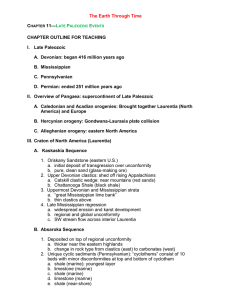
Chapter 11—Late Paleozoic Events
... single cycle of minor rise and full of sea level. Eustatic conditions are best accounted for by periodic changes in water volume due to glacial ice buildup and melting. Other water-level changes might be due to inflation and deflation of midocean ridges. Tectonic conditions might include periodic el ...
... single cycle of minor rise and full of sea level. Eustatic conditions are best accounted for by periodic changes in water volume due to glacial ice buildup and melting. Other water-level changes might be due to inflation and deflation of midocean ridges. Tectonic conditions might include periodic el ...

Note Packet
... 4. What mineral is limestone made from? ___________________________________ 5. What mineral is coal made from? _______________________________________ 6. What mineral is rock salt made from? ___________________________________ 7. Another word for clastic is ___________________________ (see reference ...
... 4. What mineral is limestone made from? ___________________________________ 5. What mineral is coal made from? _______________________________________ 6. What mineral is rock salt made from? ___________________________________ 7. Another word for clastic is ___________________________ (see reference ...
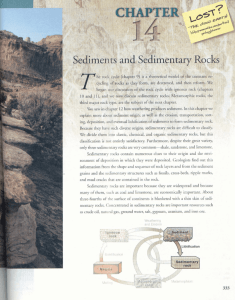
Chemical Sedimentary Rocks
... to chemid wmthering, it tends to conccnuate residually in sand as less resistant minerals such as feldspar are weathered away, probably in a low-lying humid region that dows chemical weathering to continue for a long time. The quartz grains in a quartz sandstone ax usually well-sorted and well-round ...
... to chemid wmthering, it tends to conccnuate residually in sand as less resistant minerals such as feldspar are weathered away, probably in a low-lying humid region that dows chemical weathering to continue for a long time. The quartz grains in a quartz sandstone ax usually well-sorted and well-round ...

INDUSTRIAL MINERAL POTENTIAL OF THE TERTIARY ROCKS
... The volcanic-dominated rocks of the Kamloops and Penticton groups form a continuous sheet stretching 150 kilometres north-northwest from Trepanier on the west side of Okanagan Lake (82E) (Figure 1) to north of the Sooth Thompson River east of Kamloops (921) (Figure 2). The 25 to 30 kilometre wide be ...
... The volcanic-dominated rocks of the Kamloops and Penticton groups form a continuous sheet stretching 150 kilometres north-northwest from Trepanier on the west side of Okanagan Lake (82E) (Figure 1) to north of the Sooth Thompson River east of Kamloops (921) (Figure 2). The 25 to 30 kilometre wide be ...

SAI109 Dealing 4 Dynamic Response Earths Surface
... Which layers of the earth are composed primarily of rocky material? ...
... Which layers of the earth are composed primarily of rocky material? ...
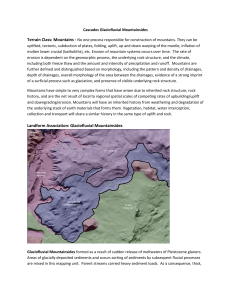
Glaciofluvial Mountainsides
... Terrain Class: Mountains - No one process responsible for construction of mountains. They can be uplifted, tectonic, subduction of plates, folding, uplift, up and down warping of the mantle, inflation of molten lower crustal (batholiths), etc. Erosion of mountain systems occurs over time. The rate o ...
... Terrain Class: Mountains - No one process responsible for construction of mountains. They can be uplifted, tectonic, subduction of plates, folding, uplift, up and down warping of the mantle, inflation of molten lower crustal (batholiths), etc. Erosion of mountain systems occurs over time. The rate o ...

Rocks from Lava
... surface. Liquid rock that reaches Earth’s surface is called lava. Lava cools quickly before large crystals have time to form. That’s why extrusive igneous rocks usually have a smooth, sometimes glassy appearance. Extrusive igneous rocks can form in two ways. In one way, volcanoes erupt and shoot out ...
... surface. Liquid rock that reaches Earth’s surface is called lava. Lava cools quickly before large crystals have time to form. That’s why extrusive igneous rocks usually have a smooth, sometimes glassy appearance. Extrusive igneous rocks can form in two ways. In one way, volcanoes erupt and shoot out ...

Geology review
... http://www.windows.ucar.edu/tour/link=/earth/geology/meta_contact.html&edu=h igh&fr=t ...
... http://www.windows.ucar.edu/tour/link=/earth/geology/meta_contact.html&edu=h igh&fr=t ...

Constraining the Texture and Composition of Pore - USRA
... (MSL) rover Curiosity has encountered a wide variety of sedimentary rocks deposited in fluvio-lacuestrine sequences at the base of Gale Crater [1]. The presence of sedimentary rocks requires that initial sediments underwent diagenesis and were lithified. Lithification involves sediment compaction, c ...
... (MSL) rover Curiosity has encountered a wide variety of sedimentary rocks deposited in fluvio-lacuestrine sequences at the base of Gale Crater [1]. The presence of sedimentary rocks requires that initial sediments underwent diagenesis and were lithified. Lithification involves sediment compaction, c ...

Geology of the Rogue Valley
... The names for the three rock types—igneous, sedimentary, and metamorphic— refer to the way each rock is formed. Igneous rocks form when molten rock (melted by Earth’s internal heat) cools. Extrusive igneous rock forms when molten lava cools quickly on the earth’s surface after a volcanic eruption. L ...
... The names for the three rock types—igneous, sedimentary, and metamorphic— refer to the way each rock is formed. Igneous rocks form when molten rock (melted by Earth’s internal heat) cools. Extrusive igneous rock forms when molten lava cools quickly on the earth’s surface after a volcanic eruption. L ...

Geology Background booklet
... continental North American Plate. As the plates converge, the heavier oceanic plate moves underneath the continental plate. As this rock material is forced under the earth’s surface it enters the much hotter upper mantle and melts, forming magma. Under the right conditions, this magma will rise up t ...
... continental North American Plate. As the plates converge, the heavier oceanic plate moves underneath the continental plate. As this rock material is forced under the earth’s surface it enters the much hotter upper mantle and melts, forming magma. Under the right conditions, this magma will rise up t ...

The Earth
... between continents that ride on the lithospheric plates… these continents are too low-density to allow subduction to continue (isostasy again!), and mountain belts form Figure 03.12b: These diagrams depict the collision and suturing of the India and Asia plates. ...
... between continents that ride on the lithospheric plates… these continents are too low-density to allow subduction to continue (isostasy again!), and mountain belts form Figure 03.12b: These diagrams depict the collision and suturing of the India and Asia plates. ...
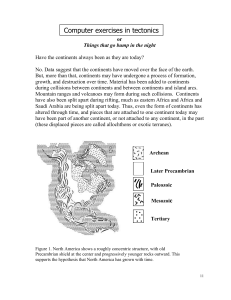
Computer exercises in tectonics
... Three orogenic periods formed the Appalachian mountains: the Taconic (late Ordovician to Silurian), Acadian (Devonian to early Carboniferous), and Alleghenian (Permian) Orogenies. Very strong folding and faulting, including formation of thrust faults (low angle faults), and metamorphism marked these ...
... Three orogenic periods formed the Appalachian mountains: the Taconic (late Ordovician to Silurian), Acadian (Devonian to early Carboniferous), and Alleghenian (Permian) Orogenies. Very strong folding and faulting, including formation of thrust faults (low angle faults), and metamorphism marked these ...
5. North Atlantic Tertiary Igneous Province (NATP)
... 2. 63 mya uplift & updoming of continental crust raises Britain high above sea-level & actively eroded 3. 60 mya eruption from fissures onto continental crust of extensive sheets of basaltic lava (flood basalts) 4. 58 mya large volcanoes erupted more lavas onto the land. The roots of these volcanoes ...
... 2. 63 mya uplift & updoming of continental crust raises Britain high above sea-level & actively eroded 3. 60 mya eruption from fissures onto continental crust of extensive sheets of basaltic lava (flood basalts) 4. 58 mya large volcanoes erupted more lavas onto the land. The roots of these volcanoes ...

Geology of Paraná
... found on the coastal plain. There, and all over Serra do Mar and the First Plateau, igneous and metamorphic rocks of Archean to early Paleozoic age outcrop in the region known as the PARANÁ SHIELD, whose strong relief reflects how resistant to weathering its rocks are. From the Devonian scarp known ...
... found on the coastal plain. There, and all over Serra do Mar and the First Plateau, igneous and metamorphic rocks of Archean to early Paleozoic age outcrop in the region known as the PARANÁ SHIELD, whose strong relief reflects how resistant to weathering its rocks are. From the Devonian scarp known ...

THE ROCK CYCLE
... After I cooled off and hardened, I thought that the heat wave was over, but after years of… ...
... After I cooled off and hardened, I thought that the heat wave was over, but after years of… ...

Background information - Science Web Australia
... pebbles into the Earth’s oceans. As microscopic sea creatures die, their tiny skeletons and shells fall to the ocean floor. The action of the waves sorts all these sediments into horizontal layers or beds. The largest, heaviest materials fall through water more quickly, so they form the bottom layer ...
... pebbles into the Earth’s oceans. As microscopic sea creatures die, their tiny skeletons and shells fall to the ocean floor. The action of the waves sorts all these sediments into horizontal layers or beds. The largest, heaviest materials fall through water more quickly, so they form the bottom layer ...
Geology of Great Britain

The geology of Great Britain is renowned for its diversity. As a result of its eventful geological history, Great Britain shows a rich variety of landscapes across the constituent countries of England, Wales and Scotland. Rocks of almost all geological ages are represented at outcrop, from the Archaean onwards.