
Unit Plan Sketch Part 1: Topic Content and Objectives
... folded mountains, hot spots, volcanoes. Related actions—earthquakes (see PWV-IV.4 m.6), volcanic activity, seafloor spreading, mountain building, convection in mantle. Evidence of “continental drift”—physical fit of continents, fossil evidence, measurements of movement, rock layer sequences, glacial ...
... folded mountains, hot spots, volcanoes. Related actions—earthquakes (see PWV-IV.4 m.6), volcanic activity, seafloor spreading, mountain building, convection in mantle. Evidence of “continental drift”—physical fit of continents, fossil evidence, measurements of movement, rock layer sequences, glacial ...
Volcanic Rocks of South-Central New Mexico
... overlain by the late basaltic volcanic sequence. In the Animas Hills area, this rock is a black to dark blue, massive to scoriaceous basaltic andesite with a maximum thickness of about 800 feet. Farther to the south, just north of Sibley Mountain, this sequence also includes a series of latitic flow ...
... overlain by the late basaltic volcanic sequence. In the Animas Hills area, this rock is a black to dark blue, massive to scoriaceous basaltic andesite with a maximum thickness of about 800 feet. Farther to the south, just north of Sibley Mountain, this sequence also includes a series of latitic flow ...

No Slide Title
... 5. Principle of Biological Succession: Different kinds of plants and animals succeed one another in time because life has evolved continuously; therefore only rocks formed during the same age can contain similar assemblages of fossils. Since these fossil assemblages are unique for particular periods ...
... 5. Principle of Biological Succession: Different kinds of plants and animals succeed one another in time because life has evolved continuously; therefore only rocks formed during the same age can contain similar assemblages of fossils. Since these fossil assemblages are unique for particular periods ...

Igneous Rocks - Mr. Meyer`s Science Page
... surface or from volcanic activity. They commonly form at plate boundaries and are commonly exposed in mountainous areas. Igneous rocks form from crystallization of magma at depth (within the earth's crust) or at the surface (from volcanic eruptions) There are two (2) basic types or forms of igneous ...
... surface or from volcanic activity. They commonly form at plate boundaries and are commonly exposed in mountainous areas. Igneous rocks form from crystallization of magma at depth (within the earth's crust) or at the surface (from volcanic eruptions) There are two (2) basic types or forms of igneous ...

8 Earth Science Chapter 4 – Rocks Name Section 1 – The Rock
... sedimentary rocks are classified by their composition and by the manner in which they formed. Sedimentary rocks usually are classified as detrital, chemical, or organic. The word detrital comes from the Latin word detritus, which means “to wear away.” Detrital sedimentary rocks are made from the bro ...
... sedimentary rocks are classified by their composition and by the manner in which they formed. Sedimentary rocks usually are classified as detrital, chemical, or organic. The word detrital comes from the Latin word detritus, which means “to wear away.” Detrital sedimentary rocks are made from the bro ...

Geology 12 with elaborations - BC Curriculum
... tectonics. Evaluate the evidence and offer contrarian views that may contradict the theory. • Show the interrelationships among a geologic map, a cross-section, and a block diagram for a specific feature (e.g., fold, fault, dome). • Evaluate geological maps and 3D models, with the aid of geological ...
... tectonics. Evaluate the evidence and offer contrarian views that may contradict the theory. • Show the interrelationships among a geologic map, a cross-section, and a block diagram for a specific feature (e.g., fold, fault, dome). • Evaluate geological maps and 3D models, with the aid of geological ...

8th Earth Science Chapter 4 – Rocks
... solution. Minerals collect when _____ or lakes _____________. The ___________ of minerals that come out of solution form __________ and _________. Chemical sedimentary rocks are _________ made from pieces of ________________ rocks. _____________ carbonate is carried in _____________ in ocean water. ...
... solution. Minerals collect when _____ or lakes _____________. The ___________ of minerals that come out of solution form __________ and _________. Chemical sedimentary rocks are _________ made from pieces of ________________ rocks. _____________ carbonate is carried in _____________ in ocean water. ...

Rocks - MrDanielASBSukMSSci
... Intrusive rocks usually have large, visible grains Extrusive rocks usually have small to no visible grains Color is based on the amount of silica in the magma ...
... Intrusive rocks usually have large, visible grains Extrusive rocks usually have small to no visible grains Color is based on the amount of silica in the magma ...

Coasts - Mulberry Education Centre
... • As waves break, sediments carried by waves such as sand and rocks are huried against the coast. − The loosened sediments knock and scrap against the coastal cliffs. − This weakens the surface and ...
... • As waves break, sediments carried by waves such as sand and rocks are huried against the coast. − The loosened sediments knock and scrap against the coastal cliffs. − This weakens the surface and ...

Short Course in Basic Geology Gregory A. Miles This short course
... where one plate slides under another (called subduction), and collision. Although geologists do not yet know all the details, we do know that this system is driven by the Earth's internal heat, and we think plate movement is due to convection (heat-driven, roughly circular paths of motion) within th ...
... where one plate slides under another (called subduction), and collision. Although geologists do not yet know all the details, we do know that this system is driven by the Earth's internal heat, and we think plate movement is due to convection (heat-driven, roughly circular paths of motion) within th ...

The Mineral Resource Maps of Wales
... cleavage due to the recrystallisation and realignment of platy clay minerals along a single set of micron-spaced parallel planes, allowing it to be split into thin leaves. Slaty cleavage controls the splitting properties and thickness of slate tiles or flagstones used for roofing or other architectu ...
... cleavage due to the recrystallisation and realignment of platy clay minerals along a single set of micron-spaced parallel planes, allowing it to be split into thin leaves. Slaty cleavage controls the splitting properties and thickness of slate tiles or flagstones used for roofing or other architectu ...

Chapter 14: Sediment and Sedimentary Rocks
... In this case, the shale in the above photo was deposited in an ancient lake that last occupied the Borrego Valley about a million years ago. Around that time, the climate became more arid (dry), and evaporative conditions resulted in the precipitation of calcium sulfate (i.e., the mineral, gypsum) ...
... In this case, the shale in the above photo was deposited in an ancient lake that last occupied the Borrego Valley about a million years ago. Around that time, the climate became more arid (dry), and evaporative conditions resulted in the precipitation of calcium sulfate (i.e., the mineral, gypsum) ...

Course overview – full
... 8) Faults and their geometric - kinematic classification. Systems of faults. Nappe structure. Tectonic fissures associated with folds and faults. Cleavage. 9) Magmatism: magma and its properties. Types of intrusive and hypoabyssal bodies, their classification. 10) Volcanism, lava and its properties, ...
... 8) Faults and their geometric - kinematic classification. Systems of faults. Nappe structure. Tectonic fissures associated with folds and faults. Cleavage. 9) Magmatism: magma and its properties. Types of intrusive and hypoabyssal bodies, their classification. 10) Volcanism, lava and its properties, ...

The Composition of Earth
... Learning Goals of This Chapter • Describe igneous rock textures, and explain their relationships to magma and lava and the terms intrusive and extrusive. • Identify and describe four intrusive igneous rocks and six extrusive igneous rocks. • Explain the classification of sedimentary rocks. • Explai ...
... Learning Goals of This Chapter • Describe igneous rock textures, and explain their relationships to magma and lava and the terms intrusive and extrusive. • Identify and describe four intrusive igneous rocks and six extrusive igneous rocks. • Explain the classification of sedimentary rocks. • Explai ...

Sample pages 2 PDF
... with the completion of the supercontinent of Pangea. Triassic rifting influenced southern New York and formed the Connecticut River valley, and Mesozoic intrusions developed farther east in New Hampshire and Maine. Erosion and peneplanation dominated the region from the Mesozoic through the Cenozoic ...
... with the completion of the supercontinent of Pangea. Triassic rifting influenced southern New York and formed the Connecticut River valley, and Mesozoic intrusions developed farther east in New Hampshire and Maine. Erosion and peneplanation dominated the region from the Mesozoic through the Cenozoic ...

From Sediment to Rock: Rocks that form near the Earth’s
... •Temperature: Increases with depth at a rate that varies substantially with plate-tectonic setting •20ºC per kilometer in stable continental crust •40ºC per kilometer in orogenic belts •60ºC per kilometer in volcanic regions ...
... •Temperature: Increases with depth at a rate that varies substantially with plate-tectonic setting •20ºC per kilometer in stable continental crust •40ºC per kilometer in orogenic belts •60ºC per kilometer in volcanic regions ...

JBES-Vol5No6-p338-344 - International network for natural
... of millions of years. 2) Because the crust is solid in its normal state, some thermal disturbance is required to form granitoids. 3) Most workers are of the opinion that the majority of granitoids are derived by crustal anatexis, but that the mantle may also be involved. The mantle contribution may ...
... of millions of years. 2) Because the crust is solid in its normal state, some thermal disturbance is required to form granitoids. 3) Most workers are of the opinion that the majority of granitoids are derived by crustal anatexis, but that the mantle may also be involved. The mantle contribution may ...

The geological time scale divides Earth`s history into units from its
... oldest rocks are at the bottom of the sequence and successive layers are younger than those below them. ...
... oldest rocks are at the bottom of the sequence and successive layers are younger than those below them. ...
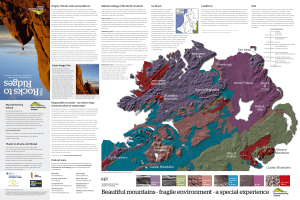
Rocks to Ridges - Mountaineering Ireland
... of Sawel Mountain. Ranging in age from 650–570 million years they are the oldest metamorphic rocks in Northern Ireland. The rocks originally accumulated as layers of sand and mud in an ancient ocean called Iapetus. Lava flows were also erupted onto the ocean floor and form part of the stack of layer ...
... of Sawel Mountain. Ranging in age from 650–570 million years they are the oldest metamorphic rocks in Northern Ireland. The rocks originally accumulated as layers of sand and mud in an ancient ocean called Iapetus. Lava flows were also erupted onto the ocean floor and form part of the stack of layer ...

PLATE TECTONICS AND SEDIMENTARY ROCK 1 Plate Tectonics
... the superior plate. In this instance, the sedimentary rock is transformed into metamorphic rock by heat and pressure. At a divergent plate boundary, where plates are moving away from one another, new bedding would be found closest to the plate boundary, while older bedding would be found at position ...
... the superior plate. In this instance, the sedimentary rock is transformed into metamorphic rock by heat and pressure. At a divergent plate boundary, where plates are moving away from one another, new bedding would be found closest to the plate boundary, while older bedding would be found at position ...

Equilibration in Metamorphic Rocks
... • Mafic: Derived from basalts and gabbros. High concentrations of Mg, Fe, and Ca and Al. Usually called metabasalts (e.g. greenstones and greenschists). Also related are spillites (contain cordierite and anthophyllite), derived from metasomatic alteration at the ocean ridges. ...
... • Mafic: Derived from basalts and gabbros. High concentrations of Mg, Fe, and Ca and Al. Usually called metabasalts (e.g. greenstones and greenschists). Also related are spillites (contain cordierite and anthophyllite), derived from metasomatic alteration at the ocean ridges. ...


HONORS EARTH SCIENCE MIDTERM REVIEW
... 6. Identify common sedimentary rocks from description (limestone, sandstone, conglomerate, shale, coal) AND explain how and where they formed ( see #7) 7. Recognize depositional environments of sedimentary rocks (ex. conglomerate= river) 8. Categorize a rock as either clastic, chemical or bioclastic ...
... 6. Identify common sedimentary rocks from description (limestone, sandstone, conglomerate, shale, coal) AND explain how and where they formed ( see #7) 7. Recognize depositional environments of sedimentary rocks (ex. conglomerate= river) 8. Categorize a rock as either clastic, chemical or bioclastic ...
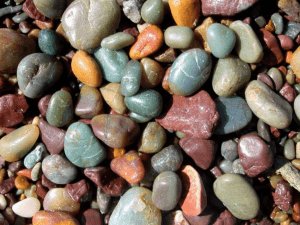
FACTORS AFFECTING WEATHERING RATES
... Breakdown of rock material without changing the chemical makeup of the rock. Example: smashing chalk with hammer. ...
... Breakdown of rock material without changing the chemical makeup of the rock. Example: smashing chalk with hammer. ...

gEOLOGy AND earth structure
... called eons, include the Hadean, Archean, Proterozoic (together, these three eons are commonly referred to as the Precambrian), and beginning about 570 million years ago, the Phanerozoic. The Phanerozoic (meaning “visible life”) eon is divided into the following eras: Paleozoic (“ancient life”), Mes ...
... called eons, include the Hadean, Archean, Proterozoic (together, these three eons are commonly referred to as the Precambrian), and beginning about 570 million years ago, the Phanerozoic. The Phanerozoic (meaning “visible life”) eon is divided into the following eras: Paleozoic (“ancient life”), Mes ...
Geology of Great Britain

The geology of Great Britain is renowned for its diversity. As a result of its eventful geological history, Great Britain shows a rich variety of landscapes across the constituent countries of England, Wales and Scotland. Rocks of almost all geological ages are represented at outcrop, from the Archaean onwards.