
Notes
... Steps to determine absolute age using radioactive dating: 1. ______________________________________________________________________________ 2. Compare the amount with the amount of the stable element into which the radioactive element ...
... Steps to determine absolute age using radioactive dating: 1. ______________________________________________________________________________ 2. Compare the amount with the amount of the stable element into which the radioactive element ...

Quiz 13 on Chapters 13-15 Notes to Landforms, Internal Processes
... Note to Question 6: Wasatch Front mountains are formed by block-fault earthquakes, with one side rising and the other sinking. As described in the note to Question 5 above, the granite rocks in mountains east of Salt Lake City are from magma plutons that never reached the surface on their own, but c ...
... Note to Question 6: Wasatch Front mountains are formed by block-fault earthquakes, with one side rising and the other sinking. As described in the note to Question 5 above, the granite rocks in mountains east of Salt Lake City are from magma plutons that never reached the surface on their own, but c ...

The Rock Record
... solidifies (vertical intrusions are called dikes and horizontal intrusions are called sills). • The Law of Crosscutting Relationships states that a fault or igneous intrusion is always younger than all the rocks layers it cuts through. • If the fault or intrusion cuts through an Unconformity, the fa ...
... solidifies (vertical intrusions are called dikes and horizontal intrusions are called sills). • The Law of Crosscutting Relationships states that a fault or igneous intrusion is always younger than all the rocks layers it cuts through. • If the fault or intrusion cuts through an Unconformity, the fa ...

Intro to Earth
... complete theory of the earth’s dynamics occurred in the early 1960’s, when the topography of the ocean floors was mapped and magnetic and seismic characteristics were determined ...
... complete theory of the earth’s dynamics occurred in the early 1960’s, when the topography of the ocean floors was mapped and magnetic and seismic characteristics were determined ...

Geology 3015 Lecture Notes Week 4a
... Some processes, such as earthquakes, landslips or volcanic eruptions occur over very short timescales (seconds - decades) ...
... Some processes, such as earthquakes, landslips or volcanic eruptions occur over very short timescales (seconds - decades) ...

GEOLOGY - Geological Time
... with the addition of water, makes a natural cement that glues the pieces of sediment together. ...
... with the addition of water, makes a natural cement that glues the pieces of sediment together. ...

Document
... California, Berkeley The Karakoram fault is a major NW-SE aligned dextral strike-slip that has accommodated a minor amount of eastward extrusion of thickenend Tibetan crust following the India-Asia collision ca 50 m.y. ago1,2. Minimum - maximum dextral offsets are 40-150 km and long-term slip rates ...
... California, Berkeley The Karakoram fault is a major NW-SE aligned dextral strike-slip that has accommodated a minor amount of eastward extrusion of thickenend Tibetan crust following the India-Asia collision ca 50 m.y. ago1,2. Minimum - maximum dextral offsets are 40-150 km and long-term slip rates ...
The Forces of Weathering and Erosion
... • Compounds from burning coal, oil and gas react chemically with water forming acids. • Acid rain causes very rapid chemical weathering ...
... • Compounds from burning coal, oil and gas react chemically with water forming acids. • Acid rain causes very rapid chemical weathering ...

U72015 [1018443]
... subjected to high pressure and temperature and thereby transformed into metamorphic rocks. Sedimentary rocks can also be subjected to exogenetic forces or can be subducted into the earth as a result of tectonic movements where they too can be fused or converted by pressure and temperature into metam ...
... subjected to high pressure and temperature and thereby transformed into metamorphic rocks. Sedimentary rocks can also be subjected to exogenetic forces or can be subducted into the earth as a result of tectonic movements where they too can be fused or converted by pressure and temperature into metam ...

geological setting of the vms project
... Unit 10C rhyolite is widespread, and is characterized by 2-5% 1-3 mm quartz phenocrysts, 10-35% feldspar phenocrysts 1-4 mm long, and perhaps 1% mafic phenocrysts (Fig. 7.5). The unit is a rather typical ignimbrite sequence with: (i) dense crystal tuff at the base (10CF) overlain by, (ii) welded lap ...
... Unit 10C rhyolite is widespread, and is characterized by 2-5% 1-3 mm quartz phenocrysts, 10-35% feldspar phenocrysts 1-4 mm long, and perhaps 1% mafic phenocrysts (Fig. 7.5). The unit is a rather typical ignimbrite sequence with: (i) dense crystal tuff at the base (10CF) overlain by, (ii) welded lap ...

PPT - nsf margins
... displacement (post-6 Ma) from N to S (pole of opening far away, and mainly a transform boundary); ~300 km in northern basins and Guaymas Basin ...
... displacement (post-6 Ma) from N to S (pole of opening far away, and mainly a transform boundary); ~300 km in northern basins and Guaymas Basin ...

Geology 12 - BC Science Teachers` Association
... Why is geologic time broken into eons, eras, and epochs? ...
... Why is geologic time broken into eons, eras, and epochs? ...

"Seafloor Spreading" Lab
... subduction zone and happens at converging boundaries. Rock on the subducting plate becomes part of the asthenosphere. Oceanic crust is denser and thinner than continental crust, so all seafloor rock is eventually destroyed in this way. Thus, the oldest seafloor rocks are only 180 million years old, ...
... subduction zone and happens at converging boundaries. Rock on the subducting plate becomes part of the asthenosphere. Oceanic crust is denser and thinner than continental crust, so all seafloor rock is eventually destroyed in this way. Thus, the oldest seafloor rocks are only 180 million years old, ...

Geology 13/14 (RTF 44kB)
... planet formation is followed by a chronological introduction to events that shaped the Earth until the oxygenation of the atmosphere. The module will introduce students to rocks that are unique to the early Earth with a focus on the most important events that have shaped the planet from the billion ...
... planet formation is followed by a chronological introduction to events that shaped the Earth until the oxygenation of the atmosphere. The module will introduce students to rocks that are unique to the early Earth with a focus on the most important events that have shaped the planet from the billion ...

1. [ST8.2] - Zanesville City Schools
... slid past each other, a fault formed, and the mountains were exposed by earthquake movement. B. As a continental plate and an oceanic plate collided, part of the oceanic plate subducted, and volcanoes erupted, forming the mountains. C. As two oceanic plates collided, one of the oceanic plates subduc ...
... slid past each other, a fault formed, and the mountains were exposed by earthquake movement. B. As a continental plate and an oceanic plate collided, part of the oceanic plate subducted, and volcanoes erupted, forming the mountains. C. As two oceanic plates collided, one of the oceanic plates subduc ...

Landforms
... The European Alps began forming during the Alpine Orogeny (~ 20-120 mya) with the collision of the African Plate moving northward into the European Plate. This motion is still active today as the Alps continue to uplift, fold, fault, and accrete. The Alps are the largest mountain range in Europe and ...
... The European Alps began forming during the Alpine Orogeny (~ 20-120 mya) with the collision of the African Plate moving northward into the European Plate. This motion is still active today as the Alps continue to uplift, fold, fault, and accrete. The Alps are the largest mountain range in Europe and ...

Early Paleozoic Geology 2.
... Scandinavia and Northern Europe (Norway, Scotland – “Caledonia”). On the North American craton the effects were less severe, but helped to create the mountainous terrain of the Northern Appalachian Mountains. This mountain-building episode continued into Devonian time as the ACADIAN OROGENY (part of ...
... Scandinavia and Northern Europe (Norway, Scotland – “Caledonia”). On the North American craton the effects were less severe, but helped to create the mountainous terrain of the Northern Appalachian Mountains. This mountain-building episode continued into Devonian time as the ACADIAN OROGENY (part of ...


Chapter 2: Rocks of the Midwestern US
... ore. Metamorphic rocks make up the majority of the bedrock of the Superior Upland. Sedimentary rocks, often fossiliferous, are found in every state. They represent the overwhelming majority of bedrock in the Midwest and include some important natural resources such as coal, salt, gypsum, and limesto ...
... ore. Metamorphic rocks make up the majority of the bedrock of the Superior Upland. Sedimentary rocks, often fossiliferous, are found in every state. They represent the overwhelming majority of bedrock in the Midwest and include some important natural resources such as coal, salt, gypsum, and limesto ...

Sediments and Sedimentary Rocks
... the earth is an ever-changing, dynamic system, whereby mountains rise up and are eroded down volcanoes erupt and the igneous rocks formed weather to other sedimentary rocks rivers change their courses depending upon the ever-changing terrain seas inundate the lowlands, only to recede or to e ...
... the earth is an ever-changing, dynamic system, whereby mountains rise up and are eroded down volcanoes erupt and the igneous rocks formed weather to other sedimentary rocks rivers change their courses depending upon the ever-changing terrain seas inundate the lowlands, only to recede or to e ...

The Wonders of Rocks and Minerals
... Fern fossils embedded in sedimentary rocks indicate: ❑ drought conditions when the rock was forming. ❑ the rock was formed where swamp conditions existed. ❑ glaciers existed when the rock was being formed. ❑ heavy rain. ...
... Fern fossils embedded in sedimentary rocks indicate: ❑ drought conditions when the rock was forming. ❑ the rock was formed where swamp conditions existed. ❑ glaciers existed when the rock was being formed. ❑ heavy rain. ...

Fire Up rock
... What step in the rock cycle would be required to change granite into sandstone? a. Magma hardens into granite sediment b. granite particles settle on the ocean floor. c. Lava flows melt the granite sediment d. Pieces of granite melt when they return to the mantle by subduction. ...
... What step in the rock cycle would be required to change granite into sandstone? a. Magma hardens into granite sediment b. granite particles settle on the ocean floor. c. Lava flows melt the granite sediment d. Pieces of granite melt when they return to the mantle by subduction. ...


Rock Cycle, Igneous, and Sedimentary Rocks PowerPoint
... • Much of Earth’s surface is covered with sediments. • Sediments are pieces of solid material that have been deposited on Earth’s surface. • When sediments become cemented together, they form sedimentary rocks. • The formation of sedimentary rocks begins when weathering and erosion produce sediments ...
... • Much of Earth’s surface is covered with sediments. • Sediments are pieces of solid material that have been deposited on Earth’s surface. • When sediments become cemented together, they form sedimentary rocks. • The formation of sedimentary rocks begins when weathering and erosion produce sediments ...
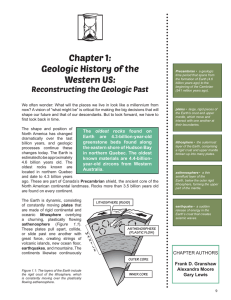
Geologic History of the - Teacher Friendly Guides
... Farther inland, as the oceanic crust descends deep into the upper mantle, the rock above the descending crust melts and forms a line of volcanoes on the surface. This process, called subduction, is responsible for creating the Cascades of Oregon and Washington as well as the Aleutian Islands and Wra ...
... Farther inland, as the oceanic crust descends deep into the upper mantle, the rock above the descending crust melts and forms a line of volcanoes on the surface. This process, called subduction, is responsible for creating the Cascades of Oregon and Washington as well as the Aleutian Islands and Wra ...
Geology of Great Britain

The geology of Great Britain is renowned for its diversity. As a result of its eventful geological history, Great Britain shows a rich variety of landscapes across the constituent countries of England, Wales and Scotland. Rocks of almost all geological ages are represented at outcrop, from the Archaean onwards.