
Background Info SBTaylor
... cover 75% of the earth's surface exposures. The sedimentary environment is a surface environment (at surface pressures and temperatures) 4. As geologists we can examine modern day sedimentary processes, look at depositional forms and life in sediments, and then go to ancient lithified sequences of s ...
... cover 75% of the earth's surface exposures. The sedimentary environment is a surface environment (at surface pressures and temperatures) 4. As geologists we can examine modern day sedimentary processes, look at depositional forms and life in sediments, and then go to ancient lithified sequences of s ...
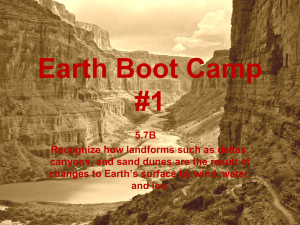
Earth BootCamp_5.7B_Part 1_AC
... 16. People living on the Texas Gulf Coast have to place stone barriers along the shoreline to prevent wearing away of coastal land by wave action. This process is called: ...
... 16. People living on the Texas Gulf Coast have to place stone barriers along the shoreline to prevent wearing away of coastal land by wave action. This process is called: ...
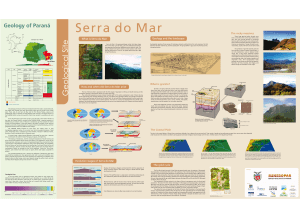
Geology of Paraná - Mineropar
... Terrains in the coastal plains of Paraná have a maximum altitude of 20 m above the current sea level. They consist of sandy marine sediments younger than 120,000 years that deposited under large sea level variation conditions during glacial (cold) and interglacial (warm) stages over the last 1.8 mil ...
... Terrains in the coastal plains of Paraná have a maximum altitude of 20 m above the current sea level. They consist of sandy marine sediments younger than 120,000 years that deposited under large sea level variation conditions during glacial (cold) and interglacial (warm) stages over the last 1.8 mil ...

CHAPTER 2CROCKS AND MINERALS C A FIRST LOOK
... rocks form at or very close to the earth’s surface, and their rapid cooling and solidification usually result in fine-grained textures. (b) Sedimentary rocks are formed from sediments at low temperatures. Clastic sedimentary rocks are formed from fragments of preexisting rocks; examples include sand ...
... rocks form at or very close to the earth’s surface, and their rapid cooling and solidification usually result in fine-grained textures. (b) Sedimentary rocks are formed from sediments at low temperatures. Clastic sedimentary rocks are formed from fragments of preexisting rocks; examples include sand ...
Phases of activity and geochemistry of basaltic dike systems in
... with a basanite composition. It is reasonable to assume that the emplacement of the dikes was part of the same volcanic phase and regional tectonic regime associated with the phases of volcanic activity of the Red Sea System. q 2002 Elsevier Science Ltd. All rights reserved. Keywords: Red Sea; Basal ...
... with a basanite composition. It is reasonable to assume that the emplacement of the dikes was part of the same volcanic phase and regional tectonic regime associated with the phases of volcanic activity of the Red Sea System. q 2002 Elsevier Science Ltd. All rights reserved. Keywords: Red Sea; Basal ...

Unit 5.4 PowerPoint File
... Metamorphic Rocks metamorphism the process in which one type of rock changes into metamorphic rock because of chemical processes or changes in temperature and pressure. During metamorphism, heat, pressure, and hot fluids cause some minerals to change into other minerals. Minerals may also chan ...
... Metamorphic Rocks metamorphism the process in which one type of rock changes into metamorphic rock because of chemical processes or changes in temperature and pressure. During metamorphism, heat, pressure, and hot fluids cause some minerals to change into other minerals. Minerals may also chan ...
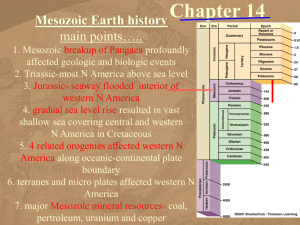
Chapter 14 - Mesozoic Geology
... • Subduction of the Farallon plate – beneath the North American plate continued during this time, – resulting in numerous overlapping, – low-angle thrust faults – in which blocks of older strata – were thrust eastward – on top of younger strata ...
... • Subduction of the Farallon plate – beneath the North American plate continued during this time, – resulting in numerous overlapping, – low-angle thrust faults – in which blocks of older strata – were thrust eastward – on top of younger strata ...

1 Rocks and weathering new
... evaporated to show that water can dissolve minerals. Activity 3 shows that water expands on freezing by placing a sealed jar of water in the freezer overnight and looks at the effect of freezing on a water-soaked sample of porous rock Activity 4 simulates the effect of water impact on rocks by pouri ...
... evaporated to show that water can dissolve minerals. Activity 3 shows that water expands on freezing by placing a sealed jar of water in the freezer overnight and looks at the effect of freezing on a water-soaked sample of porous rock Activity 4 simulates the effect of water impact on rocks by pouri ...

Alpine–Himalayan orogenic belt
... of the Grand Canyon, continued uplift and erosion of the Himalayas in Asia and the Andes in South America, the origin and evolution of the San Andreas fault, and the origin of the volcanoes that make the Cascade Range ...
... of the Grand Canyon, continued uplift and erosion of the Himalayas in Asia and the Andes in South America, the origin and evolution of the San Andreas fault, and the origin of the volcanoes that make the Cascade Range ...

Stratigraphy (GEOL 4/54070)
... Three Midterms (each worth 15%) Average Grade on Lab Assignments Average Grade on Field Trip Reports Cumulative Final Exam Total ...
... Three Midterms (each worth 15%) Average Grade on Lab Assignments Average Grade on Field Trip Reports Cumulative Final Exam Total ...

Rocks - The Science Queen
... older rocks. These pieces may be transported some distance by water, wind, or glacial ice, then deposited, buried, and turned into rock. Examples include sandstone and conglomerate. 2. Chemical sedimentary rocks form from chemical precipitation, generally precipitation from a solution of water and d ...
... older rocks. These pieces may be transported some distance by water, wind, or glacial ice, then deposited, buried, and turned into rock. Examples include sandstone and conglomerate. 2. Chemical sedimentary rocks form from chemical precipitation, generally precipitation from a solution of water and d ...

Types of Rocks
... – Rocks can have striped or swirls because of minerals melting and pressure – An entirely new rock can be formed that looks nothing like the original sedimentary or igneous rock ...
... – Rocks can have striped or swirls because of minerals melting and pressure – An entirely new rock can be formed that looks nothing like the original sedimentary or igneous rock ...

Chapter 7 - Earth and Atmospheric Sciences
... Schematic cross section of convergent, collisional, and extensional plate boundaries associated with supercontinent cycle showing estimated amounts (in km3 yr−1) of continental addition (numbers in blue above Earth surface) and removal (numbers in red below... ...
... Schematic cross section of convergent, collisional, and extensional plate boundaries associated with supercontinent cycle showing estimated amounts (in km3 yr−1) of continental addition (numbers in blue above Earth surface) and removal (numbers in red below... ...

Quiz 1
... 10. An isograd is a line separating _______________________? A. copper from gold B. two different mineral assemblages formed by transitional different metamorphic conditions. C. iron from copper D. sandstone from limestone ...
... 10. An isograd is a line separating _______________________? A. copper from gold B. two different mineral assemblages formed by transitional different metamorphic conditions. C. iron from copper D. sandstone from limestone ...

File
... of the second half of the 20th Century: Note: no plates shown Absolute Age Dating of Rocks Conclusion: PlateNote: driftnois yet shown to be worked out. plates We’ll have to work with continental crust drift maps 250 million yearsuntil ago plate drift is defined ...
... of the second half of the 20th Century: Note: no plates shown Absolute Age Dating of Rocks Conclusion: PlateNote: driftnois yet shown to be worked out. plates We’ll have to work with continental crust drift maps 250 million yearsuntil ago plate drift is defined ...

Worksheet 2
... Geologists have organized the events of Earth’s history and represented them on the (1) ______________________________________. This record of Earth’s history is divided into units of time, the longest of which is the (2) _________________, measured in billions of years. The nest longest unit of tim ...
... Geologists have organized the events of Earth’s history and represented them on the (1) ______________________________________. This record of Earth’s history is divided into units of time, the longest of which is the (2) _________________, measured in billions of years. The nest longest unit of tim ...


rocks2
... • Formed from the remains of plants & animals that are compacted – Fossil Limestone – formed when shell remains of marine organisms are cemented in fragments • Shells are made of CALCITE which reacts with acid and is a natural “cement” ...
... • Formed from the remains of plants & animals that are compacted – Fossil Limestone – formed when shell remains of marine organisms are cemented in fragments • Shells are made of CALCITE which reacts with acid and is a natural “cement” ...

Sedimentary Rocks
... B. Descriptions of individual clastic rocks Arkose Graywacke Quartz Sandstone ...
... B. Descriptions of individual clastic rocks Arkose Graywacke Quartz Sandstone ...

The Planet Oceanus
... pressure. Log P = -0.06 (H), where P is pressure and H is altitude in km. At 700 km above sea level one encounters an almost perfect vacuum. By definition boundary of atmosphere set at 1000 km Exosphere-the sphere above the atmosphere - is where molecules escape into space and have to pass through t ...
... pressure. Log P = -0.06 (H), where P is pressure and H is altitude in km. At 700 km above sea level one encounters an almost perfect vacuum. By definition boundary of atmosphere set at 1000 km Exosphere-the sphere above the atmosphere - is where molecules escape into space and have to pass through t ...

Document
... A rock’s (87Sr/86Sr)i value call tell you how enriched or depleted its mantle source was. i.e. (87Sr/86Sr)i = 0.7020 at 2Ga means a depleted source How would you explain a (87Sr/86Sr)i value of 0.728 at 1.4Ga? ...
... A rock’s (87Sr/86Sr)i value call tell you how enriched or depleted its mantle source was. i.e. (87Sr/86Sr)i = 0.7020 at 2Ga means a depleted source How would you explain a (87Sr/86Sr)i value of 0.728 at 1.4Ga? ...

VOYAGE OF THE CONTINENTS AFRICA ORIGINS Script
... Fish River, there on the valley floor. This river dug through a series of rocks making it possible to now study their history and also creating this magnificent scenery. This history begins about 1 billion years ago. So, what are we looking at? At the bottom of Fish River, near the valley, we see la ...
... Fish River, there on the valley floor. This river dug through a series of rocks making it possible to now study their history and also creating this magnificent scenery. This history begins about 1 billion years ago. So, what are we looking at? At the bottom of Fish River, near the valley, we see la ...

ASOL SCIENCESCOPEhighschool14
... Most large scale, high-energy events of geologic activity (e.g., earthquakes, volcanoes, and mountain building) occur as a result of relative motion along plate boundaries. Plate motion occurs as a consequence of convection in Earth’s mantle, including upwelling of material from the deep mantle in r ...
... Most large scale, high-energy events of geologic activity (e.g., earthquakes, volcanoes, and mountain building) occur as a result of relative motion along plate boundaries. Plate motion occurs as a consequence of convection in Earth’s mantle, including upwelling of material from the deep mantle in r ...

Vancouver Geology - GAC-CS
... three times. Jack headed the Vancouver office from 1955 to 1968, after which he was seconded to Ottawa to organize the 24th International Geological Congress. With Bill Mathews, a close friend and professor at the University of British Columbia, he organized section meetings in Vancouver for the Geo ...
... three times. Jack headed the Vancouver office from 1955 to 1968, after which he was seconded to Ottawa to organize the 24th International Geological Congress. With Bill Mathews, a close friend and professor at the University of British Columbia, he organized section meetings in Vancouver for the Geo ...
Geology of Great Britain

The geology of Great Britain is renowned for its diversity. As a result of its eventful geological history, Great Britain shows a rich variety of landscapes across the constituent countries of England, Wales and Scotland. Rocks of almost all geological ages are represented at outcrop, from the Archaean onwards.