Part B KEY
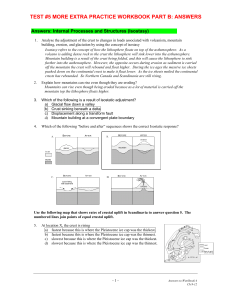
... surface rises steeply in a hill formed from nearly horizontal layers of schist, gabbro and quartzite units. 38. Name the type of fold which is shown on the flat part of the map and describe, with reference to the available geologic evidence, how the fold would likely have formed. It is a dome. This ...
... surface rises steeply in a hill formed from nearly horizontal layers of schist, gabbro and quartzite units. 38. Name the type of fold which is shown on the flat part of the map and describe, with reference to the available geologic evidence, how the fold would likely have formed. It is a dome. This ...

igneous rocks - Te reo Māori
... • OBSIDIAN is usually black or a very dark green caused by the iron and magnesium in the rock, but it can also be found in an almost clear form and can also contain white 'snowflake' crystal patterns of the mineral Cristobalite as shown in the photo above. • Ancient people throughout the world have ...
... • OBSIDIAN is usually black or a very dark green caused by the iron and magnesium in the rock, but it can also be found in an almost clear form and can also contain white 'snowflake' crystal patterns of the mineral Cristobalite as shown in the photo above. • Ancient people throughout the world have ...
Igneous Rocks - School District of Grafton
... Veins: streaks of valuable metal within a mineral. Created when a metal-rich fluid, such as goldquartz, goes through fractional crystallization, the mineral (quartz) has a lower crystallization temp and thus solidifies before the gold. The gold remains liquid and settles between the quartz crystals ...
... Veins: streaks of valuable metal within a mineral. Created when a metal-rich fluid, such as goldquartz, goes through fractional crystallization, the mineral (quartz) has a lower crystallization temp and thus solidifies before the gold. The gold remains liquid and settles between the quartz crystals ...

Glossary of Terms Related to Prospecting and Exploration
... A large-scale, roughly circular volcanic depression, formed near the top of a volcano when eruption empties the magma chamber under the volcano. The caldera can then be filled with sediments and volcanics and intruded by younger intrusions. More than one caldera can form in any one area as volcanism ...
... A large-scale, roughly circular volcanic depression, formed near the top of a volcano when eruption empties the magma chamber under the volcano. The caldera can then be filled with sediments and volcanics and intruded by younger intrusions. More than one caldera can form in any one area as volcanism ...

The Earth - El Camino College
... 1. Granitic magma = new cont. crust P. 2. Compressed sediment=made rocks (coastal mtns.) 3. Subd. Zn still happening in N. Cal (Cascades) B. San Andreas Fault = stopped subduction in most Cal. ~ 15 m.y. ago..... C. Erosion – since - granite now on surface ex. Sierras -------------------------------- ...
... 1. Granitic magma = new cont. crust P. 2. Compressed sediment=made rocks (coastal mtns.) 3. Subd. Zn still happening in N. Cal (Cascades) B. San Andreas Fault = stopped subduction in most Cal. ~ 15 m.y. ago..... C. Erosion – since - granite now on surface ex. Sierras -------------------------------- ...

Archean
... The mantle plume is the source of the volcanic rocks in the lower and middle units of the greenstone belt and erosion of volcanic rocks and flanks for the rift supply the sediment to the upper unit ...
... The mantle plume is the source of the volcanic rocks in the lower and middle units of the greenstone belt and erosion of volcanic rocks and flanks for the rift supply the sediment to the upper unit ...

SUBDUCTION ZONE PETROTECTONIC ASSEMBLAGES
... This lab includes three samples from mélanges associated with Iapetus subduction in Newfoundland. Sample A shows “web texture”. This is commonly developed in disrupted sandstones in melanges. It probably results from catastrophic dewatering during intergranular deformation. Samples B and C are sampl ...
... This lab includes three samples from mélanges associated with Iapetus subduction in Newfoundland. Sample A shows “web texture”. This is commonly developed in disrupted sandstones in melanges. It probably results from catastrophic dewatering during intergranular deformation. Samples B and C are sampl ...
Igneous Rock
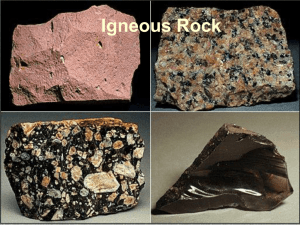
... • Contains no fossils • Has no layering • Rarely reacts with acids • Can be light-colored to dark-colored • Can be fine-grained, coarse-grained, or glassy • Resistant to weathering ...
... • Contains no fossils • Has no layering • Rarely reacts with acids • Can be light-colored to dark-colored • Can be fine-grained, coarse-grained, or glassy • Resistant to weathering ...

canadian engineering qualifications board
... Introduction to materials in hostile environments: corrosion, creep at high temperature, refractory materials, subnormal temperature brittle fracture. 04-BS-14 Geology: The structure of the earth, plate tectonics, earthquakes and igneous activity. Minerals and rocks including their formation, identi ...
... Introduction to materials in hostile environments: corrosion, creep at high temperature, refractory materials, subnormal temperature brittle fracture. 04-BS-14 Geology: The structure of the earth, plate tectonics, earthquakes and igneous activity. Minerals and rocks including their formation, identi ...

The Geological Revolution
... conception of a beginning for the Earth. Historical and Physical age estimates give different answers. Geological discoveries uncovered the deep history of the Earth, and developed techniques for reading that history. The Earth is 4.54 ± 0.05 Billion Years old, measured by radiometric age dating of ...
... conception of a beginning for the Earth. Historical and Physical age estimates give different answers. Geological discoveries uncovered the deep history of the Earth, and developed techniques for reading that history. The Earth is 4.54 ± 0.05 Billion Years old, measured by radiometric age dating of ...

Northrop -
... plaza, these sedimentary and metamorphosed sedimentary rocks did not form on an active plate tectonic boundary, but in a plate interior as deposition occurred along a passive continental margin or within a continental basin. Although they share a roughly similar original setting, variations in their ...
... plaza, these sedimentary and metamorphosed sedimentary rocks did not form on an active plate tectonic boundary, but in a plate interior as deposition occurred along a passive continental margin or within a continental basin. Although they share a roughly similar original setting, variations in their ...

perspective objects for creation of a network national geoparks in
... The territory of Ukraine is characterized by an extremely complex and varied geological structure. Ukraine’s territory covering 603,700km2 includes the complete range of stratigraphic scale (from Precambrian up to Quaternary systems) and almost all types of large geological structures are represente ...
... The territory of Ukraine is characterized by an extremely complex and varied geological structure. Ukraine’s territory covering 603,700km2 includes the complete range of stratigraphic scale (from Precambrian up to Quaternary systems) and almost all types of large geological structures are represente ...

Rock Identification and stories lab
... cemented together. If you look at the particles with a handlens, or even with the naked eye, you can see individual grains often somewhat rounded because sharp edges were knocked off during transport down stream, along beaches, etc. Sand-sized particles range from just big enough to see to about 2mm ...
... cemented together. If you look at the particles with a handlens, or even with the naked eye, you can see individual grains often somewhat rounded because sharp edges were knocked off during transport down stream, along beaches, etc. Sand-sized particles range from just big enough to see to about 2mm ...


ttu_gs0001_000468
... animal and plant life, originally formed in the ocean. Other layers, consisting of sand grains winnowed clean by the pounding surf, obviously formed as beach deposits that marked the shorelines of ancient seas. Certain layers are in the form of sand bars and gravel banks-rock debris spread over the ...
... animal and plant life, originally formed in the ocean. Other layers, consisting of sand grains winnowed clean by the pounding surf, obviously formed as beach deposits that marked the shorelines of ancient seas. Certain layers are in the form of sand bars and gravel banks-rock debris spread over the ...

Bloomfield_Nov2015
... America showed that they were once joined together, 500 million years ago. Around that time, plate movements in the Earth’s crust caused the uplift of a range of mountains stretching from North America, through Scotland to Norway. The tectonic plate covered by the ancient Iapetus ocean was subducted ...
... America showed that they were once joined together, 500 million years ago. Around that time, plate movements in the Earth’s crust caused the uplift of a range of mountains stretching from North America, through Scotland to Norway. The tectonic plate covered by the ancient Iapetus ocean was subducted ...

TWO OCCURRENCES OF CHLORITOID AS A HYDROTHBRMAL
... replacement lodes occupying shear zones.Mineralogically they are somewhat similar to the Kirkland Lake ores of Ontario. Although generally classedas hydrothermal, they have many mesothermal characteristics. Curonrrorn rN PoncuprNp Drsrnrcr Chloritoid.in Altered,Laaas In the eastern part of the Holli ...
... replacement lodes occupying shear zones.Mineralogically they are somewhat similar to the Kirkland Lake ores of Ontario. Although generally classedas hydrothermal, they have many mesothermal characteristics. Curonrrorn rN PoncuprNp Drsrnrcr Chloritoid.in Altered,Laaas In the eastern part of the Holli ...

field project
... The Bay Area is a region of California that belongs to two different tectonic plates, the North American Plate and the Pacific Plate. The boundary separating the regions is the San Andreas fault, a transform fault formed ~30 million years ago. The transform boundary that exists today was once a conv ...
... The Bay Area is a region of California that belongs to two different tectonic plates, the North American Plate and the Pacific Plate. The boundary separating the regions is the San Andreas fault, a transform fault formed ~30 million years ago. The transform boundary that exists today was once a conv ...

Igneous rocks
... composition as the major distinguishing factor. This technique provides the petrologist (or rock scientist) with a good objective method of determining the true origins of the rock from a plate tectonics aspect. The chemistry of igneous rocks and plate tectonics are closely related and therefore the ...
... composition as the major distinguishing factor. This technique provides the petrologist (or rock scientist) with a good objective method of determining the true origins of the rock from a plate tectonics aspect. The chemistry of igneous rocks and plate tectonics are closely related and therefore the ...

1. Define habitat and describe how geologic processes influence habitats. Habitats
... Both are very geologically active—earthquakes cluster at the ridges and volcanoes are common near trenches. Layers of sediment get thicker and thicker moving away from the mid-ocean ridges (and towards the continents on either side). Also, deep-sea drilling revealed that the oldest, deepest sediment ...
... Both are very geologically active—earthquakes cluster at the ridges and volcanoes are common near trenches. Layers of sediment get thicker and thicker moving away from the mid-ocean ridges (and towards the continents on either side). Also, deep-sea drilling revealed that the oldest, deepest sediment ...

GEOLOGICAL REPORT CPMS-310. PARAÍSO
... the fine grained igneous are here classified as submarine extrusions, rather than shallow intrusive or dykes, on the basis of the observed pillow-lava structures already mentioned. The possibility of some of this igneous being intrusive is not discarded, for igneous activity in this area must have r ...
... the fine grained igneous are here classified as submarine extrusions, rather than shallow intrusive or dykes, on the basis of the observed pillow-lava structures already mentioned. The possibility of some of this igneous being intrusive is not discarded, for igneous activity in this area must have r ...

Rock Identification Lab Information
... rock. Examples of different sizes of foliation include: slate = very thin layers; gneiss = thick bands (> ¼ inch). Foliated textures can also be produced by shearing and breaking, such as in a fault zone or a meteor impact crater, and these are referred to as mylonitic textures. Non-Foliated Metamor ...
... rock. Examples of different sizes of foliation include: slate = very thin layers; gneiss = thick bands (> ¼ inch). Foliated textures can also be produced by shearing and breaking, such as in a fault zone or a meteor impact crater, and these are referred to as mylonitic textures. Non-Foliated Metamor ...

Physical world of mountainss
... Towering mountains topped with snow create a skyline of breathtaking beauty, but the picture tells only part of the story. Mountains are not simply bare rock. Many plants and animals live on them, yet they are often different from those on the plains at the foot of the mountain range. Temperature an ...
... Towering mountains topped with snow create a skyline of breathtaking beauty, but the picture tells only part of the story. Mountains are not simply bare rock. Many plants and animals live on them, yet they are often different from those on the plains at the foot of the mountain range. Temperature an ...

Shales sandstones and associated rocks
... as the deposits of a paleoIndus River and shows that the river started to flow soon after initial collision and uplift of southern Tibet (Clift et al., 2001). ...
... as the deposits of a paleoIndus River and shows that the river started to flow soon after initial collision and uplift of southern Tibet (Clift et al., 2001). ...
Geology of Great Britain

The geology of Great Britain is renowned for its diversity. As a result of its eventful geological history, Great Britain shows a rich variety of landscapes across the constituent countries of England, Wales and Scotland. Rocks of almost all geological ages are represented at outcrop, from the Archaean onwards.