
Classifying Rocks
... Identifying rocks can be a challenging exercise even for experienced geologists. Rocks in their natural setting might be found in various states of decomposition due to weathering. Depending on the degree of weathering, it may be challenging even to tell if a particular rock is igneous, sedimentary, ...
... Identifying rocks can be a challenging exercise even for experienced geologists. Rocks in their natural setting might be found in various states of decomposition due to weathering. Depending on the degree of weathering, it may be challenging even to tell if a particular rock is igneous, sedimentary, ...
Natural History of Newfoundland and Labrador: Geological Formation
... the continents drifted together, the ocean floor was squeezed and then pushed upward to form huge mountain ranges, one of which we now call the Appalachians. Central Newfoundland is actually the northernmost part of the Appalachians in North America. This range, although known by another name, conti ...
... the continents drifted together, the ocean floor was squeezed and then pushed upward to form huge mountain ranges, one of which we now call the Appalachians. Central Newfoundland is actually the northernmost part of the Appalachians in North America. This range, although known by another name, conti ...
Continental Drift Theory of Alfred Wegener
... theoretical commitments. The idea of continental drift has been subsumed by the theory of plate tectonics, which explains how the continents move. The hypothesis that the continents had once formed a single landmass before breaking apart and drifting to their present locations was first presented by ...
... theoretical commitments. The idea of continental drift has been subsumed by the theory of plate tectonics, which explains how the continents move. The hypothesis that the continents had once formed a single landmass before breaking apart and drifting to their present locations was first presented by ...

1. Paleogeography
... building of mountains (CALEDONIDES) which underwent intense erosion and formed a wedge of nonmarine clastics over much of what is now Northern Europe. This was the "Old Red Continent" - composed mainly of rusty-colored sandstones (old red sandstones) - similar to the Queenston Clastic Wedge of North ...
... building of mountains (CALEDONIDES) which underwent intense erosion and formed a wedge of nonmarine clastics over much of what is now Northern Europe. This was the "Old Red Continent" - composed mainly of rusty-colored sandstones (old red sandstones) - similar to the Queenston Clastic Wedge of North ...

Geosphere - Written - Geological Society of India
... Central Mediterranean tectonics is dominated by the slow relative converging motion of the African and European Plates. Italy sits on the converging plate margin, and its volcanic and seismic activity are related to this first order phenomena. In the central Mediterranean area subduction is continuo ...
... Central Mediterranean tectonics is dominated by the slow relative converging motion of the African and European Plates. Italy sits on the converging plate margin, and its volcanic and seismic activity are related to this first order phenomena. In the central Mediterranean area subduction is continuo ...
The Mid-continent Rift
... • isotopic signature consistent with onset of a new mantle plume beneath the area at about 1110 Ma. • plume head provided a hot source for production of basaltic magma by decompression melting. • Deposition of ~8 km thick mostly alluvial fan, river and lake sediments continued for a few tens of mill ...
... • isotopic signature consistent with onset of a new mantle plume beneath the area at about 1110 Ma. • plume head provided a hot source for production of basaltic magma by decompression melting. • Deposition of ~8 km thick mostly alluvial fan, river and lake sediments continued for a few tens of mill ...

THE OTHER SEDIMENTARY ROCKS OF EARLY MARS. KS Edgett
... vapor, and solidified melt produced by these events was further weathered, eroded, transported, sorted, and re-deposited. At the same time, volcanism produced tephra and lavas and these would also undergo weathering and erosion (including via impact events), again with some of the debris becoming we ...
... vapor, and solidified melt produced by these events was further weathered, eroded, transported, sorted, and re-deposited. At the same time, volcanism produced tephra and lavas and these would also undergo weathering and erosion (including via impact events), again with some of the debris becoming we ...

Petrology of Ibillo-Mangongo area of Igarra, Edo State
... succession in the Igarra formation consist of; Quartz-biotite-schist, mica-schist, marbles and calc-silicates and metaconglomerates [16]. These shows that the area is within metamorphic terrain. The present of both calcareous rocks and conglomerates is peculiar to the Igarra schist belt which set it ...
... succession in the Igarra formation consist of; Quartz-biotite-schist, mica-schist, marbles and calc-silicates and metaconglomerates [16]. These shows that the area is within metamorphic terrain. The present of both calcareous rocks and conglomerates is peculiar to the Igarra schist belt which set it ...
Chapter 9—The Proterozoic: Dawn of a More Modern World
... Cyclomedusa were initially thought to be jellyfish. Another circular form, Tribrachidium, appears to have no modern counterpart and may be a member of an extinct phylum. Frond-like fossils resemble the living soft corals informally called sea pens. They look rather like fronds of ferns, except that ...
... Cyclomedusa were initially thought to be jellyfish. Another circular form, Tribrachidium, appears to have no modern counterpart and may be a member of an extinct phylum. Frond-like fossils resemble the living soft corals informally called sea pens. They look rather like fronds of ferns, except that ...

summary notes on minerals, rocks
... 3. Organic sub-class - rocks formed from biologic products or processes a. these have a bioclastic texture - rough and containing biologic remains b. there are only 2 - coal and limestone G. How to identify a rock as sedimentary in origin: 1. they commonly look like sediments - the clastic sub-class ...
... 3. Organic sub-class - rocks formed from biologic products or processes a. these have a bioclastic texture - rough and containing biologic remains b. there are only 2 - coal and limestone G. How to identify a rock as sedimentary in origin: 1. they commonly look like sediments - the clastic sub-class ...

GEOELECTRIC STRUCTURE BENEATH A 14 KM TRANSECT
... Geo-electric resistivity survey was conducted along a 14km transect at the boundary between Kericho and Nakuru counties to observe the structure beneath and its relation to ground water occurrence. The study area is located between Latitude 35.5820700 to 35.792290o and Longitude 0.1556140 to 0.25576 ...
... Geo-electric resistivity survey was conducted along a 14km transect at the boundary between Kericho and Nakuru counties to observe the structure beneath and its relation to ground water occurrence. The study area is located between Latitude 35.5820700 to 35.792290o and Longitude 0.1556140 to 0.25576 ...

From National Geographic Erosion is the act in which earth is worn
... as ice ages. Glaciers carved much of the northern North American and European landscape. They scoured the ground to form the bottom of what are now the Finger Lakes in the U.S. state of New York. They also carved fjords, deep inlets along the coast of Scandinavia. Today, in places such as Greenland ...
... as ice ages. Glaciers carved much of the northern North American and European landscape. They scoured the ground to form the bottom of what are now the Finger Lakes in the U.S. state of New York. They also carved fjords, deep inlets along the coast of Scandinavia. Today, in places such as Greenland ...

Review of Seafloor Spreading
... 4. Magma cools and becomes solid – new seafloor 5. New sea floor moves away from the ridge *cools, contracts and becomes denser 6. denser, colder seafloor sinks helping to form the ridge 7. Subduction: old ocean floor sinks beneath the trench and returns to the mantle ...
... 4. Magma cools and becomes solid – new seafloor 5. New sea floor moves away from the ridge *cools, contracts and becomes denser 6. denser, colder seafloor sinks helping to form the ridge 7. Subduction: old ocean floor sinks beneath the trench and returns to the mantle ...
Sedimentary Rocks I
... • Four main classes of sediment: – Detritus: Solid fragments of rock or mineral matter that have weathered out of pre-existing rock. – Inorganic precipitates from natural waters. – Shells, often microscopic, that were secreted by plants or animals. – Buried plant remains. ...
... • Four main classes of sediment: – Detritus: Solid fragments of rock or mineral matter that have weathered out of pre-existing rock. – Inorganic precipitates from natural waters. – Shells, often microscopic, that were secreted by plants or animals. – Buried plant remains. ...

Biology and Geology 3. Secondary Education Coastal features
... Arches are relief forms caused by marine abrasion on a cliff. They normally start from a cave. ...
... Arches are relief forms caused by marine abrasion on a cliff. They normally start from a cave. ...
Site Account
... The Pandy GCR site consists of three outcrop areas in the Ceiriog Valley near Pandy, Denbighshire, where three tuffs, belonging to the Cwm Clwyd, Swch Gorge and Pandy tuff formations, are well exposed. Two of these tuffs are products of explosive silicic volcanism, and comprise pumiceous ash-fall, a ...
... The Pandy GCR site consists of three outcrop areas in the Ceiriog Valley near Pandy, Denbighshire, where three tuffs, belonging to the Cwm Clwyd, Swch Gorge and Pandy tuff formations, are well exposed. Two of these tuffs are products of explosive silicic volcanism, and comprise pumiceous ash-fall, a ...

Layers of the Earth
... SEDIMENTARY ROCKS • Formed when particles of rocks are pressed and cemented together. • Pebbles, sand, silt, or clay are sediments • Shells and bones can ...
... SEDIMENTARY ROCKS • Formed when particles of rocks are pressed and cemented together. • Pebbles, sand, silt, or clay are sediments • Shells and bones can ...

Igneous Rocks Metamorphic Rocks Sedimentary Rocks Igneous
... Igneous rocks are classified more precisely on the basis of the relative proportions of their minerals. Silicic or Felsic rocks: white, grey or pink in colour; rich in quartz, potassium feldspars and sodium plagioclase feldspars and biotite/muscovite. Intermediate rocks: salt and pepper for coarsegr ...
... Igneous rocks are classified more precisely on the basis of the relative proportions of their minerals. Silicic or Felsic rocks: white, grey or pink in colour; rich in quartz, potassium feldspars and sodium plagioclase feldspars and biotite/muscovite. Intermediate rocks: salt and pepper for coarsegr ...

Unit 3 Chapter
... Punctuated Equilibrium. Which involves a slow natural process then some kind of change happens to the environment and there is a series of very rapid changes or Bursts of Evolution. Precambrian Life It is the time period from 4.6 billion to 542 million years ago. This includes about 88% of Earth’s h ...
... Punctuated Equilibrium. Which involves a slow natural process then some kind of change happens to the environment and there is a series of very rapid changes or Bursts of Evolution. Precambrian Life It is the time period from 4.6 billion to 542 million years ago. This includes about 88% of Earth’s h ...

Unit 3 Chapter 9
... points to Punctuated Equilibrium. Which involves a slow natural process then some kind of change happens to the environment and there is a series of very rapid changes or Bursts of Evolution. ...
... points to Punctuated Equilibrium. Which involves a slow natural process then some kind of change happens to the environment and there is a series of very rapid changes or Bursts of Evolution. ...
Earth`s History Regents Questions
... The drawing below shows an artist’s view of the dinosaur, based on the fossilized remains. ...
... The drawing below shows an artist’s view of the dinosaur, based on the fossilized remains. ...

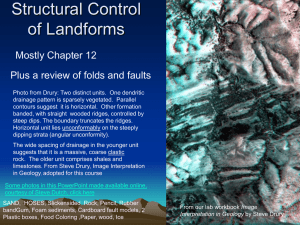
03 Structural Control mod 4b
... • Form in jointed igneous rocks or horizontal sedimentary beds with well-developed jointing or intersecting faults. ...
... • Form in jointed igneous rocks or horizontal sedimentary beds with well-developed jointing or intersecting faults. ...

PG Syllabus Geology 12-13
... Faults and Joints: Their nomenclature, age relationship, origin and significance. Causes and dynamics of faulting, strike-slip fault, normal faults, over thrust and nappe. Planner and linear fabrics in deformed rocks, their origin and significance. Concepts of petrofabrics and Symmetry: objective, f ...
... Faults and Joints: Their nomenclature, age relationship, origin and significance. Causes and dynamics of faulting, strike-slip fault, normal faults, over thrust and nappe. Planner and linear fabrics in deformed rocks, their origin and significance. Concepts of petrofabrics and Symmetry: objective, f ...

Building Stones 1– a resource for several Earthlearningidea activities
... Basalt is the fine grained equivalent of gabbro and dolerite, mostly formed when a magma of gabbroic composition reached the Earth’s surface, and erupted to form basalt lava. The rapid cooling resulted in a much finer grain size than either gabbro or dolerite. The sample in the photograph has been c ...
... Basalt is the fine grained equivalent of gabbro and dolerite, mostly formed when a magma of gabbroic composition reached the Earth’s surface, and erupted to form basalt lava. The rapid cooling resulted in a much finer grain size than either gabbro or dolerite. The sample in the photograph has been c ...
Geology of Great Britain

The geology of Great Britain is renowned for its diversity. As a result of its eventful geological history, Great Britain shows a rich variety of landscapes across the constituent countries of England, Wales and Scotland. Rocks of almost all geological ages are represented at outcrop, from the Archaean onwards.