
SEDIMENTARY ROCKS
... Classification of Sedimentary Rocks Three main categories of sedimentary rocks are recognized. -Sediment has two principal sources: First, it may be an accumulation of material that originates and is transported as solid particles derived from both mechanical and chemical weathering. These deposits ...
... Classification of Sedimentary Rocks Three main categories of sedimentary rocks are recognized. -Sediment has two principal sources: First, it may be an accumulation of material that originates and is transported as solid particles derived from both mechanical and chemical weathering. These deposits ...

GEOL-1403-McMahon
... In the asthenosphere ultramafic rocks are partially melted to form mafic magmas that solidify to form oceanic crust (basaltic in compositions. At convergent plate boundaries oceanic crust basaltic in composition is subducted, and at a depth of approximately 100 km is partially melted to produce a mo ...
... In the asthenosphere ultramafic rocks are partially melted to form mafic magmas that solidify to form oceanic crust (basaltic in compositions. At convergent plate boundaries oceanic crust basaltic in composition is subducted, and at a depth of approximately 100 km is partially melted to produce a mo ...
Unit 4 Overview, Obduction
... Part below water will rise up. - It will be almost as high. - Depends on the density difference. ...
... Part below water will rise up. - It will be almost as high. - Depends on the density difference. ...

3: physiography, topography and geology
... bottom of the sea, close to the equator. About 400 million years ago, Europe and North America collided, forming the Appalachian Mountains, which at that time were far higher and more rugged than the Rocky Mountains are now. In the Mesozoic Era (the time when dinosaurs lived), New Jersey was part of ...
... bottom of the sea, close to the equator. About 400 million years ago, Europe and North America collided, forming the Appalachian Mountains, which at that time were far higher and more rugged than the Rocky Mountains are now. In the Mesozoic Era (the time when dinosaurs lived), New Jersey was part of ...

File
... To maintain land above sea level! Erosion over time will sweep all the continents into the sea. ...
... To maintain land above sea level! Erosion over time will sweep all the continents into the sea. ...

Geology and Mineral Resources: Kamloops-Cache Creek
... The Intermontane terranes are interpreted to have been accreted to North America about 180 million years ago. After that they formed the western edge of North America upon which younger volcanic arc evolved, and upon which younger, continental (i.e. non‐marine) sequences were deposited. A tectonic ...
... The Intermontane terranes are interpreted to have been accreted to North America about 180 million years ago. After that they formed the western edge of North America upon which younger volcanic arc evolved, and upon which younger, continental (i.e. non‐marine) sequences were deposited. A tectonic ...


Geologic History of Walpole
... intervals of warming, but the ice sheet advanced four times over New England. It was after the climate had warmed again and the ice had melted back, about 12,000 years ago, when Walpole's landscape began to look as it does now. Meltwaters flowed in great torrents, carrying sand and gravel which were ...
... intervals of warming, but the ice sheet advanced four times over New England. It was after the climate had warmed again and the ice had melted back, about 12,000 years ago, when Walpole's landscape began to look as it does now. Meltwaters flowed in great torrents, carrying sand and gravel which were ...

Rocks - Faculty Server Contact
... the present day collision between the Indian subcontinent and Asia large mountain ranges are formed. It is these dynamic processes that are responsible for the formation of igneous, sedimentary, and metamorphic rocks. In areas of crustal thickening, such as the Himalayas, rocks from deep in the eart ...
... the present day collision between the Indian subcontinent and Asia large mountain ranges are formed. It is these dynamic processes that are responsible for the formation of igneous, sedimentary, and metamorphic rocks. In areas of crustal thickening, such as the Himalayas, rocks from deep in the eart ...

Petrogenesis of Oxidized Arfvedsonite Granite Gneiss from Dimra
... The arfvedsonite granite gneiss of Dimra Pahar occurs along the North Purulia Shear Zone (NPSZ) which pivots the Proterozoic Chotannagpur Gneissic Complex (CGC), Eastern India. Although minerals like arfvedsonite and aegirine depict the peralkaline nature of the pluton, the geochemistry of the rock ...
... The arfvedsonite granite gneiss of Dimra Pahar occurs along the North Purulia Shear Zone (NPSZ) which pivots the Proterozoic Chotannagpur Gneissic Complex (CGC), Eastern India. Although minerals like arfvedsonite and aegirine depict the peralkaline nature of the pluton, the geochemistry of the rock ...

Lab 8 - Geologic Maps
... For example, a sandstone unit deposited on a barrier island could have facies that represent island dunes, beachfront and tidal flat depositional environments. ...
... For example, a sandstone unit deposited on a barrier island could have facies that represent island dunes, beachfront and tidal flat depositional environments. ...
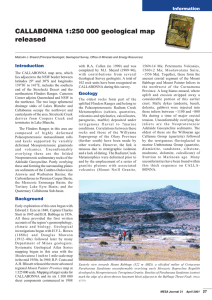
CALLABONNA 1:250 000 geological map released
... Cretaceous. The lower part of the Eromanga Basin includes a Jurassic to Early Cret aceous s equence of terrigenous, fluvial and lacustrine sediments of an unnamed group (sandstone, siltstone, mudstone, coal, calcareou s and car bonaceous equivalents). The middle and upper components belong to the Cr ...
... Cretaceous. The lower part of the Eromanga Basin includes a Jurassic to Early Cret aceous s equence of terrigenous, fluvial and lacustrine sediments of an unnamed group (sandstone, siltstone, mudstone, coal, calcareou s and car bonaceous equivalents). The middle and upper components belong to the Cr ...
Sedimentary Rocks and their processes
... • Reconstructing the depositional environment of a deposit is of practical importance. For example, knowing the depositional environment of sedimentary rocks containing petroleum and natural gas is critical for siting exploration and exploitational wells. • Sedimentary textural characteristics like ...
... • Reconstructing the depositional environment of a deposit is of practical importance. For example, knowing the depositional environment of sedimentary rocks containing petroleum and natural gas is critical for siting exploration and exploitational wells. • Sedimentary textural characteristics like ...

CONSTRUCTING A SEA-FLOOR SPREADING MODEL
... The lithosphere is composed of the crust and upper mantle and is broken into large pieces know as plates. The lithospheric plates, carrying both oceanic and continental rock, “float” on the plastic part of the mantle below the lithosphere. Plates move together, separate, and slide past each other cr ...
... The lithosphere is composed of the crust and upper mantle and is broken into large pieces know as plates. The lithospheric plates, carrying both oceanic and continental rock, “float” on the plastic part of the mantle below the lithosphere. Plates move together, separate, and slide past each other cr ...
Annexure 1c The geology and landforms of the
... of the last few million years. There have been at least 30 of these cold-warm cycles in the last 2 million years. Each cycle lasted 40,000-100,000 years and included a warm period similar to today and a cold or glacial period when large ice caps formed on southern and northern hemisphere continents. ...
... of the last few million years. There have been at least 30 of these cold-warm cycles in the last 2 million years. Each cycle lasted 40,000-100,000 years and included a warm period similar to today and a cold or glacial period when large ice caps formed on southern and northern hemisphere continents. ...

Untitled - Vermont Fish and Wildlife
... evolved. During those times, calcium-rich sediments, the remnants of marine life, collected on the sea floor. The history of Vermont’s rocks is filled with tales of continental movement, the building and wearing away of mountains, and intense volcanic activity. We will tell this story only briefly a ...
... evolved. During those times, calcium-rich sediments, the remnants of marine life, collected on the sea floor. The history of Vermont’s rocks is filled with tales of continental movement, the building and wearing away of mountains, and intense volcanic activity. We will tell this story only briefly a ...

Brief History of the White Tank Mountains and the Western Phoenix
... The mountains exhibiting the metamorphic core complexes may have remained as topographic highs in the region over time, with the Mid-Tertiary orogeny creating the greatest amount of metamorphic core mountain building. The White Tank Mountains are some of these Mid-Tertiary Metamorphic Core complexes ...
... The mountains exhibiting the metamorphic core complexes may have remained as topographic highs in the region over time, with the Mid-Tertiary orogeny creating the greatest amount of metamorphic core mountain building. The White Tank Mountains are some of these Mid-Tertiary Metamorphic Core complexes ...

Crustal Extension
... In southern Death Valley normal and strike-slip faulting associated with extensional basin formation began less than 15 Ma ago and continues today. This presentation outlines crustal extension and it’s correlation to magmatism in the southern Death Valley. (Calzia et al., 2000). ...
... In southern Death Valley normal and strike-slip faulting associated with extensional basin formation began less than 15 Ma ago and continues today. This presentation outlines crustal extension and it’s correlation to magmatism in the southern Death Valley. (Calzia et al., 2000). ...

Mineral Exploration :: 3. Mineral deposit models
... evolution, large areal extension, and great abundance. In rocks which have minerals with an appreciable content of radioactive isotopes, radiometric age determination may work. The isotopes undergo time-controlled decay, and produce daughter isotopes, elements. From the presumed initial isotope-rati ...
... evolution, large areal extension, and great abundance. In rocks which have minerals with an appreciable content of radioactive isotopes, radiometric age determination may work. The isotopes undergo time-controlled decay, and produce daughter isotopes, elements. From the presumed initial isotope-rati ...

How old is that rock?
... As we have discussed, the Earth is not a static thing. Once crust is laid down, lots of things can change it. When magma pushes its way through the layers, it’s called intrusion. Intrusions are YOUNGER than the rock they are intruding upon. ...
... As we have discussed, the Earth is not a static thing. Once crust is laid down, lots of things can change it. When magma pushes its way through the layers, it’s called intrusion. Intrusions are YOUNGER than the rock they are intruding upon. ...

Rocks and Their Origins
... • Igneous rocks are classified based on their texture. • Coarse texture- igneous rocks with large crystals. • Fine Grain texture- rocks that have small crystals. • Glassy- rocks that cool so fast they have no specific ...
... • Igneous rocks are classified based on their texture. • Coarse texture- igneous rocks with large crystals. • Fine Grain texture- rocks that have small crystals. • Glassy- rocks that cool so fast they have no specific ...

Organic sedimentary rocks
... The lagoon is created by waves crashing over the bar during high spring tides and storms The shallow lake just 1- 2m deep covers a large area and is known as a Playa Lake The water in the lagoon evaporates to precipitate thin beds of evaporites 3 metres of sea water produces just 5cm of evaporite ro ...
... The lagoon is created by waves crashing over the bar during high spring tides and storms The shallow lake just 1- 2m deep covers a large area and is known as a Playa Lake The water in the lagoon evaporates to precipitate thin beds of evaporites 3 metres of sea water produces just 5cm of evaporite ro ...

knockvologan to eilean a`chalmain
... Exposures on the small island to the north of Eilean Dubh (at 3064 1894) and on the westfacing shore of Erraid Sound (at 3077 2012) provide good examples of the mafic enclave-rich hybrid granitic rocks and of their heterogeneous textures. The hybrid host rock is predominantly a biotite-rich granite ...
... Exposures on the small island to the north of Eilean Dubh (at 3064 1894) and on the westfacing shore of Erraid Sound (at 3077 2012) provide good examples of the mafic enclave-rich hybrid granitic rocks and of their heterogeneous textures. The hybrid host rock is predominantly a biotite-rich granite ...

Late Mesozoic Geology.
... Orogenic activity, resulting from plate convergence, subduction and terrane accretion, had been going on since the Early Paleozoic - the peak periods being the Antler, Sonoma and Nevadan Orogenies. By the Late Cretaceous, the mountainous Cordillera of the west coast of North America was well establi ...
... Orogenic activity, resulting from plate convergence, subduction and terrane accretion, had been going on since the Early Paleozoic - the peak periods being the Antler, Sonoma and Nevadan Orogenies. By the Late Cretaceous, the mountainous Cordillera of the west coast of North America was well establi ...
Geology of Great Britain

The geology of Great Britain is renowned for its diversity. As a result of its eventful geological history, Great Britain shows a rich variety of landscapes across the constituent countries of England, Wales and Scotland. Rocks of almost all geological ages are represented at outcrop, from the Archaean onwards.