

History of the Theory Notes (15.1)
... give an individual survival & reproductive ____________ over other individuals. Darwin hypothesized that new species could appear gradually through small changes in ancestral species. Darwin inferred that if humans could change species by artificial selection, then perhaps the same process could ...
... give an individual survival & reproductive ____________ over other individuals. Darwin hypothesized that new species could appear gradually through small changes in ancestral species. Darwin inferred that if humans could change species by artificial selection, then perhaps the same process could ...

Evolution Unit – PDQ`s 1-3 Evolution 1 – Introduction to Evolution
... Why does evolution of organisms occur? How does evolution affect a population? Questions to Answer: 1. Explain what the “modern synthesis” is. How is it different from Darwin’s original theory of evolution? ...
... Why does evolution of organisms occur? How does evolution affect a population? Questions to Answer: 1. Explain what the “modern synthesis” is. How is it different from Darwin’s original theory of evolution? ...

Charles Darwin
... Darwin returned to England in 1836 and married his cousin, Emma Wedgwood in 1839. Unfortunately, Darwin had gotten a tropical disease, later identified as Chagas’s disease, from a beetle bite in South America. It plagued him for the rest of his life. For many years, Darwin led a double life. Publicl ...
... Darwin returned to England in 1836 and married his cousin, Emma Wedgwood in 1839. Unfortunately, Darwin had gotten a tropical disease, later identified as Chagas’s disease, from a beetle bite in South America. It plagued him for the rest of his life. For many years, Darwin led a double life. Publicl ...

Lecture 2 - Detecting Design
... individuals that vary in heritable traits and their environment 2. Over time, natural selection produces an increase in adaptation of organisms to their environment 3. If an environment changes over time, natural selection may result in adaptation to these new conditions ...
... individuals that vary in heritable traits and their environment 2. Over time, natural selection produces an increase in adaptation of organisms to their environment 3. If an environment changes over time, natural selection may result in adaptation to these new conditions ...

1 EVOLUTION Introduction: The Development and Alignment of the
... the ability of the organism to survive and reproduce. Students in the 6th grade are aware of changes that might occur in the human body. For example, students know that muscles can be enlarged through lifting weights and skills such as playing a piano can be developed. However, the enlarged muscles ...
... the ability of the organism to survive and reproduce. Students in the 6th grade are aware of changes that might occur in the human body. For example, students know that muscles can be enlarged through lifting weights and skills such as playing a piano can be developed. However, the enlarged muscles ...

File
... resources in its habitat, forcing other species to migrate. » C A community whose members work together utilizes all existing resources and migratory routes. » D The largest organisms in a species receive the only breeding opportunities ...
... resources in its habitat, forcing other species to migrate. » C A community whose members work together utilizes all existing resources and migratory routes. » D The largest organisms in a species receive the only breeding opportunities ...

Vegetables in the Cabbage Family
... Look up a breed of dog and discuss why it was bred with certain traits and not others. (due Thursday). ...
... Look up a breed of dog and discuss why it was bred with certain traits and not others. (due Thursday). ...
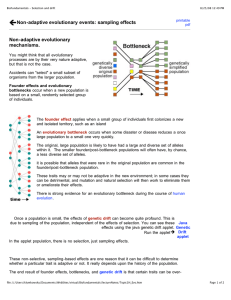
BioFundamentals - Selection and drift
... The founder effect applies when a small group of individuals first colonizes a new and isolated territory, such as an island An evolutionary bottleneck occurs when some disaster or disease reduces a once large population to a small one very quickly. The original, large population is likely to have h ...
... The founder effect applies when a small group of individuals first colonizes a new and isolated territory, such as an island An evolutionary bottleneck occurs when some disaster or disease reduces a once large population to a small one very quickly. The original, large population is likely to have h ...


A. Darwinian - cloudfront.net
... Which of the following best describes how LAMARCK would explain giraffes with long necks? A. Long-necked giraffes eat more grass than short necked giraffes so their necks grow longer. B. Natural variation in the population produces some longer and some shorter-necked giraffes and longer necked gira ...
... Which of the following best describes how LAMARCK would explain giraffes with long necks? A. Long-necked giraffes eat more grass than short necked giraffes so their necks grow longer. B. Natural variation in the population produces some longer and some shorter-necked giraffes and longer necked gira ...

Lecture 4 Genetics in Mendelian Populations I
... Populations contain genetic variation that arises by random mutation. Populations evolve by changes in gene frequency. Gene frequencies change through random genetic drift, gene flow, and natural selection. Most adaptive variants have small effects on the phenotype so changes are typically g ...
... Populations contain genetic variation that arises by random mutation. Populations evolve by changes in gene frequency. Gene frequencies change through random genetic drift, gene flow, and natural selection. Most adaptive variants have small effects on the phenotype so changes are typically g ...

A. Early Models of Evolution
... 2. Evolution by the punctuated equilibrium model can occur over a few thousand or million years, and sometimes even faster. ...
... 2. Evolution by the punctuated equilibrium model can occur over a few thousand or million years, and sometimes even faster. ...

SBI3U – Evolutionary Change without Selection
... Can we predict the relationship between allele frequency and the chances of those frequencies remaining constant? ...
... Can we predict the relationship between allele frequency and the chances of those frequencies remaining constant? ...

Chapter 5 • Lesson 28
... described as survival of the fittest.) In many cases, natural selection occurs when organisms must adapt to changing conditions. Because a population shares a gene pool, a successful adaptation will increase in frequency within the population, and variations for adaptations that do not help organism ...
... described as survival of the fittest.) In many cases, natural selection occurs when organisms must adapt to changing conditions. Because a population shares a gene pool, a successful adaptation will increase in frequency within the population, and variations for adaptations that do not help organism ...

Evolutionary Epistemology www.AssignmentPoint.com Evolutionary
... structure and function reflect adaptation, a nonteleological process of interaction between the organism and its environment. A cognitive trait tending to increase inclusive fitness in a given population should therefore grow more common over time, and a trait tending to prevent its carriers from pa ...
... structure and function reflect adaptation, a nonteleological process of interaction between the organism and its environment. A cognitive trait tending to increase inclusive fitness in a given population should therefore grow more common over time, and a trait tending to prevent its carriers from pa ...

Apr23
... 2. In nature, populations tend to remain stable in size. (Darwin) 3. Environmental resources are limited. Production of more individuals than can be supported by the environment leads competition. Not everyone will live. ...
... 2. In nature, populations tend to remain stable in size. (Darwin) 3. Environmental resources are limited. Production of more individuals than can be supported by the environment leads competition. Not everyone will live. ...

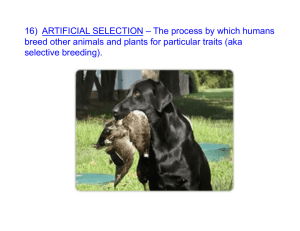
16) ARTIFICIAL SELECTION – The process by which humans breed
... their starts during the Cambrian Period and have been evolving ever since. If we wound the clock back a little more than half a billion years to the Cambrian, we would find that life then was different from life today: • All life was aquatic. • Most life was relatively small. • Many animals had unus ...
... their starts during the Cambrian Period and have been evolving ever since. If we wound the clock back a little more than half a billion years to the Cambrian, we would find that life then was different from life today: • All life was aquatic. • Most life was relatively small. • Many animals had unus ...

Chapter-16
... Environmental factors acting on a range of traits in a population influence differential survival and reproduction of individuals (natural selection) Forms of heritable traits that impart greater fitness to an individual become more common in a population over generations ...
... Environmental factors acting on a range of traits in a population influence differential survival and reproduction of individuals (natural selection) Forms of heritable traits that impart greater fitness to an individual become more common in a population over generations ...


Open File
... • In each generation, some individuals may, just by chance, leave behind a few more descendants (and genes, of course!) than other individuals. The genes of the next generation will be the genes of the "lucky" individuals, not necessarily the healthier or "better" individuals. That, is genetic drift ...
... • In each generation, some individuals may, just by chance, leave behind a few more descendants (and genes, of course!) than other individuals. The genes of the next generation will be the genes of the "lucky" individuals, not necessarily the healthier or "better" individuals. That, is genetic drift ...

A. Darwinian
... #7. Which of the following best describes how LAMARCK would explain giraffes with long necks? A. Long-necked giraffes eat more grass than short necked giraffes so their necks grow longer. B. Natural variation in the population produces some longer and some shorter-necked giraffes and longer necked ...
... #7. Which of the following best describes how LAMARCK would explain giraffes with long necks? A. Long-necked giraffes eat more grass than short necked giraffes so their necks grow longer. B. Natural variation in the population produces some longer and some shorter-necked giraffes and longer necked ...

Pre-Darwinian Thinking and Charles Darwin
... http://www.fordham.edu/halsall/mod/lect/malthus.gif ...
... http://www.fordham.edu/halsall/mod/lect/malthus.gif ...