
File - Biology by Napier
... Theory- a well-supported testable explanation of phenomena that have occurred in the natural world Evolution- change over time; modern organisms have descended from ancient organisms. Darwin’s Theory of Evolution: An adaptation is a trait that helps an organism be more suited to its environment Darw ...
... Theory- a well-supported testable explanation of phenomena that have occurred in the natural world Evolution- change over time; modern organisms have descended from ancient organisms. Darwin’s Theory of Evolution: An adaptation is a trait that helps an organism be more suited to its environment Darw ...

Natural selection factsheet
... characteristics of a population to change over generations. More recent examples of natural selection include snakes, cane toads, bacteria and insects. Natural selection in insects The rise of widespread agriculture has seen a rise in insects eating thesecrops, and a rise in efforts to eliminate the ...
... characteristics of a population to change over generations. More recent examples of natural selection include snakes, cane toads, bacteria and insects. Natural selection in insects The rise of widespread agriculture has seen a rise in insects eating thesecrops, and a rise in efforts to eliminate the ...

evolution - TeacherWeb
... 4.NATURAL SELECTION Greatly and quickly seen in isolated populations like those on islands. - Allele frequency will change over generations; situations/ENV will favor one allele over another - Those populations at equilibrium are not evolving - Species with more genetic diversity will adapt better t ...
... 4.NATURAL SELECTION Greatly and quickly seen in isolated populations like those on islands. - Allele frequency will change over generations; situations/ENV will favor one allele over another - Those populations at equilibrium are not evolving - Species with more genetic diversity will adapt better t ...

Name: Date: Period: _____ Unit 1, Part 1 Notes – Evolution Basics
... The end result of natural selection in this example is that the more advantageous trait, brown coloration, which allows the beetle to have more offspring, becomes more common in the population. If this process continues, eventually, all individuals in the population will be brown. -Several related ...
... The end result of natural selection in this example is that the more advantageous trait, brown coloration, which allows the beetle to have more offspring, becomes more common in the population. If this process continues, eventually, all individuals in the population will be brown. -Several related ...

Basic Molecular Biology Information
... Neo-Darwinian Synthesis • The is a refinement of Darwin's theory using the knowledge of genetics gained from Mendel and his followers. (Darwin had only a crude and incorrect understanding of the mechanism of heredity). • In the neo-Darwinian model, – the frequencies of alleles in the population are ...
... Neo-Darwinian Synthesis • The is a refinement of Darwin's theory using the knowledge of genetics gained from Mendel and his followers. (Darwin had only a crude and incorrect understanding of the mechanism of heredity). • In the neo-Darwinian model, – the frequencies of alleles in the population are ...

Document
... Seven pairs of morphologically closely related species pairs occur, one of each pair on each side of the isthmus and the DNA sequence results confirm that these are each others closest relatives, which is consistent with the ...
... Seven pairs of morphologically closely related species pairs occur, one of each pair on each side of the isthmus and the DNA sequence results confirm that these are each others closest relatives, which is consistent with the ...

How Organisms Evolve The Theory of Evolution The Theory of
... • A population, however, can change its phenotype over time. • Evolution is a change in the genetic make-up of a population over generations. – A population is a group that includes all the members of a species living in a given area. ...
... • A population, however, can change its phenotype over time. • Evolution is a change in the genetic make-up of a population over generations. – A population is a group that includes all the members of a species living in a given area. ...

Evolution - OpenStax CNX
... Darwin correctly pointed out the analogies between this process of natural selection and arti cial selection, the well-known process that animal breeders used to select for interesting or useful variants in animal species. In other words, natural processes can generate the diversity we nd in the na ...
... Darwin correctly pointed out the analogies between this process of natural selection and arti cial selection, the well-known process that animal breeders used to select for interesting or useful variants in animal species. In other words, natural processes can generate the diversity we nd in the na ...

Charles Darwin and Alfred Wallace independently
... America; theseadaptations equiped the birds to acquire specific food sources. Wallace and Darwin observed similar patterns in the variation of organisms and independently developed the same explanation for how such variations could occur over time, a mechanism Darwin called natural selection. Accord ...
... America; theseadaptations equiped the birds to acquire specific food sources. Wallace and Darwin observed similar patterns in the variation of organisms and independently developed the same explanation for how such variations could occur over time, a mechanism Darwin called natural selection. Accord ...

Introduction
... 1) All events can be traced to natural causes that can be comprehended 2) Laws of nature (physics) hold in all time and space 3) People perceive natural events in similar ways Scientific method is the basis of scientific inquiry: ...
... 1) All events can be traced to natural causes that can be comprehended 2) Laws of nature (physics) hold in all time and space 3) People perceive natural events in similar ways Scientific method is the basis of scientific inquiry: ...

Lecture2 - Indiana University Bloomington
... Darwin’s views on variation prior to 1856 2 types of variation, both heritable “Sports”: large, discrete effect “Individual differences”: small continuous effects Darwin’s view in 1856: The Origin of Species a) Sports are too rare b) Darwin concludes that selection operates on “individual differenc ...
... Darwin’s views on variation prior to 1856 2 types of variation, both heritable “Sports”: large, discrete effect “Individual differences”: small continuous effects Darwin’s view in 1856: The Origin of Species a) Sports are too rare b) Darwin concludes that selection operates on “individual differenc ...

Evolution Notes Part 1
... • All vertebrate forelimbs contain the same sets of bones – suggests they evolved from a common ancestor. • Homologous structures - structures that are similar because they develop from same tissues early in development; may or may not have same jobs • Ex: frog, lizard, bird, whale, cat, bat, and hu ...
... • All vertebrate forelimbs contain the same sets of bones – suggests they evolved from a common ancestor. • Homologous structures - structures that are similar because they develop from same tissues early in development; may or may not have same jobs • Ex: frog, lizard, bird, whale, cat, bat, and hu ...

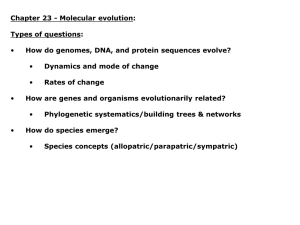
Chapter 23 - dewhozitz.net
... Population genetics: study of the distributions and changes of allele frequency in a population Modern Evolutionary Synthesis Sewall Wright ...
... Population genetics: study of the distributions and changes of allele frequency in a population Modern Evolutionary Synthesis Sewall Wright ...
How do organisms maintain homeostasis?
... Students will evidence knowledge of the basic concepts & interrelationships between the life & physical sciences, & be able to apply scientific skills, processes, & methods of inquiry to real world settings. Enduring Understandings: * Science is a process. It is a way of knowing, based on curiosity, ...
... Students will evidence knowledge of the basic concepts & interrelationships between the life & physical sciences, & be able to apply scientific skills, processes, & methods of inquiry to real world settings. Enduring Understandings: * Science is a process. It is a way of knowing, based on curiosity, ...

Chapter 15: Darwin`s Theory of Evolution
... – When the two are crossed hopefully the mule will be mid-sized and sure footed. – Sometimes though, they ended up with a small, thin ankled mule. ...
... – When the two are crossed hopefully the mule will be mid-sized and sure footed. – Sometimes though, they ended up with a small, thin ankled mule. ...

TREE Journal (Trends in Evolution and Ecology)
... on anything the least bit quirky, this very journal republished some of the evolution-inspired poems written by friends and colleagues of J.B.S. Haldane to mark his 60th birthday [2]. Suffice it say, both works are of more note for their intrinsic interest than their literary merits. Perhaps this ju ...
... on anything the least bit quirky, this very journal republished some of the evolution-inspired poems written by friends and colleagues of J.B.S. Haldane to mark his 60th birthday [2]. Suffice it say, both works are of more note for their intrinsic interest than their literary merits. Perhaps this ju ...

THE HISTORY OF EVOLUTIONARY THEORY
... Galapagos Islands. The book is therefore quite complex. This is surprising because the things Darwin was saying were very simple. His main ideas were: (a) Living things tend to produce too many offspring. They produce more offspring than could possibly survive. Only a small percentage of the offspri ...
... Galapagos Islands. The book is therefore quite complex. This is surprising because the things Darwin was saying were very simple. His main ideas were: (a) Living things tend to produce too many offspring. They produce more offspring than could possibly survive. Only a small percentage of the offspri ...
Unit VIII Review Sheet
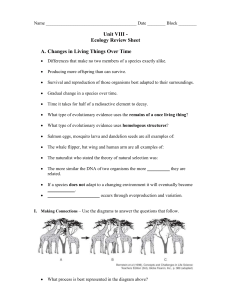
... colors labeled A and B. These beetles live on trees and are eaten by birds. The percentage of each body color in the population of this species is indicated. The habitat of this beetle population is a group of trees with light-colored bark. ...
... colors labeled A and B. These beetles live on trees and are eaten by birds. The percentage of each body color in the population of this species is indicated. The habitat of this beetle population is a group of trees with light-colored bark. ...

Misconceptions about Evolution
... been modified to include the idea that evolution can proceed at a relatively rapid pace under some circumstances. In this sense, “Darwinism” is continually being modified. Thus far, however, there have been no credible challenges to the basic Darwinian principles that evolution proceeds primarily by ...
... been modified to include the idea that evolution can proceed at a relatively rapid pace under some circumstances. In this sense, “Darwinism” is continually being modified. Thus far, however, there have been no credible challenges to the basic Darwinian principles that evolution proceeds primarily by ...

Natural Selection Finch Beak Lab
... 1. Decide who will be each role (1 person per role). There will be an opportunity to switch around. Make sure everyone gets a chance to try each role. 2. Have 1 person get one bag of food, which represents the food source on one of the eight islands. 3. Have the 1 person get one cup per bird. The 3 ...
... 1. Decide who will be each role (1 person per role). There will be an opportunity to switch around. Make sure everyone gets a chance to try each role. 2. Have 1 person get one bag of food, which represents the food source on one of the eight islands. 3. Have the 1 person get one cup per bird. The 3 ...

File
... and corresponding differences in vegetation. Accordingly, he observed that the characteristics of many animals and plants varied noticeably among the different islands. ...
... and corresponding differences in vegetation. Accordingly, he observed that the characteristics of many animals and plants varied noticeably among the different islands. ...

The Episodic Nature of EvolutIonary Change
... stasis shall dominate the fossil record. All major theories of speciation maintain that splitting takes place rapidly in very small populations. The theory of geographic, or allopatric, speciation is preferred by most evolutionists for most situations (allopatric means "in another place").. A new sp ...
... stasis shall dominate the fossil record. All major theories of speciation maintain that splitting takes place rapidly in very small populations. The theory of geographic, or allopatric, speciation is preferred by most evolutionists for most situations (allopatric means "in another place").. A new sp ...

naturally selected
... number of offspring produced – in order for natural selection and evolution to occur, it is not necessary to specify in advance which variations will be most adaptive – in fact, we often test whether or not a trait is adaptive by looking to see if it affects fitness (or a fitness component) ...
... number of offspring produced – in order for natural selection and evolution to occur, it is not necessary to specify in advance which variations will be most adaptive – in fact, we often test whether or not a trait is adaptive by looking to see if it affects fitness (or a fitness component) ...

Evidence of Evolution Pt 2
... • When species that are similar and closely related become increasingly different from each other. THEY DIVERGE • This is also called Adaptive Radiation because it has to do with ADAPTING to different environments and RADIATING out into different species. ...
... • When species that are similar and closely related become increasingly different from each other. THEY DIVERGE • This is also called Adaptive Radiation because it has to do with ADAPTING to different environments and RADIATING out into different species. ...