10.3 Theory of Natural Selection
... were presented to an important group of scientists in London. The next year, Darwin published his ideas in the book On the Origin of Species by Means of Natural Selection. There are four main principles to the theory of natural selection: variation, overproduction, adaptation, and descent with modif ...
... were presented to an important group of scientists in London. The next year, Darwin published his ideas in the book On the Origin of Species by Means of Natural Selection. There are four main principles to the theory of natural selection: variation, overproduction, adaptation, and descent with modif ...
Chapter 17 Powerpoint
... Genetics Joins Evolutionary Theory Darwin developed his theory of evolution without knowing how heritable traits passed from one generation to the next or where heritable variation came from. Researchers discovered that heritable traits are controlled by genes. Changes in genes and chromosomes gener ...
... Genetics Joins Evolutionary Theory Darwin developed his theory of evolution without knowing how heritable traits passed from one generation to the next or where heritable variation came from. Researchers discovered that heritable traits are controlled by genes. Changes in genes and chromosomes gener ...

Modelling evolutionary processes using Kernel density
... Process models are required to test hypotheses of how things have evolved through through the history of life on Earth. For example, the value of a continuously evolving character (such as body mass) through time is commonly modelled as the location of a particle moving under one-dimensional Brownia ...
... Process models are required to test hypotheses of how things have evolved through through the history of life on Earth. For example, the value of a continuously evolving character (such as body mass) through time is commonly modelled as the location of a particle moving under one-dimensional Brownia ...


Mutant Dinosaur - SI Earth Scien
... 1. Explain how variation within a species increases the species chance to survive when the environment changes. 2. Could you use the two drawings to show evidence on how one specie is related to another specie? Explain how fossils can be used to demonstrate episodic speciation. 3. Explain how natura ...
... 1. Explain how variation within a species increases the species chance to survive when the environment changes. 2. Could you use the two drawings to show evidence on how one specie is related to another specie? Explain how fossils can be used to demonstrate episodic speciation. 3. Explain how natura ...

Evolution by Natural Selection
... A heritable characteristic is influenced by genes and passed from parents to offspring. In the mice on the tan sand, tan fur was a heritable adaptive characteristic, and you saw how this characteristic became more common in the pups than in the mothers. In nature, heritable adaptive characteristics ...
... A heritable characteristic is influenced by genes and passed from parents to offspring. In the mice on the tan sand, tan fur was a heritable adaptive characteristic, and you saw how this characteristic became more common in the pups than in the mothers. In nature, heritable adaptive characteristics ...

Miller Chapter 4 Review Material Chapter 4: Biodiversity and
... vi. Genes mutate, individuals are selected and populations evolve such that they are better adapted to survive and reproduce under existing environmental conditions vii. Two limitations on adaption through natural selection 1. A change in environmental conditions can lead to such an adaptation only ...
... vi. Genes mutate, individuals are selected and populations evolve such that they are better adapted to survive and reproduce under existing environmental conditions vii. Two limitations on adaption through natural selection 1. A change in environmental conditions can lead to such an adaptation only ...

Evolution Study Guide
... 3. Why did Miller and Urey not use oxygen gas in their apparatus? There was very little oxygen in Earth’s early atmosphere 4. What did Miller and Urey produce with their apparatus? Liquid mixture of various organic compounds including amino acids (primordial soup) 5. Where did Darwin conduct his res ...
... 3. Why did Miller and Urey not use oxygen gas in their apparatus? There was very little oxygen in Earth’s early atmosphere 4. What did Miller and Urey produce with their apparatus? Liquid mixture of various organic compounds including amino acids (primordial soup) 5. Where did Darwin conduct his res ...

Ch04_sec2 Natural Selection MG
... • These deer were more likely to survive, and their young with thick fur were more likely to survive to reproduce. • Adaptation is the process of becoming adapted to an environment. • It is an anatomical, physiological, or behavioral change that improves a population’s ability to survive. ...
... • These deer were more likely to survive, and their young with thick fur were more likely to survive to reproduce. • Adaptation is the process of becoming adapted to an environment. • It is an anatomical, physiological, or behavioral change that improves a population’s ability to survive. ...

Biology Review: Earth, Evolution, and Ecology
... Explain and be able to show how half-lives work. For example, if 500,000 years have gone by, how much is left of a sample that originally was 50 g if it had a half-life of 250,000 years? (p340-41) ...
... Explain and be able to show how half-lives work. For example, if 500,000 years have gone by, how much is left of a sample that originally was 50 g if it had a half-life of 250,000 years? (p340-41) ...

2/11 - University of Texas
... that have the largest side buds and breed them. 2. Of the offspring, select individuals that have the largest side buds and breed them. 3. Of the offspring, select individuals that have the largest side buds and breed them. 4. After several generations, bud size increases dramatically. ...
... that have the largest side buds and breed them. 2. Of the offspring, select individuals that have the largest side buds and breed them. 3. Of the offspring, select individuals that have the largest side buds and breed them. 4. After several generations, bud size increases dramatically. ...

Chapter 24: Macroevolution
... C. the genetic basis for some reproductive barriers have been identified (the basis will vary depending on the species involved) III. Reproductive isolation is the key to cladogenic speciation A. speciation (the evolution of new species) has two general forms, anagenic and cladogenic B. anagenic spe ...
... C. the genetic basis for some reproductive barriers have been identified (the basis will vary depending on the species involved) III. Reproductive isolation is the key to cladogenic speciation A. speciation (the evolution of new species) has two general forms, anagenic and cladogenic B. anagenic spe ...
E3_Selection_2011 Part 3
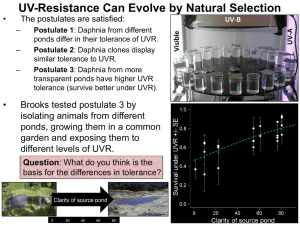
... These caveats are important; nonetheless selection can be a powerful force. To demonstrate it most fully, one would: ...
... These caveats are important; nonetheless selection can be a powerful force. To demonstrate it most fully, one would: ...

Chapter 22 - Scranton Prep Biology
... characterizes it today. The first convincing case for evolution was published in a book by Charles Darwin on November 24,1859.In this book, On the Origin of Speciesby Means of Natural Selection,Darwin: ...
... characterizes it today. The first convincing case for evolution was published in a book by Charles Darwin on November 24,1859.In this book, On the Origin of Speciesby Means of Natural Selection,Darwin: ...

Natural Selection
... survives, nor the most intelligent that survives. It is the one that is most adaptable to change.” Charles Darwin ...
... survives, nor the most intelligent that survives. It is the one that is most adaptable to change.” Charles Darwin ...

Directional Selection
... Species Definitions Biological Species Concept - A group of populations that can breed among themselves to produce fertile offspring - Are reproductively isolated from other such populations; unable to reproduce with members of other groups ...
... Species Definitions Biological Species Concept - A group of populations that can breed among themselves to produce fertile offspring - Are reproductively isolated from other such populations; unable to reproduce with members of other groups ...

Honors Biology Final Exam Review, Spring 2008
... Chapter 2: The Chemistry of Life Explain the relationship among atoms, elements, and compounds. How are acids and bases different? How do their pH values differ? What are the building blocks for carbohydrates, proteins, lipids, and nucleic acids? What relationship exists between an enzyme and a cata ...
... Chapter 2: The Chemistry of Life Explain the relationship among atoms, elements, and compounds. How are acids and bases different? How do their pH values differ? What are the building blocks for carbohydrates, proteins, lipids, and nucleic acids? What relationship exists between an enzyme and a cata ...

Chapter 7 - Southern Local Schools
... More Evidence of Evolution • One of the observations on which Darwin based his theory of evolution by natural selection is that parents pass traits to their offspring. But Darwin did not know how inheritance occurs or why individuals vary within a population. • During the 1930’s and 1940’s, biolog ...
... More Evidence of Evolution • One of the observations on which Darwin based his theory of evolution by natural selection is that parents pass traits to their offspring. But Darwin did not know how inheritance occurs or why individuals vary within a population. • During the 1930’s and 1940’s, biolog ...

Evolution - Mr. Jones Jaguars
... Darwin inferred that if humans could change species by artificial selection, then perhaps the same process could work in nature. ...
... Darwin inferred that if humans could change species by artificial selection, then perhaps the same process could work in nature. ...

The Origin of Species The Making of a Theory
... They defined the theory as a ”very ingenious theory to account for the appearance and perpetuation of varieties and of specific forms on our planet.” b. How would you rephrase what they wrote in your own words? Students’ answers will vary, but a possible answer might say “It was a very innovative th ...
... They defined the theory as a ”very ingenious theory to account for the appearance and perpetuation of varieties and of specific forms on our planet.” b. How would you rephrase what they wrote in your own words? Students’ answers will vary, but a possible answer might say “It was a very innovative th ...

How Populations Evolve
... Directional selection: shifts the frequency curve in one direction. It happens when the environment changes or a population migrates to a new habitat Disruptive selection: conditions favor individuals on both extremes. ...
... Directional selection: shifts the frequency curve in one direction. It happens when the environment changes or a population migrates to a new habitat Disruptive selection: conditions favor individuals on both extremes. ...

WHICH PATTERN IS IT?
... Idea that allele frequency will remain constant unless one or more factors cause those frequencies to change Hardy-Weinberg Principle ...
... Idea that allele frequency will remain constant unless one or more factors cause those frequencies to change Hardy-Weinberg Principle ...

hands on – science education in biology
... Year 2009 is the great occasion for celebration of Charles Darwin’s discoveries and life, since it will be the bicentenary of his birth and the 150th anniversary of the publication of his book “The Origin of Species” [2] Darwin’s accomplishments were so many and so diverse that they had impact on mo ...
... Year 2009 is the great occasion for celebration of Charles Darwin’s discoveries and life, since it will be the bicentenary of his birth and the 150th anniversary of the publication of his book “The Origin of Species” [2] Darwin’s accomplishments were so many and so diverse that they had impact on mo ...

Not by Design: Retiring Darwin`s Watchmaker
... need of some way to stay afloat, only to be saved by the improving force of natural selection. As pointed out by Croizat (1962), among others, this mode of thinking is not only teleological but also Lamarckian: a need gives rise to an organ to fulfill that need. While the best solution might be to d ...
... need of some way to stay afloat, only to be saved by the improving force of natural selection. As pointed out by Croizat (1962), among others, this mode of thinking is not only teleological but also Lamarckian: a need gives rise to an organ to fulfill that need. While the best solution might be to d ...

File - Pomp
... • If certain beetles had to nest in or around water, the amount of water could be a selecting factor • If certain beetles had to eat only certain types of plants, the vegetation would be the selecting factor ...
... • If certain beetles had to nest in or around water, the amount of water could be a selecting factor • If certain beetles had to eat only certain types of plants, the vegetation would be the selecting factor ...