
Name
... Why are trees tall? Why do zebras have stripes? Who do cheetahs have long, narrow legs? These questions can all be answered using Darwin’s theory of evolution by natural selection. In fact, virtually every trait of an organism can be explained using natural selection theory. While learning the anato ...
... Why are trees tall? Why do zebras have stripes? Who do cheetahs have long, narrow legs? These questions can all be answered using Darwin’s theory of evolution by natural selection. In fact, virtually every trait of an organism can be explained using natural selection theory. While learning the anato ...
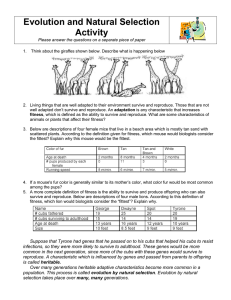
Evolution and Natural Selection Activity
... population. This process is called evolution by natural selection. Evolution by natural selection takes place over many, many generations. ...
... population. This process is called evolution by natural selection. Evolution by natural selection takes place over many, many generations. ...

Population genetics 1
... Provided synthesis of Mendelian genetics and Darwinian natural selection in the first part of the 20th century “modern synthesis”. ...
... Provided synthesis of Mendelian genetics and Darwinian natural selection in the first part of the 20th century “modern synthesis”. ...

here - ScienceA2Z.com
... • In the year following Darwin, all of this evidence accumulated in favor of evolution, yet until the discovery of modern genetics, the mechanism for variation was not known • Greg Mendel first noted patterns in heredity, however with Watson and Crick’s discovery of the double helix we have now come ...
... • In the year following Darwin, all of this evidence accumulated in favor of evolution, yet until the discovery of modern genetics, the mechanism for variation was not known • Greg Mendel first noted patterns in heredity, however with Watson and Crick’s discovery of the double helix we have now come ...

natural selection
... for survival, some organisms have traits that give them an advantage (like the fast antelope). Other organisms have traits that do not give them an advantage. The organisms with advantageous traits are more likely to survive and pass on their genes. The concept that some organisms are better able to ...
... for survival, some organisms have traits that give them an advantage (like the fast antelope). Other organisms have traits that do not give them an advantage. The organisms with advantageous traits are more likely to survive and pass on their genes. The concept that some organisms are better able to ...

Microevolution
... The Hardy-Weinberg Equilibrium occurs when the frequency of alleles in a gene pool is constant over time. This equilibrium requires random mating, a large population, no movement in or out of the population, no mutations, and no Hardy-Weinberg Equilibrium natural selection. In real life, ...
... The Hardy-Weinberg Equilibrium occurs when the frequency of alleles in a gene pool is constant over time. This equilibrium requires random mating, a large population, no movement in or out of the population, no mutations, and no Hardy-Weinberg Equilibrium natural selection. In real life, ...

Evolution misconceptions
... groups have no conflict with the theory of evolution or other scientific findings. ...
... groups have no conflict with the theory of evolution or other scientific findings. ...

Lesson 1 - FineTunedUniverse.com
... clearly of the same type as the ancestor. This might better be called variation, or adaptation, but the changes are "horizontal" in effect, not "vertical." Such changes might be accomplished by "natural selection," in which a trait within the present variety is selected as the best for a given set o ...
... clearly of the same type as the ancestor. This might better be called variation, or adaptation, but the changes are "horizontal" in effect, not "vertical." Such changes might be accomplished by "natural selection," in which a trait within the present variety is selected as the best for a given set o ...

Evolutionary Narratives: A Cautionary Tale
... between and amongst life forms. In the middle is the struggle for existence, natural selection and fitness. The end is modification through descent resulting in the emergence of new life forms. Though the evolutionary narrative is one the most powerful and influential stories of modern times, it is ...
... between and amongst life forms. In the middle is the struggle for existence, natural selection and fitness. The end is modification through descent resulting in the emergence of new life forms. Though the evolutionary narrative is one the most powerful and influential stories of modern times, it is ...

Volume 16, Number 33, August 10 to August 16, 2014 Systematic
... one. He makes it a result of physical laws merely. Then, if there were a development by such a law, it should be the animal instincts and bodily organs, which are developed in the higher species. But it is not so. Man is the highest, and when he is compared with other mammalia, he is a feebler beast ...
... one. He makes it a result of physical laws merely. Then, if there were a development by such a law, it should be the animal instincts and bodily organs, which are developed in the higher species. But it is not so. Man is the highest, and when he is compared with other mammalia, he is a feebler beast ...

Chapter6-Evolution
... Uniformitarianism, proposed by Hutton and expanded by Lyell. Uniformitarianism states that the physical laws that now shape the earth have always done so, and that the past can be understood by studying the present. Both suggested that the Earth is very old. ...
... Uniformitarianism, proposed by Hutton and expanded by Lyell. Uniformitarianism states that the physical laws that now shape the earth have always done so, and that the past can be understood by studying the present. Both suggested that the Earth is very old. ...

theory of evolution
... conclusions. • Most people at the time thought Darwin’s opinions too radical (or out there) to accept. ...
... conclusions. • Most people at the time thought Darwin’s opinions too radical (or out there) to accept. ...

174-16-Winter_2_7-Ja.. - Department of Biology
... that incorporates much of Prosser's (1950) five objectives, but with more rigorous evolutionary tools and definitions. ...
... that incorporates much of Prosser's (1950) five objectives, but with more rigorous evolutionary tools and definitions. ...

ppt - Language Log
... important of all those that fall under man's control, shown themselves wiser than any nation upon the face of the earth. Their customs otherwise are not such as I admire. The one thing of which I speakis the contrivance whereby they make it impossible for the enemy who invades them to escape destruc ...
... important of all those that fall under man's control, shown themselves wiser than any nation upon the face of the earth. Their customs otherwise are not such as I admire. The one thing of which I speakis the contrivance whereby they make it impossible for the enemy who invades them to escape destruc ...

Chapter Test A
... _____ 7. Which theory states that floods and earthquakes have occurred often in Earth’s history? a. uniformitarianism b. natural selection c. catastrophism d. artificial selection ...
... _____ 7. Which theory states that floods and earthquakes have occurred often in Earth’s history? a. uniformitarianism b. natural selection c. catastrophism d. artificial selection ...
013368718X_CH16_247
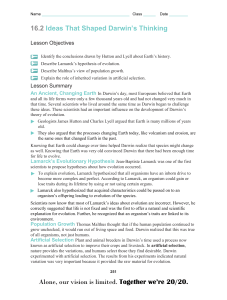
... grow unchecked, it would run out of living space and food. Darwin realized that this was true of all organisms, not just humans. Artificial Selection Plant and animal breeders in Darwin’s time used a process now known as artificial selection to improve their crops and livestock. In artificial select ...
... grow unchecked, it would run out of living space and food. Darwin realized that this was true of all organisms, not just humans. Artificial Selection Plant and animal breeders in Darwin’s time used a process now known as artificial selection to improve their crops and livestock. In artificial select ...

chapter 13 short
... occurring in offspring as a result of sexual reproduction. • Genetic changes to phenotype can be passed on to future generations. ...
... occurring in offspring as a result of sexual reproduction. • Genetic changes to phenotype can be passed on to future generations. ...

apes study guide
... Amphibians were among the earliest vertebrates to emerge from the earth’s waters and live on land. Historically, they have been able to adjust to and survive environmental changes more effectively than any other species. The amphibian world is now changing rapidly. Many scientists believe that the t ...
... Amphibians were among the earliest vertebrates to emerge from the earth’s waters and live on land. Historically, they have been able to adjust to and survive environmental changes more effectively than any other species. The amphibian world is now changing rapidly. Many scientists believe that the t ...
Biology Chapter 1 - revised Anderson- 8_19_2015
... • The sum of living things on the planet is called the Earth’s biodiversity • The theory of evolution operates on the hypothesis that all life originated from a common ancestor (LUCA – the Last Universal Common Ancestor) ...
... • The sum of living things on the planet is called the Earth’s biodiversity • The theory of evolution operates on the hypothesis that all life originated from a common ancestor (LUCA – the Last Universal Common Ancestor) ...


Pre-Evolution Quiz (A) - Harvard Life Science Outreach Program
... President and Fellows of Harvard College ...
... President and Fellows of Harvard College ...

PDF file - ucr biology
... events which occur only rarely during the lifetimes of individual organisms can nonetheless constitute important selective factors. Because the concept of safety factors is essentially derived from engineering, whereas organisms are not "engineered," we should be careful about this metaphor o r anal ...
... events which occur only rarely during the lifetimes of individual organisms can nonetheless constitute important selective factors. Because the concept of safety factors is essentially derived from engineering, whereas organisms are not "engineered," we should be careful about this metaphor o r anal ...

Evidence for evolution - Plattsburgh State Faculty and Research
... Idea of evolution was accepted rapidly by scientists. Lack of understanding of heredity and population genetics, however, prevented natural selection being accepted as the principal mechanism of evolution until 1930’s. The “Modern Synthesis” in the 1930’s of combined the ideas of population gene ...
... Idea of evolution was accepted rapidly by scientists. Lack of understanding of heredity and population genetics, however, prevented natural selection being accepted as the principal mechanism of evolution until 1930’s. The “Modern Synthesis” in the 1930’s of combined the ideas of population gene ...

Chapter 14 Evolution a History and a Process—Reading/ Study Guide
... 2. After he analyzed his findings what did he conclude? 3. Who was Thomas Mathus and what was the significance of his writings? 4. Darwin did not publish his findings at first, what caused him to finally publish his work? 5. What was the name of the famous book that Darwin wrote? Darwin’s Two Main ...
... 2. After he analyzed his findings what did he conclude? 3. Who was Thomas Mathus and what was the significance of his writings? 4. Darwin did not publish his findings at first, what caused him to finally publish his work? 5. What was the name of the famous book that Darwin wrote? Darwin’s Two Main ...

chapter1
... • Variable characteristic is measured and changed • Dependent variable: is presumably affected by the independent variable (ex. Severity of hangover) • Independent variable: controlled by the experimenter in order to explore its relationship with the dependent variable (ex. Prophylactic treatment fo ...
... • Variable characteristic is measured and changed • Dependent variable: is presumably affected by the independent variable (ex. Severity of hangover) • Independent variable: controlled by the experimenter in order to explore its relationship with the dependent variable (ex. Prophylactic treatment fo ...