
Principles of Evolution
... Why is nature so cruel?? • Limited resources means that organisms compete with themselves and others for survival. Because of this, nature weeds out inadequate individuals from the group so that only the most able produce diverse offspring. • Descent with modification allows each generation to try ...
... Why is nature so cruel?? • Limited resources means that organisms compete with themselves and others for survival. Because of this, nature weeds out inadequate individuals from the group so that only the most able produce diverse offspring. • Descent with modification allows each generation to try ...

Session 1 – Introduction
... This is in contrast to Macroevolution, which is major evolutionary change. The term applies mainly to the evolution of whole taxonomic groups over long periods of time. It is in this theory that dinosaurs can change into birds over the course of millions of years When we use the term evolution thro ...
... This is in contrast to Macroevolution, which is major evolutionary change. The term applies mainly to the evolution of whole taxonomic groups over long periods of time. It is in this theory that dinosaurs can change into birds over the course of millions of years When we use the term evolution thro ...
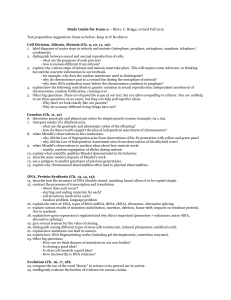
Study Guide for Exam 2 – Biol-1, C. Briggs, revised Fall 2015 Test
... 26. explain how these lines of evidence provide support for the idea of evolution: the fossil record, biogeography, comparative anatomy, comparative embryology, and molecular biology. Some of these are not in textbook. 27. describe the observations that led Darwin to develop his theory for evolutio ...
... 26. explain how these lines of evidence provide support for the idea of evolution: the fossil record, biogeography, comparative anatomy, comparative embryology, and molecular biology. Some of these are not in textbook. 27. describe the observations that led Darwin to develop his theory for evolutio ...
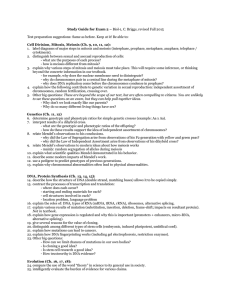
Study Guide for Exam 2 – Biol-1, C. Briggs, revised Fall 2015 Test
... 26. explain how these lines of evidence provide support for the idea of evolution: the fossil record, biogeography, comparative anatomy, comparative embryology, and molecular biology. Some of these are not in textbook. 27. describe the observations that led Darwin to develop his theory for evolutio ...
... 26. explain how these lines of evidence provide support for the idea of evolution: the fossil record, biogeography, comparative anatomy, comparative embryology, and molecular biology. Some of these are not in textbook. 27. describe the observations that led Darwin to develop his theory for evolutio ...

Section: Evolution Review Questions Name: Section Title: Evolution
... survive is known as ______________. a. Directional selection b. Disruptive selection c. Stabilizing selection 21. _____Speciation is driven by a. Species area effect b. Catastrophism c. Geographic and reproductive isolation d. Uniformitarianism 22. _____Gradualism states that new species develop ove ...
... survive is known as ______________. a. Directional selection b. Disruptive selection c. Stabilizing selection 21. _____Speciation is driven by a. Species area effect b. Catastrophism c. Geographic and reproductive isolation d. Uniformitarianism 22. _____Gradualism states that new species develop ove ...

Evolution- Mechanisms of Evolution
... - idea of uniformitarianism, that the earth was shaped entirely by slow-moving forces still in operation today, acting over a very long period of time - Stratigraphy: studying the layers which would become the different time periods in the history of the world ...
... - idea of uniformitarianism, that the earth was shaped entirely by slow-moving forces still in operation today, acting over a very long period of time - Stratigraphy: studying the layers which would become the different time periods in the history of the world ...

Unit 8 Evolution
... • Populations produce large #’s of offspring (more than can survive with given food) • Individuals in population have variations • Certain variations are more useful (these will survive better) • Over time, “good” genes prevail in the population, while “bad” ones fade out ...
... • Populations produce large #’s of offspring (more than can survive with given food) • Individuals in population have variations • Certain variations are more useful (these will survive better) • Over time, “good” genes prevail in the population, while “bad” ones fade out ...

Finding Our Place in the Great Chain of Being
... these resemblances exist because all species are actually related to one another through a common ancestral history strikes many people as more plausible than the idea that they have no relation to one another at all. Similarly, the proposal that the diversity in life forms is explained by a natural ...
... these resemblances exist because all species are actually related to one another through a common ancestral history strikes many people as more plausible than the idea that they have no relation to one another at all. Similarly, the proposal that the diversity in life forms is explained by a natural ...

15-3 - Kleins
... brought back with him It was at this time he noted that the the species on the Galapagos were like none other ...
... brought back with him It was at this time he noted that the the species on the Galapagos were like none other ...

Exam 3
... Fill in the blank answers will come from the key words or terms from each lecture. Words not used in fill in questions will likely be used in true or false, or multiple choice questions. Short answer and short essay questions will come from emboldened topics. Long essay questions will come from the ...
... Fill in the blank answers will come from the key words or terms from each lecture. Words not used in fill in questions will likely be used in true or false, or multiple choice questions. Short answer and short essay questions will come from emboldened topics. Long essay questions will come from the ...
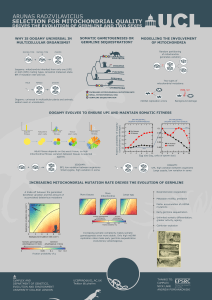

darwin׳s bicentenary and natural history museums
... traditional and characteristic resources of a natural history museum. Genetics first, and molecular biology later, have contributed very extensively to our current appreciation of evolution and additional fields spanning from ecology and ethology to developmental biology have progressively gained pr ...
... traditional and characteristic resources of a natural history museum. Genetics first, and molecular biology later, have contributed very extensively to our current appreciation of evolution and additional fields spanning from ecology and ethology to developmental biology have progressively gained pr ...

DISEASES AND TREES - UC Berkeley College of Natural Resources
... individuals will have the same set of VC alleles? • Probability calculation (multiply frequency of each allele) • More powerful the larger the number of loci • …and the larger the number of alleles per locus ...
... individuals will have the same set of VC alleles? • Probability calculation (multiply frequency of each allele) • More powerful the larger the number of loci • …and the larger the number of alleles per locus ...

dogs
... of mostly bones and scraps of food from a recent successful hunt. As dusk approaches, the wolves start to arrive. The boy is not frightened. He has seen the wolves many times before. In fact, their arrival is almost ritualistic. They move in from the forest and wait until all the humans have gone in ...
... of mostly bones and scraps of food from a recent successful hunt. As dusk approaches, the wolves start to arrive. The boy is not frightened. He has seen the wolves many times before. In fact, their arrival is almost ritualistic. They move in from the forest and wait until all the humans have gone in ...

Park Grass: testing new ideas on an old
... characteristics or 'traits' that do better on that plot will produce more seed which will, in turn, inherit those favourable traits. This can result in the genetic code of populations on different plots diverging. If this divergence results in reproductive isolation (populations on different plots s ...
... characteristics or 'traits' that do better on that plot will produce more seed which will, in turn, inherit those favourable traits. This can result in the genetic code of populations on different plots diverging. If this divergence results in reproductive isolation (populations on different plots s ...
Evolution
... A. Early ideas pg. 453 fig. 22.1 B. Darwin & Wallace – Theory of Natural Selection - a new species can arise from a gradual accumulation of adaptations - environment can select most fit members to survive ...
... A. Early ideas pg. 453 fig. 22.1 B. Darwin & Wallace – Theory of Natural Selection - a new species can arise from a gradual accumulation of adaptations - environment can select most fit members to survive ...

Into to Altruism (PowerPoint) Northeast 2012
... Learning Objectives: By the end of this tidbit, you should be able to 1. Define altruism 2. Explain why altruism is a complication for evolution by natural selection ...
... Learning Objectives: By the end of this tidbit, you should be able to 1. Define altruism 2. Explain why altruism is a complication for evolution by natural selection ...

Evolution 1
... changes in the Earth over the last 4.5 billion years • Organic evolution refers to the changes in life forms as they adapt to their changing environments. ...
... changes in the Earth over the last 4.5 billion years • Organic evolution refers to the changes in life forms as they adapt to their changing environments. ...

Chapter 6 - HCC Learning Web
... Darwin's Natural Selection Darwin's theory was unable to explain WHY offspring exhibited variability. This was to come many years later, when scientists determined that genetics is the cause of these variations. This principle can be stated as: " the survival of the fittest." ...
... Darwin's Natural Selection Darwin's theory was unable to explain WHY offspring exhibited variability. This was to come many years later, when scientists determined that genetics is the cause of these variations. This principle can be stated as: " the survival of the fittest." ...
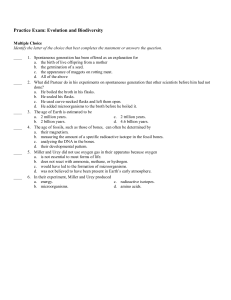
Practice Quiz 1 Quarter IV
... ____ 63. The hypothesis that evolution occurs at a slow, constant rate is known as a. gradualism. c. natural selection. b. slow motion. d. adaptation. ____ 64. The hypothesis that evolution occurs at an irregular rate through geologic time is known as a. directional evolution. c. punctuated equilibr ...
... ____ 63. The hypothesis that evolution occurs at a slow, constant rate is known as a. gradualism. c. natural selection. b. slow motion. d. adaptation. ____ 64. The hypothesis that evolution occurs at an irregular rate through geologic time is known as a. directional evolution. c. punctuated equilibr ...
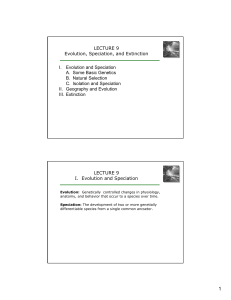
LECTURE 9 Evolution, Speciation, and Extinction I
... A. Some Basic Genetics B. Natural Selection C. Isolation and Speciation II. Geography and Evolution III. Extinction ...
... A. Some Basic Genetics B. Natural Selection C. Isolation and Speciation II. Geography and Evolution III. Extinction ...

Species
... Promontory Range (Northern Utah) now exists. When the range lifted up, it isolated two groups. Both became different as they adapted to the different environments on either side of the range. They have become so different they can no longer reproduce. ...
... Promontory Range (Northern Utah) now exists. When the range lifted up, it isolated two groups. Both became different as they adapted to the different environments on either side of the range. They have become so different they can no longer reproduce. ...
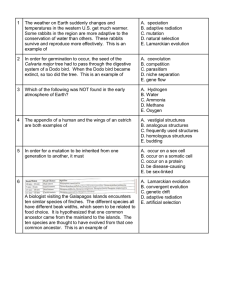
1 The weather on Earth suddenly changes and temperatures in the
... A species of turtle was observed by scientists on a small, isolated island in the Caribbean. Scientists counted the number of turtles and measured the size of each turtle. Fifty years later, a second team of scientists observed the turtles. They again counted and measured the size. What happened to ...
... A species of turtle was observed by scientists on a small, isolated island in the Caribbean. Scientists counted the number of turtles and measured the size of each turtle. Fifty years later, a second team of scientists observed the turtles. They again counted and measured the size. What happened to ...

Evolution - Westlake FFA
... Promontory Range (Northern Utah) now exists. When the range lifted up, it isolated two groups. Both became different as they adapted to the different environments on either side of the range. They have become so different they can no longer reproduce. ...
... Promontory Range (Northern Utah) now exists. When the range lifted up, it isolated two groups. Both became different as they adapted to the different environments on either side of the range. They have become so different they can no longer reproduce. ...

Evolution Unit – Tech Infused
... questions to introduce the environment and its role in evolution. This will also help students relate to Darwin’s study of beaks in the Galapagos Finches. Day 2: The details behind the theory Also using an app such as Evolution FAQ (which is free) can help students explore the commonly asked questi ...
... questions to introduce the environment and its role in evolution. This will also help students relate to Darwin’s study of beaks in the Galapagos Finches. Day 2: The details behind the theory Also using an app such as Evolution FAQ (which is free) can help students explore the commonly asked questi ...