
Document
... Darwin illustrated the evolution of the neck of giraffes by his theory of natural selection: ...
... Darwin illustrated the evolution of the neck of giraffes by his theory of natural selection: ...

Lamarck vs. Darwin Worksheet
... changing, that living things change to be better suited and adapted to their environments, and that all organisms are related. Darwin and Lamarck also agreed that life evolved from fewer, simpler organisms to many, more complex organisms. Lamarck is best known for his Theory of Inheritance of Acquir ...
... changing, that living things change to be better suited and adapted to their environments, and that all organisms are related. Darwin and Lamarck also agreed that life evolved from fewer, simpler organisms to many, more complex organisms. Lamarck is best known for his Theory of Inheritance of Acquir ...

Name: ______ Class: ________________ Date: ___________
... changing, that living things change to be better suited and adapted to their environments, and that all organisms are related. Darwin and Lamarck also agreed that life evolved from fewer, simpler organisms to many, more complex organisms. Lamarck is best known for his Theory of Inheritance of Acquir ...
... changing, that living things change to be better suited and adapted to their environments, and that all organisms are related. Darwin and Lamarck also agreed that life evolved from fewer, simpler organisms to many, more complex organisms. Lamarck is best known for his Theory of Inheritance of Acquir ...

Evol Bgram
... the French scientist who had competing theories during Darwin’s time, thought that characteristics that you get after you are born, can be passed to your offspring. This is called ‘acquired traits’. So working out a whole lot and then having young ones insures that the young will be born really, rea ...
... the French scientist who had competing theories during Darwin’s time, thought that characteristics that you get after you are born, can be passed to your offspring. This is called ‘acquired traits’. So working out a whole lot and then having young ones insures that the young will be born really, rea ...

Chapter 1 - HCC Southeast Commons
... LIFE’S UNDERLYING UNITY All organisms are alike in key respects: • Consist of one or more cells • Live through inputs of energy and raw materials • Sense and respond to changes in their external and internal environments • Cells contain DNA (molecule that offspring inherit from parents; encodes in ...
... LIFE’S UNDERLYING UNITY All organisms are alike in key respects: • Consist of one or more cells • Live through inputs of energy and raw materials • Sense and respond to changes in their external and internal environments • Cells contain DNA (molecule that offspring inherit from parents; encodes in ...


Written exam starting with Synapomorphy
... between generation by changes in the essence} {A form of transformation of the essence to explain change} NOTE: Some students defined both transmutation of the essence and species. The first explanation is the one that will be marked. ...
... between generation by changes in the essence} {A form of transformation of the essence to explain change} NOTE: Some students defined both transmutation of the essence and species. The first explanation is the one that will be marked. ...

Evolution
... III. Natural Selection and Evidence for Evolution • Molecular/biochemical evidence • Mutations that help an organism survive its environment are passed on to the next generation. • Species that diverged longer ago have more differences in their corresponding proteins. (just like comparing how close ...
... III. Natural Selection and Evidence for Evolution • Molecular/biochemical evidence • Mutations that help an organism survive its environment are passed on to the next generation. • Species that diverged longer ago have more differences in their corresponding proteins. (just like comparing how close ...

Co-Requisite – Characteristics of Science
... c. Explain how fossil and biochemical evidence support the theory. *Give five pieces of evidence to support the theory of evolution: ...
... c. Explain how fossil and biochemical evidence support the theory. *Give five pieces of evidence to support the theory of evolution: ...
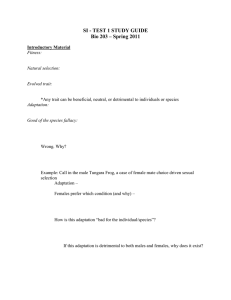
SI - TEST 1 STUDY GUIDE Bio 203 – Spring 2011 Introductory
... Good of the species fallacy, natural selection, fitness, adaptation, evolved trait, reproductive success, nonrandom differential reproductive success, random differential reproductive success, sexual dimorphism, sexual selection, honest signal, female mate choice, sperm competition, pairbonding, mat ...
... Good of the species fallacy, natural selection, fitness, adaptation, evolved trait, reproductive success, nonrandom differential reproductive success, random differential reproductive success, sexual dimorphism, sexual selection, honest signal, female mate choice, sperm competition, pairbonding, mat ...

Exhibit 10 - Horizon Research, Inc.
... 6. Evolution is a change in the frequency of heritable traits within a population or species over time. Evolution may result in new species developing, but does not always. Evolution is driven largely by natural selection, which is the survival and reproduction of organisms that carry traits that ...
... 6. Evolution is a change in the frequency of heritable traits within a population or species over time. Evolution may result in new species developing, but does not always. Evolution is driven largely by natural selection, which is the survival and reproduction of organisms that carry traits that ...

Darwinism - Francis Marion University
... 2. Inheritance of Acquired Characteristics -Lamarck also believed that any changes in an organism that occur during its lifetime can be passed on to its offspring. By Lamarck’s reasoning, the weightlifter with large biceps will pass on large biceps to his or her offspring. Lamarckian evolution w ...
... 2. Inheritance of Acquired Characteristics -Lamarck also believed that any changes in an organism that occur during its lifetime can be passed on to its offspring. By Lamarck’s reasoning, the weightlifter with large biceps will pass on large biceps to his or her offspring. Lamarckian evolution w ...

Advanced Biology\AB U1 Screen Show
... characteristics that best let them survive in their environment will thrive and reproduce. For example, those with coloration that blends with their environment (camouflage) are less likely to be seen by their predators/prey. Those without beneficial characteristics may not survive to reproduce so t ...
... characteristics that best let them survive in their environment will thrive and reproduce. For example, those with coloration that blends with their environment (camouflage) are less likely to be seen by their predators/prey. Those without beneficial characteristics may not survive to reproduce so t ...

The Study of Life
... organisms respond to changes in their external environment, adjusting their processes accordingly homeostasis is the maintenance of this internal environment in spite of external changes ...
... organisms respond to changes in their external environment, adjusting their processes accordingly homeostasis is the maintenance of this internal environment in spite of external changes ...

The Spandrels of San Marco
... architectural elements or byproducts of having adjacent arches? • How many traits of living organisms are spandrels rather than adaptations? • Organisms are more than collections of traits. ...
... architectural elements or byproducts of having adjacent arches? • How many traits of living organisms are spandrels rather than adaptations? • Organisms are more than collections of traits. ...

Document
... – This selection is done by the environment – Those which are best suited reproduce – They pass these well suited characteristics on to their young ...
... – This selection is done by the environment – Those which are best suited reproduce – They pass these well suited characteristics on to their young ...

evolution 2
... Various mechanisms help to preserve genetic variation in a population Diploidy maintains genetic variation in the form of hidden recessive alleles Balancing selection occurs when natural selection maintains stable frequencies of two or more phenotypic forms in a population Balancing selection ...
... Various mechanisms help to preserve genetic variation in a population Diploidy maintains genetic variation in the form of hidden recessive alleles Balancing selection occurs when natural selection maintains stable frequencies of two or more phenotypic forms in a population Balancing selection ...

Chapter 10 - Peoria Public Schools
... Section 10.3: Theory of Natural Selection • Adaptation leads to fitness. • Fitness is the measure of the ability to survive and produce more offspring relative to other organisms. • The fitness only remains if the environment remains constant. • As the environment changes, the traits that were onc ...
... Section 10.3: Theory of Natural Selection • Adaptation leads to fitness. • Fitness is the measure of the ability to survive and produce more offspring relative to other organisms. • The fitness only remains if the environment remains constant. • As the environment changes, the traits that were onc ...

spatial sorting - The University of Sydney
... process might be both less and more important than proposed, and a likely key role for natural selection. Species’ ranges cannot expand indefinitely: the exaggeration of dispersal traits at the expansion front caused by spatial sorting will eventually disappear, being gradually diluted after range ex ...
... process might be both less and more important than proposed, and a likely key role for natural selection. Species’ ranges cannot expand indefinitely: the exaggeration of dispersal traits at the expansion front caused by spatial sorting will eventually disappear, being gradually diluted after range ex ...

Final Exam Study Guide
... Asa Gray accommodated the new views of Natural Selection and evolutionary theory with his belief. He corresponds with Darwin from 1855, arranges US editions of Origin of Species. He tackles Agassiz on definition of species, ideal types, catastrophes, argues about Origin from 1859. Natural Selection ...
... Asa Gray accommodated the new views of Natural Selection and evolutionary theory with his belief. He corresponds with Darwin from 1855, arranges US editions of Origin of Species. He tackles Agassiz on definition of species, ideal types, catastrophes, argues about Origin from 1859. Natural Selection ...

Darwin`s Theory of Evolution
... the scientists and their findings that influenced Darwin. Lyell – 5 main points (describe each one) Lamarck – 3 main points (describe each one) Malthus – 2 main points (describe each one) Use pages 375-377 to find the information ...
... the scientists and their findings that influenced Darwin. Lyell – 5 main points (describe each one) Lamarck – 3 main points (describe each one) Malthus – 2 main points (describe each one) Use pages 375-377 to find the information ...

16_4 - Mater Academy of International Studies
... chemistry, and embryology, did not have the technology or understanding to test Darwin’s assumptions during his lifetime. And other fields, like genetics and molecular biology, didn’t exist yet! In the 150 years since Darwin published On the Origin of Species, discoveries in all these fields have se ...
... chemistry, and embryology, did not have the technology or understanding to test Darwin’s assumptions during his lifetime. And other fields, like genetics and molecular biology, didn’t exist yet! In the 150 years since Darwin published On the Origin of Species, discoveries in all these fields have se ...

1.9 MB - Charles Darwin Foundation
... fly from one island to another and· establish a new population, changes occur through an accumulation of different mutations (Lack 1947). Given enough time the changes would be so profound that the two populations would no longer be capable of inter-breeding, and hence should be considered two speci ...
... fly from one island to another and· establish a new population, changes occur through an accumulation of different mutations (Lack 1947). Given enough time the changes would be so profound that the two populations would no longer be capable of inter-breeding, and hence should be considered two speci ...

Name
... 21. What did Darwin observe about the animals living in South America and Europe? _____________________ _______________________________________________________________________________________ _______________________________________________________________________________________ 22. The South Americ ...
... 21. What did Darwin observe about the animals living in South America and Europe? _____________________ _______________________________________________________________________________________ _______________________________________________________________________________________ 22. The South Americ ...

Notes 1-2
... light of his theory. The hierarchical classification scheme simply reflected varying degrees of relationship among different species. Throughout the Origin, Darwin contrasts his theory of evolution by natural selection to the leading competing theory at the time: separate creation of species in thei ...
... light of his theory. The hierarchical classification scheme simply reflected varying degrees of relationship among different species. Throughout the Origin, Darwin contrasts his theory of evolution by natural selection to the leading competing theory at the time: separate creation of species in thei ...