
The Extinction of Darwinism
... modified descendants or by competing species that were more proficient at surviving and reproducing. If Darwin was right, both the origin and the extinction of living forms occurred through the slow and steady action of forces -- reproduction, inheritance, and competition -which we see operating in ...
... modified descendants or by competing species that were more proficient at surviving and reproducing. If Darwin was right, both the origin and the extinction of living forms occurred through the slow and steady action of forces -- reproduction, inheritance, and competition -which we see operating in ...
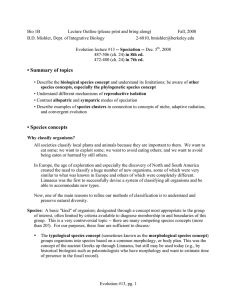
Speciation - Integrative Biology
... Prezygotic mechanisms fall into two broad categories, depending on whether they could have evolved because of natural or sexual selection. Habitat isolation, that is, preferring different habitats, is likely to have evolved because of natural selection. In this case, reproductive isolation is a byp ...
... Prezygotic mechanisms fall into two broad categories, depending on whether they could have evolved because of natural or sexual selection. Habitat isolation, that is, preferring different habitats, is likely to have evolved because of natural selection. In this case, reproductive isolation is a byp ...

Test Specifications: Biology
... Synthesis, the unification of genetics and evolution and historical perspectives of evolutionary theory. The study of evolution must include gene flow, mutation, speciation, natural selection, genetic drift, sexual selection and Hardy Weinberg’s law. The basic concept of biological evolution is that ...
... Synthesis, the unification of genetics and evolution and historical perspectives of evolutionary theory. The study of evolution must include gene flow, mutation, speciation, natural selection, genetic drift, sexual selection and Hardy Weinberg’s law. The basic concept of biological evolution is that ...

How Populations Evolve - Mrs. Ford MHS Biology
... The Hardy-Weinberg equation can test whether a population is evolving o Sexual reproduction alone does not lead to evolutionary change in a population. o Although alleles are shuffled, the frequency of alleles and genotypes in the population does not change. o Similarly, if you shuffle a deck of ca ...
... The Hardy-Weinberg equation can test whether a population is evolving o Sexual reproduction alone does not lead to evolutionary change in a population. o Although alleles are shuffled, the frequency of alleles and genotypes in the population does not change. o Similarly, if you shuffle a deck of ca ...

Biological evolution
... Pesticides were ineffective against mosquitoes that carried the mutation. ...
... Pesticides were ineffective against mosquitoes that carried the mutation. ...


Biology 4.29 Types of Evolution
... part and evolve rapidly (in geological time-scale terms) to form a new species while leaving most of the original species population unchanged. ...
... part and evolve rapidly (in geological time-scale terms) to form a new species while leaving most of the original species population unchanged. ...

Evolution Definitions
... c. They are the ones that are best adapted to survive in their environment. d. They will perpetuate unfavorable changes in the s pecies. ...
... c. They are the ones that are best adapted to survive in their environment. d. They will perpetuate unfavorable changes in the s pecies. ...


Honors Biology Ch. 15 Notes Tracing Evolutionary History Opening Essay
... Homeotic genes: o master control genes in development o they determine where appendages will develop. o Changes in such genes or in where these genes are expressed can have a profound impact of body form. Example: Evol. of terrestrial vertebrates from fishes. o Location in developing limb where home ...
... Homeotic genes: o master control genes in development o they determine where appendages will develop. o Changes in such genes or in where these genes are expressed can have a profound impact of body form. Example: Evol. of terrestrial vertebrates from fishes. o Location in developing limb where home ...


ch 14 quick check answers
... Identify an important observation made by Darwin during his time in Australia. While in Australia, Darwin saw that niches that were occupied by one species in the northern hemisphere were occupied by very different species in the southern hemisphere. Darwin wrote that he ‘reflected on the strange ch ...
... Identify an important observation made by Darwin during his time in Australia. While in Australia, Darwin saw that niches that were occupied by one species in the northern hemisphere were occupied by very different species in the southern hemisphere. Darwin wrote that he ‘reflected on the strange ch ...

GA Intro [1]
... where the probability of selection is an increasing function of fitness. Perform crossover and add offspring to the new population Mutate the offspring while new population is not full Replace current population with the new ...
... where the probability of selection is an increasing function of fitness. Perform crossover and add offspring to the new population Mutate the offspring while new population is not full Replace current population with the new ...

Tusi (1201 – 1274) Persian Scholar Argued that those organisms
... but had developed through the same evolutionary process. He emphasised survival of the fittest and the competition that allowed certain varieties to survive due to inherited traits. The reason Darwin is known for evolutionary theory is the way that he combined the ideas so that they made sense – the ...
... but had developed through the same evolutionary process. He emphasised survival of the fittest and the competition that allowed certain varieties to survive due to inherited traits. The reason Darwin is known for evolutionary theory is the way that he combined the ideas so that they made sense – the ...

CONCEPT MAP
... What is proximate development? "video" at the individual level of biology age-related changes in behavioral traits of individuals (Nature/Nurture); how much is learning, how much is instinct? developmental changes in behavior related to maturation and age; mental models re. processes of change in in ...
... What is proximate development? "video" at the individual level of biology age-related changes in behavioral traits of individuals (Nature/Nurture); how much is learning, how much is instinct? developmental changes in behavior related to maturation and age; mental models re. processes of change in in ...

16.4 Evidence of Evolution
... B. Inherited characteristic that increases an organism’s chance of survival ...
... B. Inherited characteristic that increases an organism’s chance of survival ...

Evolution 1 - Napa Valley College
... the struggle for limited resources will survive. These individuals are more likely to leave offspring than individuals that are less fit ...
... the struggle for limited resources will survive. These individuals are more likely to leave offspring than individuals that are less fit ...

Evolution
... SC.912.L.15.10 Identify basic trends in hominid evolution from early ancestors six million years ago to modern humans, including brain size, jaw size, language, and manufacture of tools. SC.912.L.15.13 Describe the conditions required for natural selection, including: overproduction of offspring, in ...
... SC.912.L.15.10 Identify basic trends in hominid evolution from early ancestors six million years ago to modern humans, including brain size, jaw size, language, and manufacture of tools. SC.912.L.15.13 Describe the conditions required for natural selection, including: overproduction of offspring, in ...

Robert Hooke
... • Made over 500 microscopes, but only ten have survived to this day • Leeuwenhoek was very skillful at grinding lenses and was able to use this skill to magnify objects over 200 times • Hired an illustrator to create drawing of what he saw under his microscopes • In 1673, Leeuwenhoek began to write ...
... • Made over 500 microscopes, but only ten have survived to this day • Leeuwenhoek was very skillful at grinding lenses and was able to use this skill to magnify objects over 200 times • Hired an illustrator to create drawing of what he saw under his microscopes • In 1673, Leeuwenhoek began to write ...

Chapter 4
... 4-2 How Does the Earth’s Life Change over Time? • Concept 4-2A The scientific theory of evolution explains how life on earth changes over time through changes in the genes of populations. • Concept 4-2B Populations evolve when genes mutate and give some individuals genetic traits that enhance their ...
... 4-2 How Does the Earth’s Life Change over Time? • Concept 4-2A The scientific theory of evolution explains how life on earth changes over time through changes in the genes of populations. • Concept 4-2B Populations evolve when genes mutate and give some individuals genetic traits that enhance their ...
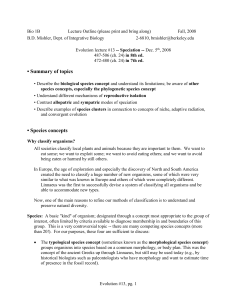
Speciation - Integrative Biology
... Prezygotic mechanisms fall into two broad categories, depending on whether they could have evolved because of natural or sexual selection. Habitat isolation, that is, preferring different habitats, is likely to have evolved because of natural selection. In this case, reproductive isolation is a byp ...
... Prezygotic mechanisms fall into two broad categories, depending on whether they could have evolved because of natural or sexual selection. Habitat isolation, that is, preferring different habitats, is likely to have evolved because of natural selection. In this case, reproductive isolation is a byp ...

Natural Selection
... What’s the premise of Natural Selection - coined by Charles Darwin… 1. There is a struggle for existence Organisms must compete for limited resources - food, space, a mate. 2. Many more offspring are born each season than can possibly survive to maturity (overpopulation) 3. Their survival is based ...
... What’s the premise of Natural Selection - coined by Charles Darwin… 1. There is a struggle for existence Organisms must compete for limited resources - food, space, a mate. 2. Many more offspring are born each season than can possibly survive to maturity (overpopulation) 3. Their survival is based ...

Simulation_Course
... problem -- e.g., is there evidence of evolution of altruism via kin selection? what is it?) 8. Operation (how to build and run your program; operational limits.) 9. Appendices. optional Source code; more detailed test results; reports of failed experiments; etc. ...
... problem -- e.g., is there evidence of evolution of altruism via kin selection? what is it?) 8. Operation (how to build and run your program; operational limits.) 9. Appendices. optional Source code; more detailed test results; reports of failed experiments; etc. ...
