
Unit 8 Evolution UDS 17 final
... Explain how the finches of Galapagos Islands proved to Darwin that Natural Selection results in changes to a species. Explain Darwin’s first theory “Descent with Modification” Explain what data led Darwin to believe this to be true. Describe Darwin’s 4 components that we referred to as natural selec ...
... Explain how the finches of Galapagos Islands proved to Darwin that Natural Selection results in changes to a species. Explain Darwin’s first theory “Descent with Modification” Explain what data led Darwin to believe this to be true. Describe Darwin’s 4 components that we referred to as natural selec ...

contributions to evolutionary biology
... This is the idea that traits changed or acquired over a lifetime can be passed down to offspring. According to Lamarck’s Theory, giraffes that acquired long necks would have offspring with long necks. This type of inheritance has been disproved. ...
... This is the idea that traits changed or acquired over a lifetime can be passed down to offspring. According to Lamarck’s Theory, giraffes that acquired long necks would have offspring with long necks. This type of inheritance has been disproved. ...

Spring 2012 Biology Final Exam Review Guide Mrs. Hawkins What
... “Are We Still Evolving”? –Why is the rate of evolution in developing countries different than the rate of evolution in the western world? What is the connection between Hemochromatosis and Alzheimers? What does the “Evolutionary Arms race” refer to? Why is this statement a misconception: Evoluti ...
... “Are We Still Evolving”? –Why is the rate of evolution in developing countries different than the rate of evolution in the western world? What is the connection between Hemochromatosis and Alzheimers? What does the “Evolutionary Arms race” refer to? Why is this statement a misconception: Evoluti ...

What kind of evolutionary biology suits cultural research?
... theory of evolution – the replacement of the standard theory (also called Modern Synthesis, neo-Darwinism, etc.) by a more relevant (and also more fundamental) one, that is variably called the Extended Synthesis or post-Darwinism, yet can also be called a semiotic theory of evolution. To put it brie ...
... theory of evolution – the replacement of the standard theory (also called Modern Synthesis, neo-Darwinism, etc.) by a more relevant (and also more fundamental) one, that is variably called the Extended Synthesis or post-Darwinism, yet can also be called a semiotic theory of evolution. To put it brie ...

10.1 Early Ideas About Evolution
... Distribution of Fossils • Law of Superposition – successive layers of rock or soil were deposited on top of one another by wind or water • Lowest stratum (rock layer) is the oldest • Relative age – using law of superposition to figure out the age of one fossil compared to another ...
... Distribution of Fossils • Law of Superposition – successive layers of rock or soil were deposited on top of one another by wind or water • Lowest stratum (rock layer) is the oldest • Relative age – using law of superposition to figure out the age of one fossil compared to another ...

Practice Questions (269 KB pdf file)
... Suppose a species of grasshopper normally breeds in June and lays its eggs on the young shoots of an annual grass that comes up in June. A mutant female grasshopper in the population produces a batch of eggs that carry a new allele that delays sexual development until August. Her offspring feed on t ...
... Suppose a species of grasshopper normally breeds in June and lays its eggs on the young shoots of an annual grass that comes up in June. A mutant female grasshopper in the population produces a batch of eggs that carry a new allele that delays sexual development until August. Her offspring feed on t ...

Available - GGU Home
... Darwin these were enough proof to revolt against the immutability of species. (viii) Darwin observed the living and extinct organism in the flat plains of the Argentina pampas and Galapagos islands, and sowed in him the view of evolution. He dug up bony remains (fossil) of extinct animals such as To ...
... Darwin these were enough proof to revolt against the immutability of species. (viii) Darwin observed the living and extinct organism in the flat plains of the Argentina pampas and Galapagos islands, and sowed in him the view of evolution. He dug up bony remains (fossil) of extinct animals such as To ...

IDHEF – Chapter Six – New Life Forms: From Goo to You via the Zoo
... into. Now we can see that the molecular level is immeasurably more complex than Darwin ever dreamed. The cell is filled with parts that must be completely formed, in the right places, in the right sizes, in operating order, at the same time, for the cell to function. An example the book gives is a c ...
... into. Now we can see that the molecular level is immeasurably more complex than Darwin ever dreamed. The cell is filled with parts that must be completely formed, in the right places, in the right sizes, in operating order, at the same time, for the cell to function. An example the book gives is a c ...
Chapter 1 Notes
... The Origin of Species developed two main points Descent with Modification: - as populations spilled into new environments, modifications become prominent over time - helped fit organisms into ways of life ...
... The Origin of Species developed two main points Descent with Modification: - as populations spilled into new environments, modifications become prominent over time - helped fit organisms into ways of life ...

File
... Variation among species. What differences can you spot in these two animals? How are they the same? ( Structure, Behaviour, Reproduction) Different? ...
... Variation among species. What differences can you spot in these two animals? How are they the same? ( Structure, Behaviour, Reproduction) Different? ...

Warm Up 2/24
... the message stay the same from beginning to end? What caused the changes? Small mistakes in DNA (mutations) can change populations over time, like the mistakes in the message we passed along ...
... the message stay the same from beginning to end? What caused the changes? Small mistakes in DNA (mutations) can change populations over time, like the mistakes in the message we passed along ...

Name: Date: Period: _____ Unit 10, Part 1 Notes – Evolution Basics
... The end result of natural selection in this example is that the more advantageous trait, brown coloration, which allows the beetle to have more offspring, becomes more common in the population. If this process continues, eventually, all individuals in the population will be brown. -Several related ...
... The end result of natural selection in this example is that the more advantageous trait, brown coloration, which allows the beetle to have more offspring, becomes more common in the population. If this process continues, eventually, all individuals in the population will be brown. -Several related ...

BIL 160 - Spring 1998 Krempels
... a. distantly related taxa often exhibit synapomorphies b. the more closely related two taxa are, the more persistent their developmental similarities c. it allows one to track the extent of inbreeding in natural populations d. fossilized embryos are plentiful and informative e. after a long day of c ...
... a. distantly related taxa often exhibit synapomorphies b. the more closely related two taxa are, the more persistent their developmental similarities c. it allows one to track the extent of inbreeding in natural populations d. fossilized embryos are plentiful and informative e. after a long day of c ...

What evolution is and how Darwin became convinced of it
... − unlike observations in the wild, these cases of “artificial” evolution don't show that evolution actually occurs in nature − but they do confirm two things: − evolution does happen under certain circumstances − that is, species are not fixed and unchanging − evolution can result in large, rapid ch ...
... − unlike observations in the wild, these cases of “artificial” evolution don't show that evolution actually occurs in nature − but they do confirm two things: − evolution does happen under certain circumstances − that is, species are not fixed and unchanging − evolution can result in large, rapid ch ...

Study Guide - Issaquah Connect
... of finches on the Galápagos Islands. A drought reduced the number of small soft seeds but left plenty of large, tough-shelled seeds intact. The next year there was a(n) (increase, decrease) in the number of large-beaked hatchlings. 14. After several years, the supply of large seeds went down after a ...
... of finches on the Galápagos Islands. A drought reduced the number of small soft seeds but left plenty of large, tough-shelled seeds intact. The next year there was a(n) (increase, decrease) in the number of large-beaked hatchlings. 14. After several years, the supply of large seeds went down after a ...

Adaptive responses in animals to climate change
... What are the conditions by which ecological rescue through phenotypic plasticity and evolutionary rescue through natural selection most efficiently foster adaptation to climate change? First, populations that are large and with connectivity (gene flow) to other populations will have the greatest abi ...
... What are the conditions by which ecological rescue through phenotypic plasticity and evolutionary rescue through natural selection most efficiently foster adaptation to climate change? First, populations that are large and with connectivity (gene flow) to other populations will have the greatest abi ...

on the origin of architectural species
... In his revolutionary treatise of 1859, On the Origin of Species, Charles Darwin explained his powerful theory of the evolution of animal species. By Darwin’s elegant algorithm, A) if individuals within a group are subject to variation, and B) if the environment results in a struggle for survival, an ...
... In his revolutionary treatise of 1859, On the Origin of Species, Charles Darwin explained his powerful theory of the evolution of animal species. By Darwin’s elegant algorithm, A) if individuals within a group are subject to variation, and B) if the environment results in a struggle for survival, an ...
Chapter 15 Darwin`s Theory of Evolution Chapter Vocabulary Review
... 1. Two scientists who helped Darwin and others recognize how old Earth is were ___________________________ and ___________________________. 2. Circle the letter of each idea that was proposed by James Hutton. a. Earth is a few thousand years old. b. Layers of rock are moved by forces beneath Earth’s ...
... 1. Two scientists who helped Darwin and others recognize how old Earth is were ___________________________ and ___________________________. 2. Circle the letter of each idea that was proposed by James Hutton. a. Earth is a few thousand years old. b. Layers of rock are moved by forces beneath Earth’s ...

Evolution Jeopardy
... search for a transitional species between lobe-finned fishes and amphibians. Justify your selection. (b) Describe TWO pieces of evidence provided by fossils of a transitional species that would support a hypothesis that ...
... search for a transitional species between lobe-finned fishes and amphibians. Justify your selection. (b) Describe TWO pieces of evidence provided by fossils of a transitional species that would support a hypothesis that ...

File
... islands. One would expect that each island would have only one species, however, each island has more than one species of finch and larger islands may have as many as ten. The process one species going to a new area and evolving into several new species is called adaptive radiation. ...
... islands. One would expect that each island would have only one species, however, each island has more than one species of finch and larger islands may have as many as ten. The process one species going to a new area and evolving into several new species is called adaptive radiation. ...

document
... struggle for existence. Individuals best suited to their environment survive and reproduce most successfully. They pass on their adaptations to their offspring. ...
... struggle for existence. Individuals best suited to their environment survive and reproduce most successfully. They pass on their adaptations to their offspring. ...

Evolution - mvhs
... gender) and intragender (compete with each other) specific • Ultimately has to do with competition for higher fitness ...
... gender) and intragender (compete with each other) specific • Ultimately has to do with competition for higher fitness ...
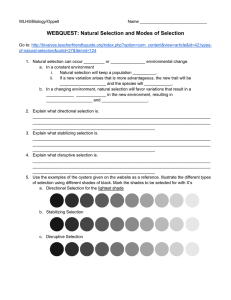
WEBQUEST: Natural Selection and Modes of Selection
... Go to http://www.sciencechannel.com/games-and-interactives/charles-darwin-game/ and then click on “Natural Selection” on the top of the main image. Answer the following questions. Part 1: Every ____________________ exhibits _________________________. Not all members within a _______________________ ...
... Go to http://www.sciencechannel.com/games-and-interactives/charles-darwin-game/ and then click on “Natural Selection” on the top of the main image. Answer the following questions. Part 1: Every ____________________ exhibits _________________________. Not all members within a _______________________ ...
Document
... • the descendants lived in various habitats developing adaptations to fit them to their habitat • called the mechanism of this evolutionary adaptation = Natural Selection ...
... • the descendants lived in various habitats developing adaptations to fit them to their habitat • called the mechanism of this evolutionary adaptation = Natural Selection ...

EvolutionReview2016
... white. The food they hunt has become scarce because other predators in the area are getting to the food first. The bears move north and find food out on the ice and tundra. Over time this bear population becomes all white by choosing to not produce color in their fur so that they may camouflage with ...
... white. The food they hunt has become scarce because other predators in the area are getting to the food first. The bears move north and find food out on the ice and tundra. Over time this bear population becomes all white by choosing to not produce color in their fur so that they may camouflage with ...